MOTS-c
Mitochondrial-Derived Peptide for Metabolic Homeostasis & Longevity
MOTS-c — Mitochondrial Open Reading Frame of the 12S rRNA-c
Last reviewed: August 2026
MOTS-c is a peptide encoded in mitochondrial DNA that acts as a metabolic master regulator, activating AMPK to improve insulin sensitivity, increase fat burning, and promote longevity pathways. It was discovered in 2015 and found at higher levels in centenarians.
MOTS-c activates AMPK in muscle and liver, producing effects similar to intense exercise: increased glucose uptake, enhanced fat oxidation, and improved insulin sensitivity.
MOTS-c levels decline with age and obesity. Its discovery in centenarians at higher levels than in younger adults suggests it may be a key mediator of exceptional longevity.
MOTS-c is a mitochondrial-derived peptide that activates AMPK to mimic the metabolic effects of exercise, with declining levels linked to aging and metabolic disease.
What is MOTS-c?
MOTS-c (Mitochondrial Open Reading Frame of the 12S rRNA-c) is a 16-amino-acid peptide encoded within the mitochondrial genome — one of the only peptides known to be encoded by mitochondrial DNA. It regulates metabolic homeostasis, insulin sensitivity, and exercise capacity by activating AMPK signaling. Circulating MOTS-c levels decline with age, and higher levels have been found in centenarians.
- MOTS-c (Mitochondrial Open Reading Frame of the 12S rRNA Type-c) is a 16-amino acid peptide encoded within the mitochondrial 12S ribosomal RNA gene — one of the first mitochondrial-derived peptides (MDPs) identified.
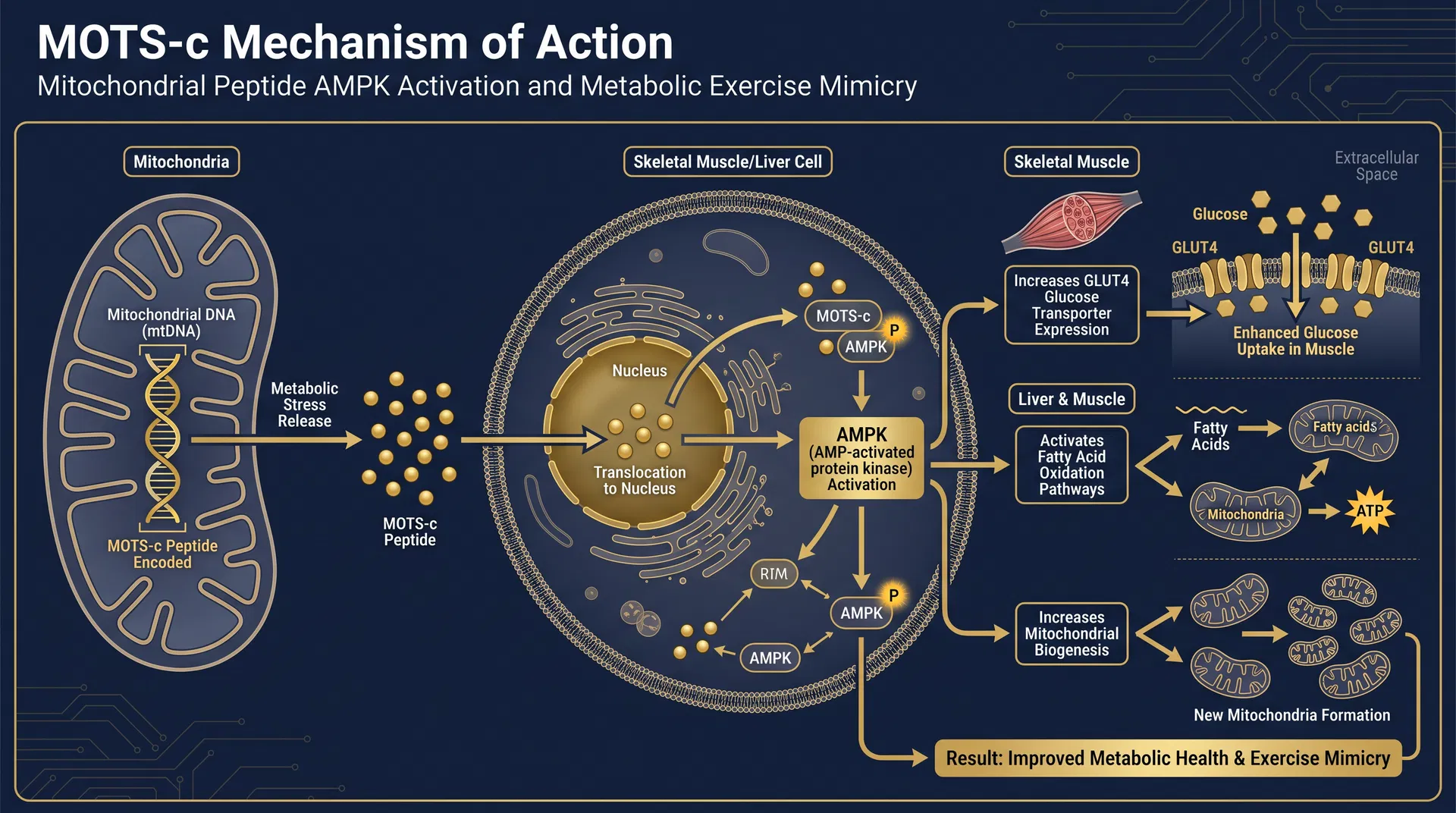
- Primary mechanism: activates AMPK (AMP-activated protein kinase) and translocates to the nucleus under metabolic stress, where it regulates nuclear gene expression to enhance glucose uptake via GLUT4 and fatty acid oxidation.
- Lee et al. (Cell Metabolism, 2015) demonstrated that MOTS-c injection improved insulin sensitivity, reduced obesity, and extended lifespan in mice on high-fat diets — the foundational paper establishing MOTS-c as a metabolic regulator.
- MOTS-c is described as an 'exercise mimetic' because its metabolic effects (AMPK activation, GLUT4 upregulation, mitochondrial biogenesis) overlap significantly with the molecular adaptations induced by aerobic exercise.
- Plasma MOTS-c levels decline with age and are lower in individuals with type 2 diabetes and obesity, suggesting a potential role in age-related metabolic dysfunction.
Molecular Composition
MOTS-c is a 16-amino-acid peptide (MRWQEMGYIFYPRKLR) encoded within the 12S rRNA gene of the mitochondrial genome. Unlike nuclear-encoded peptides, MOTS-c is translated in the mitochondrial matrix and can translocate to the nucleus under metabolic stress, directly regulating gene expression.
How Does It Work?
MOTS-c mimics the metabolic effects of exercise by activating AMPK in skeletal muscle and liver, increasing glucose uptake and fatty acid oxidation.
MOTS-c activates AMP-activated protein kinase (AMPK) in skeletal muscle and liver, mimicking the metabolic effects of exercise and caloric restriction. It also regulates the folate cycle and one-carbon metabolism, affecting nucleotide synthesis, methylation reactions, and redox balance. Under metabolic stress, MOTS-c translocates to the nucleus where it regulates stress-response genes.
Key Research Pathways
AMPK Activation / Metabolic Homeostasis
Activates AMP-activated protein kinase (AMPK) in skeletal muscle and liver, mimicking the metabolic effects of exercise and caloric restriction.
Folate Cycle / One-Carbon Metabolism
Regulates the folate cycle and one-carbon metabolism, affecting nucleotide synthesis, methylation reactions, and redox balance.
Insulin Sensitization
Improves insulin sensitivity in skeletal muscle by activating AMPK-dependent glucose transporter (GLUT4) translocation, independent of insulin signaling.
Key Findings from the Literature
- Discovered by Changhan David Lee at USC; published in Cell Metabolism (2015)
- Higher circulating MOTS-c levels found in centenarians vs. younger adults (Nature Communications, 2021)
- Activates AMPK to improve insulin sensitivity and increase fat oxidation
- Regulates folate cycle and one-carbon metabolism
- Translocates to the nucleus under metabolic stress to regulate gene expression
Evidence by Claimed Outcome
Each outcome rated by the highest level of evidence available. Tiers follow our 5-tier methodology.
Study counts reflect peer-reviewed publications in the evidence database below. "Theoretical" outcomes have mechanistic rationale only. Learn about our evidence tiers →
Structured Evidence Table
1 cited study — model, sample size, outcome, and effect size from published literature.
| Study | Model | Sample | Outcome | Effect Size | Level |
|---|---|---|---|---|---|
Lee C, et al. (2015) The mitochondrial-derived peptide MOTS-c promotes metabolic homeostasis and redu… PubMed | Rodent (mouse) — diet-induced obesity | n=40 | Reduced body weight, improved insulin sensitivity, and AMPK activation | Body weight reduction: ~15% vs. control; insulin sensitivity: ~2× improvement | Animal |
How Long It Lasts & How It Works in the Body
MOTS-c — half-life, bioavailability, onset, and duration data
| Parameter | Value | Source |
|---|---|---|
| Half-Life (t½) | ~1–2 hours (estimated) Preclinical data; no human PK studies | Preclinical Data |
| Time to Peak (Tmax) | ~30–60 minutes Preclinical estimates | Preclinical Data |
| Bioavailability (F) | Estimated 60–80% (SC/IM) No published human bioavailability data | Preclinical Data |
| Onset of Action | Hours to days AMPK activation and metabolic effects | — |
| Duration of Action | Variable Metabolic effects persist beyond plasma half-life | — |
Mitochondria-derived peptide encoded in the 12S rRNA gene. Activates AMPK and improves insulin sensitivity. Endogenous levels decline with age. Research-stage only; no clinical trials completed.
References:
• Lee C et al. Cell Metab 2015
• Kim KH et al. Nat Commun 2018
Important Research Context
Research References
Peer-reviewed literature supporting the research profile of MOTS-c
The following peer-reviewed studies form the primary evidence base for MOTS-c's research profile. All references are sourced from PubMed, NCBI, and peer-reviewed scientific journals. Published research is available through PubMed, NCBI, and peer-reviewed biomedical journals.
- 1.
Lee C, et al. The mitochondrial-derived peptide MOTS-c promotes metabolic homeostasis and reduces obesity and insulin resistance. Cell Metabolism. 2015.PMID: 25738459
MOTS-c reduced obesity and improved insulin sensitivity in diet-induced obese mice via AMPK activation.
- 2.
Kim SJ, et al. Mitochondrially derived peptides as novel regulators of metabolism. Journal of Physiology. 2017.PMID: 28574175
Review of MOTS-c and other mitochondrial-derived peptides as metabolic regulators.
- 3.
Reynolds JC, et al. MOTS-c is an exercise-induced mitochondrial-encoded regulator of age-dependent physical decline and muscle homeostasis. Nature Communications. 2021.PMID: 33473109
MOTS-c levels increase with exercise and decline with age; supplementation improved physical performance in aged mice.
MOTS-c
Longevity Research
Purgo Labs list price, read 12 Sep 2026 · per-lot COA on the vendor page
10mg $49.99 → $39.99 with code HEALTH (20% off; price read 2 Oct 2026)
- 1 certificate verified at the lab40mg$124.99→ $99.99
- 2 certificates verified at the lab40mg$45.00→ $36.00
- 1 certificate verified at the lab40mg$134.99→ $107.99
Fast FedEx shipping · Discreet packaging
Technical Specifications
| Peptide Class | Mitochondrial-derived peptide (16 amino acids) |
| Molecular Weight | 2,174.5 Da |
| Regulatory Status | Research chemical; no clinical approval |
| Available Sizes | 5mg, 10mg vials |
| Form | Lyophilized powder |
| Purity | ≥99% (third-party tested) |
View full legal status guide →
Known Interactions
5 documented interactions for MOTS-c
Both target cellular aging pathways via different mechanisms — Epithalon via telomerase, MOTS-c via AMPK/mitochondrial function.
Interaction data is based on published research, known pharmacological mechanisms, and clinical practitioner experience. Evidence tiers: Clinical = human data; Emerging = preclinical/case reports; Theoretical = mechanism-based inference. Always consult a qualified healthcare provider before combining compounds.
Source MOTS-c at Purgo Labs
10mg $49.99 list · $39.99 with code HEALTH · lab-verifiable COA per lot
Other Compounds in This Guide



Related Research Guides
Supporting Research
MOTS-c is a mitochondrial-derived peptide with interesting metabolic biology, but human efficacy data does not exist yet. The foundational work is in mice and cell systems. Present as an early-stage research compound, not a proven metabolic therapy.
References
- Lee C, Zeng J, Drew BG, et al.[PRECLINICAL — mouse + in vitro]AMPK activation, improved insulin sensitivity, resistance to diet-induced obesity — in mice.
- Reynolds JC, et al.[PRECLINICAL — aged mouse model]Nature Communications. 2021. PubMedMOTS-c improved physical performance and metabolic parameters in aged mice.
Research Databases
Ready to Source MOTS-c?
Purgo Labs offers MOTS-c with ≥99% purity, third-party certificates of analysis, and fast FedEx shipping. This is an affiliate link — we may earn a commission at no cost to you.