MOTS-c vs NAD+
Complete head-to-head comparison of two leading mitochondrial longevity compounds — MOTS-c (AMPK activation, insulin sensitization) vs NAD+ (sirtuin activation, DNA repair) — mechanisms, evidence, stacking protocols, and decision tree.
| Category | MOTS-c | NAD+ |
|---|---|---|
| Primary Mechanism | AMPK activation, mitochondrial biogenesis, AICAR-mediated metabolic regulation | Sirtuin activation, PARP-1 support, mitochondrial electron transport chain cofactor |
| Primary Application | Metabolic health, insulin sensitivity, exercise performance, longevity | Cellular energy, DNA repair, mitochondrial function, cognitive support |
| Route | SubQ injection | Oral (NMN/NR precursors) or IV infusion |
| Evidence Level | Tier 3 — animal models; early human pilot data | Tier 2 — human RCTs for NMN/NR precursors; extensive mechanistic data |
| Best For | Metabolic optimization, AMPK activation, exercise performance, insulin sensitivity | Mitochondrial energy, DNA repair, cognitive function, sirtuin-mediated longevity |
MOTS-c and NAD+ represent two of the most mechanistically distinct approaches to mitochondrial longevity research. Both compounds target mitochondrial function and metabolic aging, but through fundamentally different pathways: MOTS-c is a mitochondrial-derived peptide that activates AMPK — the cellular energy sensor — while NAD+ is a coenzyme that serves as the substrate for sirtuin activation and the electron transport chain.
The key insight for researchers is that these compounds are not alternatives but complementary tools addressing different aspects of mitochondrial aging. MOTS-c levels decline with age and obesity, impairing AMPK signaling and insulin sensitivity. NAD+ levels decline ~50% between ages 40 and 60, impairing sirtuin activity and DNA repair capacity. Restoring both simultaneously addresses the two primary mitochondrial aging pathways — signaling decline and substrate depletion.
Research Disclaimer: All content on this page is for educational and research purposes only. These compounds are not FDA-approved for the indications discussed. Always consult a qualified healthcare professional before considering any peptide or supplement protocol.
Mechanism Deep Dive
Mitochondrial Open Reading Frame of the 12S rRNA-c · 16 Amino Acids
MOTS-c is a 16-amino acid peptide encoded in the mitochondrial 12S rRNA gene. Under metabolic stress — elevated AMP:ATP ratio, nutrient excess, or oxidative stress — MOTS-c translocates from the mitochondria to the nucleus, where it activates AMPK (AMP-activated protein kinase). AMPK is the master regulator of cellular energy homeostasis: it increases GLUT4 translocation to the plasma membrane (improving glucose uptake in skeletal muscle), stimulates mitochondrial biogenesis via PGC-1α, and suppresses anabolic pathways (mTOR, de novo lipogenesis) that consume ATP.
MOTS-c also suppresses the folate cycle and de novo purine synthesis, reducing one-carbon metabolites that impair insulin signaling. Human observational studies show MOTS-c plasma levels are inversely correlated with age, BMI, and metabolic syndrome markers. Preclinical studies demonstrate MOTS-c extends lifespan in C. elegans and reverses diet-induced insulin resistance in rodents.
Nicotinamide Adenine Dinucleotide · Mitochondrial Coenzyme
NAD+ (nicotinamide adenine dinucleotide) is a coenzyme present in every cell, serving two primary roles: as the electron carrier in mitochondrial oxidative phosphorylation (Complexes I and III of the ETC), and as the substrate for sirtuin deacetylases (SIRT1–SIRT7). Sirtuins are NAD+-dependent enzymes that regulate gene expression, DNA repair, mitochondrial biogenesis, and inflammation. SIRT1 deacetylates PGC-1α (activating mitochondrial biogenesis), p53 (regulating apoptosis), and NF-κB (reducing inflammation). SIRT3 regulates mitochondrial protein acetylation and ROS production.
NAD+ also activates PARP1/2 enzymes for DNA damage repair — a process that consumes NAD+ and contributes to NAD+ depletion in aging. NAD+ levels decline ~50% between ages 40 and 60, which is associated with reduced sirtuin activity, impaired DNA repair, increased inflammation, and mitochondrial dysfunction. Clinical studies with NMN and NR (oral NAD+ precursors) have shown improvements in NAD+ levels, muscle insulin sensitivity, aerobic capacity, and inflammatory markers.
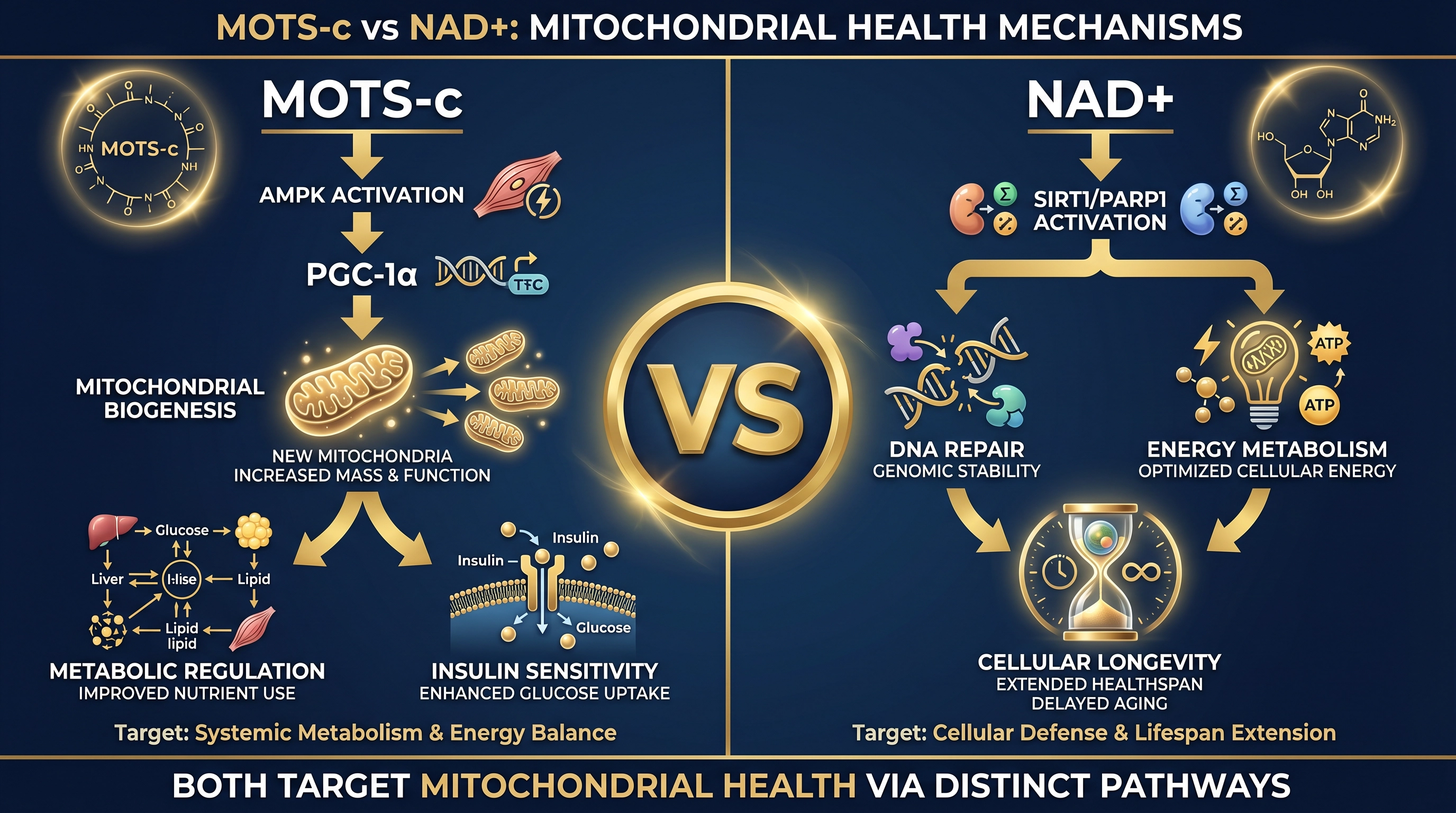
Pathway Comparison Diagram
MOTS-c activates AMPK → PGC-1α → mitochondrial biogenesis for metabolic regulation; NAD+ activates SIRT1/PARP1 for DNA repair and energy metabolism — complementary mitochondrial health pathways.
What the cited studies used
One row per compound: the amount and schedule administered in a specific indexed study, who received it, and the paper. These are reports of what was done in that study, not recommendations, and several are animal or single-dose studies. Where no indexed human regimen exists we say so rather than print a number. Community "stacks" and cycle schedules are not reproduced on this site.
Research use only. Compound Review scores vendors on documentation — laboratory certificates, lot records, pricing and company identity. Nothing on this page is guidance on human or veterinary use, dosing or health outcomes.
| Compound | Regimen in the study | Population | Source |
|---|---|---|---|
| MOTS-c | Intraperitoneal injection in mice (the amount is in the paper's methods, not its abstract; we do not reproduce it) No human interventional trial. Reynolds 2021 (PMID 33473109) adds late-life mouse dosing and human plasma observations after exercise — not administration to people. | Mice — age-related and high-fat-diet insulin resistance models | PMID 25738459 Lee et al., Cell Metab 2015 |
| NAD+ (via nicotinamide riboside) | Nicotinamide riboside 1,000 mg/day oral (500 mg twice daily) for 6 weeks A 2 × 6-week crossover of an oral precursor (the abstract states the design; the 500 mg twice-daily amount is in the methods). We have no PubMed-indexed trial of intravenous NAD+ at the gram amounts sold by clinics. | Healthy middle-aged and older adults (n = 24), randomised crossover | PMID 29599478 Martens et al., Nat Commun 2018 |
Head-to-Head Comparison
| Category | MOTS-c | NAD+ |
|---|---|---|
| Primary Mechanism | AMPK activation → GLUT4 upregulation, mitochondrial biogenesis | Sirtuin activation (SIRT1–7) + electron transport chain substrate |
| Mitochondrial Target | AMPK energy sensor — responds to AMP:ATP ratio | Direct ETC substrate + SIRT1/3 deacetylase activation |
| Insulin Sensitivity | Excellent — primary mechanism; GLUT4 translocation | Good — SIRT1 activation improves insulin signaling |
| DNA Repair | Indirect (via AMPK → autophagy) | Direct — PARP1/2 activation requires NAD+ as substrate |
| Inflammation | Moderate — AMPK suppresses mTOR/NF-κB | Good — SIRT1 deacetylates NF-κB, reduces pro-inflammatory cytokines |
| Mitochondrial Biogenesis | Yes — AMPK activates PGC-1α | Yes — SIRT1/3 activate PGC-1α |
| Aging Pathway | AMPK signaling decline with age; MOTS-c restores it | NAD+ depletion with age; supplementation restores sirtuin activity |
| Metabolic Syndrome | Excellent — primary indication; reverses insulin resistance | Good — SIRT1 improves lipid metabolism and glucose homeostasis |
| Exercise Performance | Studied — AMPK mimics exercise signaling | Studied — NMN improves VO2 max and muscle function in older adults |
| Administration | SubQ injection only | IV infusion, SubQ injection, or oral precursors (NMN/NR) |
| Cycle Length | 8–12 weeks | Ongoing (oral precursors); 4–8 week IV courses |
| Evidence Level | Preclinical + Phase 1; human observational data | Phase 2/3 human trials (NMN, NR); clinical IV use |
| Stackable With | NAD+, GHK-Cu, SS-31, Epithalon, Semaglutide | MOTS-c, SS-31, GHK-Cu, Epithalon, Resveratrol |
Research Verdict
Synergistic, Not Competing
MOTS-c and NAD+ address the two primary mitochondrial aging pathways — AMPK signaling decline (MOTS-c) and NAD+ substrate depletion (NAD+). For insulin resistance specifically, MOTS-c has the more direct mechanism. For DNA repair and sirtuin activation, NAD+ is essential. For comprehensive longevity protocols, stacking both with SS-31 (mitochondrial membrane protection) represents the current state of the art in mitochondrial longevity research.
Stacking Protocols
Protocol 1: Metabolic Optimization
MOTS-c drives AMPK-mediated insulin sensitization and GLUT4 upregulation in skeletal muscle, while NMN restores NAD+ levels to activate SIRT1 (improving lipid metabolism and insulin signaling) and SIRT3 (improving mitochondrial efficiency). This combination addresses both the AMPK signaling and NAD+ substrate aspects of metabolic aging. Practical for ongoing use: MOTS-c 3x/week injections + daily oral NMN.
Protocol 2: Longevity / Anti-Aging Stack
The canonical mitochondrial longevity stack. MOTS-c addresses AMPK signaling decline, NAD+ IV addresses sirtuin substrate depletion and DNA repair capacity, and SS-31 (if included) protects the inner mitochondrial membrane from oxidative damage. This triple combination targets three distinct mitochondrial aging pathways simultaneously. IV NAD+ produces higher plasma levels than oral precursors and is preferred for quarterly longevity protocols.
Protocol 3: Exercise Performance + Recovery
MOTS-c mimics exercise signaling via AMPK activation, improving glucose uptake and mitochondrial biogenesis. NMN improves NAD+ levels, which has been shown in Phase 2 RCTs to improve VO2 max and muscle function in older adults. The combination is used in research protocols for age-related decline in exercise capacity. MOTS-c provides the AMPK signal; NMN provides the NAD+ substrate for sirtuin-mediated mitochondrial adaptation.
Compound Selection by Research Goal
| Research Goal | Recommended | Rationale |
|---|---|---|
| Insulin resistance / HOMA-IR reduction | MOTS-c | Most direct AMPK/GLUT4 mechanism for insulin sensitization |
| DNA repair / genome stability | NAD+ | PARP1/2 require NAD+ as direct substrate for DNA repair |
| Sirtuin activation (SIRT1–7) | NAD+ | Sirtuins are NAD+-dependent; cannot function without adequate NAD+ |
| Metabolic syndrome (multi-component) | Stack both | MOTS-c (insulin resistance) + NAD+ (lipid metabolism, inflammation) |
| Exercise performance / VO2 max | NAD+ (NMN) | Phase 2 RCT: NMN improved VO2 max and muscle function in older adults |
| Mitochondrial biogenesis | Stack both | Both activate PGC-1α via different pathways (AMPK vs SIRT1) |
| Longevity / anti-aging protocol | Stack both | Complementary pathways; MOTS-c + NAD+ + SS-31 is the canonical longevity stack |
| Inflammation reduction | NAD+ | SIRT1 deacetylates NF-κB; stronger anti-inflammatory evidence |
| Practical daily protocol (oral) | NAD+ (NMN/NR) | Oral NMN/NR available; MOTS-c requires injection |
Frequently Asked Questions
What is the difference between MOTS-c and NAD+?
MOTS-c is a mitochondrial-derived peptide that activates AMPK (AMP-activated protein kinase) in skeletal muscle, improving insulin sensitivity and glucose uptake. NAD+ (nicotinamide adenine dinucleotide) is a coenzyme that serves as the primary electron carrier in mitochondrial oxidative phosphorylation and activates sirtuins (SIRT1–SIRT7), which regulate gene expression, DNA repair, and metabolic adaptation. Both improve mitochondrial function but through distinct mechanisms: MOTS-c acts via AMPK signaling; NAD+ acts via sirtuin activation and direct electron transport chain support.
Which is better for longevity — MOTS-c or NAD+?
Both have strong longevity research profiles but target different aging pathways. NAD+ levels decline ~50% between ages 40 and 60, and restoring NAD+ activates SIRT1 and SIRT3, which regulate mitochondrial biogenesis, DNA repair, and inflammation. MOTS-c levels also decline with age and obesity, and MOTS-c administration has been shown to extend lifespan in preclinical models. For comprehensive longevity protocols, stacking both is rational: NAD+ addresses the coenzyme depletion aspect of mitochondrial aging; MOTS-c addresses the AMPK signaling decline.
Can MOTS-c and NAD+ be stacked?
Yes — MOTS-c and NAD+ are highly complementary and are commonly stacked in longevity protocols. They work through distinct but synergistic mitochondrial pathways: MOTS-c activates AMPK (the energy sensor), while NAD+ activates sirtuins (the longevity gene regulators) and supports the electron transport chain directly. There is no known mechanism-based conflict. The combination addresses both the signaling (MOTS-c/AMPK) and substrate (NAD+/sirtuin) aspects of mitochondrial aging simultaneously.
What is MOTS-c and how does it work?
MOTS-c is a 16-amino acid peptide encoded in the mitochondrial 12S rRNA gene. Under metabolic stress, it translocates from the mitochondria to the nucleus and activates AMPK (AMP-activated protein kinase), the master regulator of cellular energy homeostasis. AMPK activation increases GLUT4 translocation to the plasma membrane (improving glucose uptake), stimulates mitochondrial biogenesis, and suppresses the folate cycle and de novo purine synthesis. MOTS-c levels decline with age and obesity, correlating with metabolic syndrome severity.
What is NAD+ and how does it work for longevity?
NAD+ (nicotinamide adenine dinucleotide) is a coenzyme found in every cell, serving as the primary electron carrier in mitochondrial oxidative phosphorylation (converting nutrients to ATP). Beyond energy production, NAD+ activates sirtuins (SIRT1–SIRT7), a family of NAD+-dependent deacetylases that regulate gene expression, DNA repair, inflammation, and mitochondrial biogenesis. NAD+ also activates PARP enzymes for DNA damage repair. NAD+ levels decline ~50% between ages 40 and 60, which is associated with reduced mitochondrial function, increased inflammation, and accelerated aging.
Does MOTS-c improve insulin resistance?
Yes — MOTS-c is one of the most mechanistically direct research peptides for insulin resistance. It activates AMPK in skeletal muscle, which increases GLUT4 translocation to the cell membrane, improving glucose uptake independent of insulin signaling. MOTS-c also suppresses the folate cycle and de novo purine synthesis, reducing one-carbon metabolites that impair insulin signaling. In preclinical models, MOTS-c administration reversed diet-induced insulin resistance and improved glucose tolerance.
What biomarkers does NAD+ improve?
NAD+ supplementation has been shown to improve: mitochondrial function (measured by VO2 max and ATP production), insulin sensitivity (via SIRT1 activation), inflammatory markers (reduced NF-κB signaling), DNA repair capacity (PARP activation), and muscle function in older adults. Clinical studies with NMN and NR have shown improvements in NAD+ levels, muscle insulin sensitivity, aerobic capacity, and inflammatory biomarkers. The SIRT1 pathway also improves lipid metabolism and reduces visceral fat.
Source MOTS-c and NAD+ at Purgo Labs
Pharmaceutical-grade MOTS-c and NAD+ with third-party COA verification. Use code HEALTH for 20% off.
Visit Purgo LabsAffiliate disclosure: Compound Review may earn a commission on qualifying purchases.