GLP-1
Incretin Hormone & Insulin Secretion Regulation
Semaglutide (sold by Purgo Labs as "GLP-1") — GLP-1 Receptor Agonist
Last reviewed: August 2026
GLP-1 (Glucagon-Like Peptide-1) is a hormone your gut naturally releases after you eat. It's the biological signal behind some of the most talked-about drugs in medicine right now — semaglutide (Ozempic/Wegovy) and tirzepatide (Mounjaro) are both designed to mimic or enhance GLP-1's effects. The research-grade GLP-1 peptide itself is the native molecule those drugs are based on.
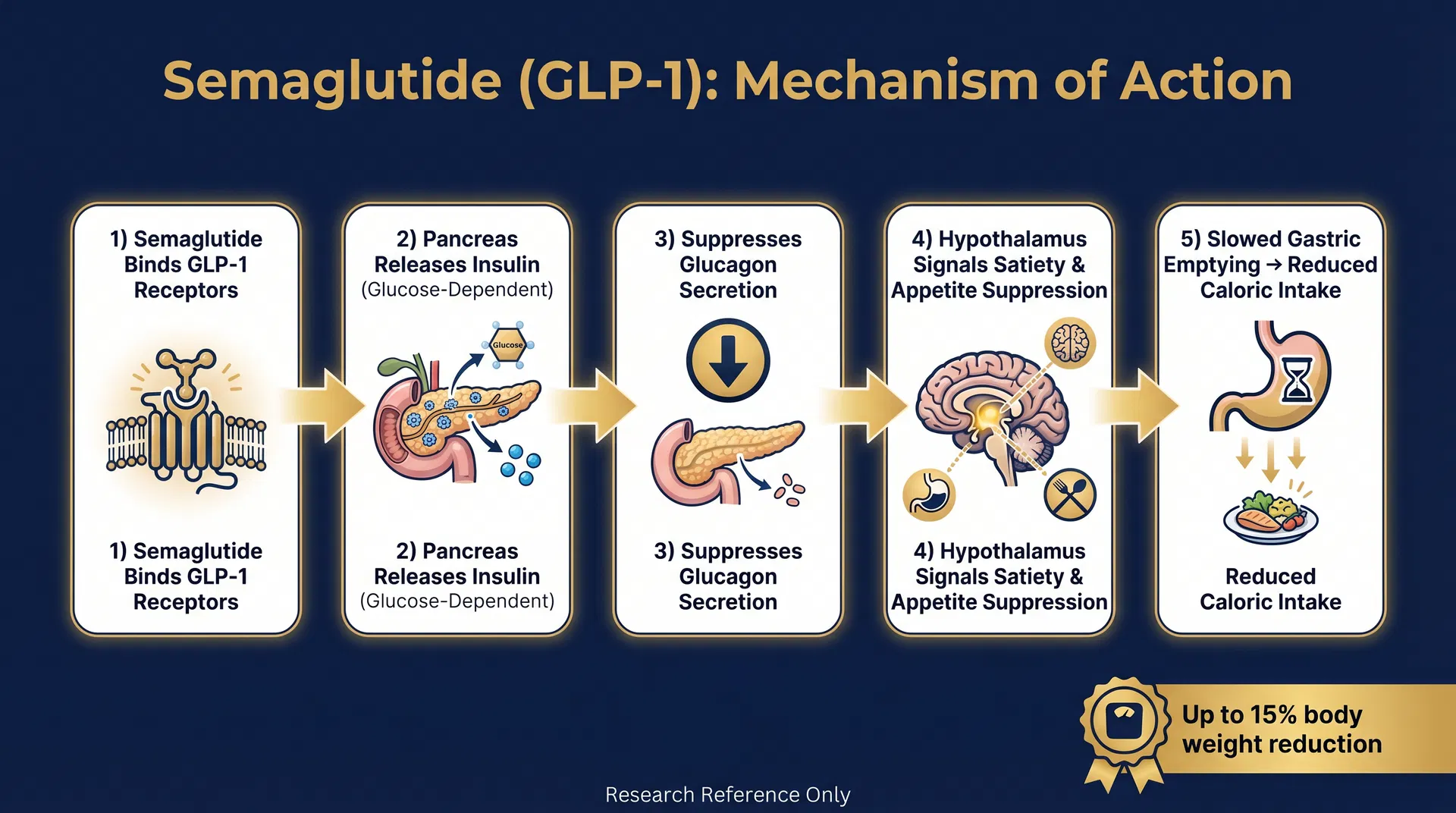
GLP-1 works through three main mechanisms: it tells the pancreas to release insulin when blood sugar is high (glucose-dependent, meaning it won't cause hypoglycemia when blood sugar is normal), it suppresses glucagon (the hormone that raises blood sugar), and it slows gastric emptying — meaning food leaves your stomach more slowly, which reduces appetite and blunts post-meal blood sugar spikes. It also acts on the brain's appetite centers to reduce hunger signals.
GLP-1 is at the center of one of the most significant breakthroughs in metabolic medicine in decades. The GLP-1 receptor agonist drug class has demonstrated not just blood sugar control and weight loss, but also cardiovascular risk reduction and potential neuroprotective effects. Understanding the native GLP-1 peptide is foundational to this entire research area.
GLP-1 is the native hormone that the entire GLP-1 agonist drug class (Ozempic, Wegovy, Mounjaro) is built around. The research-grade peptide supplied by Purgo Labs has a very short half-life (~2 minutes) compared to pharmaceutical analogs, making it a precise research tool for studying GLP-1 receptor biology. For laboratory research use only.
What is GLP-1?
Identity note (12 September 2026): the product Purgo Labs lists as "GLP-1" is semaglutide — its product handle is /products/semaglutide and its certificates carry the lot prefix PL-SM. This profile therefore covers semaglutide, the GLP-1 receptor agonist, with native GLP-1 physiology as background.
Glucagon-Like Peptide-1 (GLP-1) is a 30-amino-acid incretin hormone produced by L-cells in the distal small intestine and colon in response to nutrient ingestion. It is derived from the proglucagon gene through tissue-specific post-translational processing. GLP-1 plays a central role in the regulation of glucose homeostasis, insulin secretion, and appetite.
GLP-1 is the parent molecule of an entire class of FDA-approved diabetes and obesity medications — the GLP-1 receptor agonists. This class includes semaglutide (Ozempic®, Wegovy®), liraglutide (Victoza®), and tirzepatide. Research on native GLP-1 continues to be foundational for understanding the pharmacology of this drug class and for developing next-generation metabolic therapeutics.
- GLP-1 is the parent molecule of the entire GLP-1 agonist drug class — semaglutide (Ozempic/Wegovy), liraglutide, and tirzepatide are all engineered analogs of this native hormone
- Insulin secretion is glucose-dependent: GLP-1R activation only triggers insulin release when blood glucose is elevated, providing an inherent protection against hypoglycemia
- Native GLP-1 has a half-life of ~1–2 minutes in vivo due to rapid DPP-IV cleavage — pharmaceutical analogs achieve once-weekly dosing through structural modifications that resist this degradation
- GLP-1 receptors are expressed in the pancreas, brain, heart, kidneys, and GI tract — explaining the multi-system effects observed in GLP-1 agonist clinical trials (weight loss, cardiovascular protection, renal benefits)
- Research-grade GLP-1 is used to study receptor biology, beta-cell function, and incretin pharmacology; it is not a pharmaceutical substitute for semaglutide or other approved GLP-1 agonists
Molecular Composition
Semaglutide is a 31-residue analog of GLP-1(7-37) with two substitutions — α-aminoisobutyric acid at position 8 (blocking DPP-IV cleavage) and arginine at position 34 — and a C18 fatty diacid attached to Lys26 through a γ-glutamate/OEG linker, which binds albumin and extends the half-life to about one week. Molecular weight 4,113.6 Da.
For background: GLP-1 (7-36 amide) is the biologically active form of native GLP-1, consisting of 30 amino acids (residues 7–36 of the full proglucagon-derived peptide) with a C-terminal amide group. The amide group is essential for full GLP-1 receptor binding activity. The molecular weight is 3,297.7 Daltons.
Native GLP-1 has an extremely short half-life of approximately 1–2 minutes in vivo due to rapid cleavage by dipeptidyl peptidase IV (DPP-IV) at the His⁷-Ala⁸ bond, and by neutral endopeptidase (NEP). This rapid degradation is the primary limitation of native GLP-1 as a therapeutic agent and has driven the development of DPP-IV-resistant analogs.
How Does It Work?
GLP-1 reduces appetite and blood glucose by activating GLP-1 receptors in the pancreas, brain, and gut — slowing gastric emptying and increasing insulin secretion in response to meals.
GLP-1 exerts its primary effects by binding to the GLP-1 receptor (GLP-1R), a class B G-protein coupled receptor expressed on pancreatic beta cells, the gastrointestinal tract, the heart, kidneys, and the central nervous system. GLP-1R activation stimulates adenylyl cyclase via Gαs. This increases intracellular cAMP levels and activates both PKA and EPAC (exchange protein directly activated by cAMP) signaling pathways.
In pancreatic beta cells, this cascade potentiates glucose-stimulated insulin secretion (GSIS) in a glucose-dependent manner — a critical safety feature that means GLP-1 only stimulates insulin release when blood glucose is elevated, minimizing hypoglycemia risk. GLP-1 also inhibits glucagon secretion from alpha cells, slows gastric emptying, and acts on hypothalamic GLP-1R to reduce appetite and food intake.
Key Research Pathways
GLP-1R / cAMP / PKA Signaling
Activates GLP-1R on beta cells, stimulating adenylyl cyclase → cAMP → PKA/EPAC cascade that potentiates glucose-stimulated insulin secretion.
Glucose-Dependent Insulin Secretion
Insulin secretion is potentiated only in the presence of elevated blood glucose, providing an inherent safety mechanism against hypoglycemia.
Glucagon Suppression
Inhibits alpha cell glucagon secretion, reducing hepatic glucose output and contributing to postprandial glucose control.
Central Appetite Regulation
Hypothalamic GLP-1R activation reduces food intake and body weight through central satiety signaling pathways.
Key Findings from the Literature
- Parent molecule of the GLP-1 receptor agonist drug class (semaglutide, liraglutide, tirzepatide)
- Glucose-dependent insulin secretion — stimulates insulin only when blood glucose is elevated
- Inhibits glucagon secretion from pancreatic alpha cells, reducing hepatic glucose output
- Central GLP-1R activation reduces appetite and food intake via hypothalamic pathways
- Slows gastric emptying, reducing postprandial glucose excursions
- Cardioprotective effects via GLP-1R on cardiomyocytes demonstrated in preclinical models
Evidence by Claimed Outcome
Each outcome rated by the highest level of evidence available. Tiers follow our 5-tier methodology.
Study counts reflect peer-reviewed publications in the evidence database below. "Theoretical" outcomes have mechanistic rationale only. Learn about our evidence tiers →
Important Research Context
Research References
Peer-reviewed literature supporting the research profile of GLP-1
The following peer-reviewed studies form the primary evidence base for GLP-1's research profile. All references are sourced from PubMed, NCBI, and peer-reviewed scientific journals. Published research is available through PubMed, NCBI, and peer-reviewed biomedical journals.
- 1.
Drucker DJ. The biology of incretin hormones. Cell Metabolism. 2006.PMID: 16517403
Comprehensive review of GLP-1 biology, receptor distribution, and therapeutic implications.
- 2.
Holst JJ. The physiology of glucagon-like peptide 1. Physiological Reviews. 2007.PMID: 17928588
Definitive review of GLP-1 physiology covering pancreatic, cardiovascular, and CNS effects.
- 3.
Marso SP, et al. Liraglutide and Cardiovascular Outcomes in Type 2 Diabetes. New England Journal of Medicine. 2016.PMID: 27295427
GLP-1 receptor agonism demonstrated significant cardiovascular mortality reduction in the LEADER trial.
GLP-1
Metabolic Research
Purgo Labs list price, read 12 Sep 2026 · per-lot COA on the vendor page
10mg $49.99 → $39.99 with code HEALTH (20% off; price read 2 Oct 2026)
- 1 certificate verified at the lab10mg$49.99→ $39.99
- 2 certificates verified at the lab5mg$45.75$32.00→ $28.80
- 1 certificate verified at the lab10mg$49.99→ $39.99
Fast FedEx shipping · Discreet packaging
Technical Specifications
| Peptide Class | GLP-1 receptor agonist (semaglutide, 31 AA, lipidated) |
| Molecular Weight | 4,113.6 Da |
| Receptor Target | GLP-1 receptor (GLP-1R) — class B GPCR |
| Half-life | ~1 week (semaglutide); native GLP-1 ~1–2 minutes |
| Drug Class Progenitor | Semaglutide, liraglutide, tirzepatide |
| Available Sizes | 10mg and 20mg vials |
| Form | Lyophilized powder |
| Purity | ≥99% (third-party tested) |
View full legal status guide →
Source GLP-1 at Purgo Labs
10mg $49.99 list · $39.99 with code HEALTH · lab-verifiable COA per lot
Other Compounds in This Guide



Related Research Guides
Supporting Research
GLP-1 receptor agonists are among the most rigorously studied compounds in modern endocrinology. Large randomized controlled trials in humans establish both weight-loss efficacy and cardiovascular benefit for GLP-1R agonists. Claims about GLP-1 receptor biology can be stated with high confidence when tied to these trials.
References
- Wilding JPH, et al. (STEP 1)[HUMAN RCT, n=1961]14.9% mean body-weight reduction at 68 weeks with semaglutide 2.4 mg; ~86% achieved ≥5% loss.
- Lincoff AM, et al. (SELECT)[HUMAN RCT, n=17,604]~20% reduction in major adverse cardiovascular events vs placebo in adults with overweight/obesity without diabetes.
Research Databases
Ready to Source GLP-1?
Purgo Labs offers GLP-1 with ≥99% purity, third-party certificates of analysis, and fast FedEx shipping. This is an affiliate link — we may earn a commission at no cost to you.