Epithalon
Telomerase Activation & Epigenetic Anti-Aging (Preclinical / Unreplicated)
Epithalon (Epitalon) — Tetrapeptide Telomere Regulator
Last reviewed: August 2026
Epithalon (also spelled Epitalon) is a synthetic tetrapeptide — just four amino acids — derived from a natural protein called epithalamin that's produced by the pineal gland. It's one of the most studied longevity peptides in the Russian scientific literature, with research dating back to the 1980s from the St. Petersburg Institute of Bioregulation and Gerontology.
Epithalon's primary studied mechanism is the activation of telomerase — the enzyme that maintains and lengthens telomeres, the protective caps on the ends of your chromosomes. Telomeres shorten every time a cell divides, and when they get too short, the cell stops dividing (senescence) or dies. Telomere shortening is one of the most well-established biological markers of aging. Epithalon has been shown in cell culture and animal studies to activate telomerase and extend telomere length. It also appears to regulate melatonin production and circadian rhythm function through the pineal gland.
Telomere biology is a Nobel Prize-winning field (Elizabeth Blackburn, 2009) and one of the most credible theories of biological aging. A compound that can activate telomerase is of enormous interest to longevity researchers. The Russian research program on Epithalon is unusually extensive for a peptide of this type, including some of the longest-running animal longevity studies in the literature.
Epithalon is the most telomerase-focused compound in this catalog. Its mechanism is biologically plausible and the in-vitro telomere data is interesting. However, the evidence base is almost entirely in-vitro and from a single Russian research group — no independent controlled human trials have replicated these findings. It is a research-only compound; anti-aging claims should not be extrapolated beyond the current unreplicated, in-vitro/Russian-literature tier of evidence.
What is Epithalon?
Epithalon (also spelled Epitalon) is a synthetic tetrapeptide with the sequence Ala-Glu-Asp-Gly, developed by Professor Vladimir Khavinson at the St. Petersburg Institute of Bioregulation and Gerontology in Russia. It is a synthetic analog of epithalamin, a natural peptide extract from the pineal gland that was observed to have life-extension properties in early Soviet-era animal research.
Epithalon has generated significant scientific interest due to its reported capacity to activate telomerase — the enzyme responsible for maintaining telomere length — in somatic cells. Telomere shortening is a fundamental mechanism of cellular aging, and the ability to modulate telomerase activity has profound implications for aging research. Khavinson's group has published extensively on epithalon's effects across multiple species and organ systems over more than three decades.
- Epithalon (Epitalon) is a synthetic tetrapeptide (Ala-Glu-Asp-Gly) derived from epithalamin, a natural extract from the pineal gland, developed by Vladimir Khavinson at the St. Petersburg Institute of Bioregulation.
- Primary proposed mechanism: stimulation of telomerase (hTERT) expression, potentially enabling telomere length maintenance or elongation — a key hallmark of cellular aging.
- Khavinson et al. published multiple studies showing epithalon increased telomere length in human somatic cells in vitro and extended lifespan in animal models (fruit flies, mice, rats).
- The pineal gland connection: epithalamin (the natural precursor) is secreted by the pineal gland and declines with age; epithalon is proposed to restore pineal-mediated regulation of the neuroendocrine system.
- Unlike NAD+ (which targets metabolic/redox pathways) or SS-31 (which targets mitochondrial membrane integrity), epithalon's proposed mechanism operates at the level of telomere biology and gene expression.
Molecular Composition
Epithalon is a tetrapeptide with the sequence Ala-Glu-Asp-Gly (AEDG), with a molecular weight of 390.35 Daltons. Despite its extremely small size — just four amino acids — it has been reported to exert significant biological effects in preclinical models, a finding that has been both celebrated and scrutinized in the research community.
The peptide is structurally simple and chemically stable, with no unusual amino acid modifications. Its small size facilitates cellular uptake and potential nuclear localization, which may be relevant to its reported effects on gene expression and chromatin structure.
How Does It Work?
Epithalon extends cellular lifespan by reactivating telomerase in somatic cells, allowing them to maintain telomere length and continue dividing beyond their normal limit.
The primary mechanism attributed to epithalon in the research literature is the activation of telomerase (telomerase reverse transcriptase, TERT) in somatic cells. Telomerase is normally active only in germline cells, stem cells, and cancer cells; its reactivation in somatic cells could theoretically extend replicative lifespan by maintaining telomere length.
Khavinson et al. (2003) reported that epithalon increased telomerase activity in human fetal fibroblasts and extended their replicative lifespan beyond the normal Hayflick limit. Subsequent studies from the same group reported epigenetic effects, including chromatin remodeling and changes in histone acetylation patterns, suggesting that epithalon may act as an epigenetic regulator rather than a direct telomerase activator.
Additional reported mechanisms include antioxidant activity, melatonin synthesis regulation via the pineal gland, and modulation of neuroendocrine function.
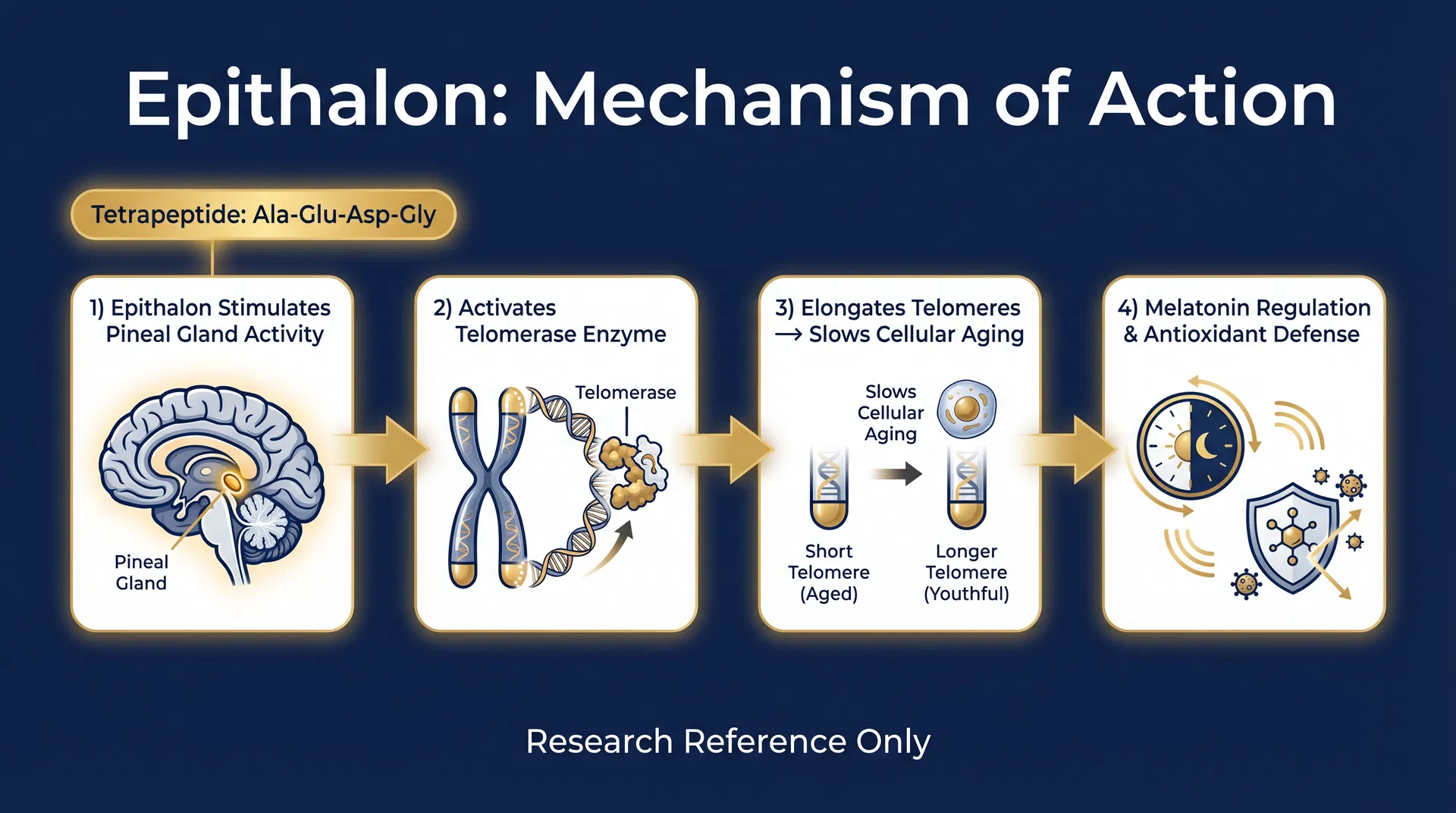
Key Research Pathways
Telomerase (TERT) Activation
Reported activation of telomerase reverse transcriptase in somatic cells, potentially extending replicative lifespan by maintaining telomere length.
Epigenetic / Chromatin Remodeling
Modulates histone acetylation and chromatin structure, potentially resetting age-related epigenetic drift.
Antioxidant Defense
Reduces lipid peroxidation and oxidative stress markers in aging animal models, contributing to cellular longevity.
Pineal / Melatonin Regulation
Modulates pineal gland function and melatonin synthesis, with downstream effects on circadian rhythm and neuroendocrine aging.
Key Findings from the Literature
- Reported activation of telomerase (TERT) in human fetal fibroblasts (Khavinson et al., 2003)
- Extended replicative lifespan of human cells beyond Hayflick limit in vitro
- Life extension observed in Drosophila melanogaster and rodent models (Khavinson et al.)
- Epigenetic effects: chromatin remodeling and histone acetylation changes
- Antioxidant activity and reduction of lipid peroxidation in aging animal models
- Regulation of melatonin synthesis and neuroendocrine function via pineal gland
Evidence by Claimed Outcome
Each outcome rated by the highest level of evidence available. Tiers follow our 5-tier methodology.
Study counts reflect peer-reviewed publications in the evidence database below. "Theoretical" outcomes have mechanistic rationale only. Learn about our evidence tiers →
Structured Evidence Table
2 cited studies — model, sample size, outcome, and effect size from published literature.
| Study | Model | Sample | Outcome | Effect Size | Level |
|---|---|---|---|---|---|
Khavinson VK, et al. (2003) Epithalon peptide induces telomerase activity and telomere elongation in human s… PubMed | Human somatic cells — in vitro | In vitro | Telomerase activation and telomere elongation in human fetal fibroblasts | Telomere length increase: ~33% after 44 passages vs. control | In Vitro |
Anisimov VN, et al. (2003) Effect of Epitalon on biomarkers of aging, life span and spontaneous tumor incid… PubMed | Rodent (mouse) — longevity study | n=200 | Extended mean lifespan; reduced spontaneous tumor incidence | Lifespan extension: ~13% vs. control; tumor incidence reduction: ~2.5× | Animal |
How Long It Lasts & How It Works in the Body
Epithalon (Epitalon) — half-life, bioavailability, onset, and duration data
| Parameter | Value | Source |
|---|---|---|
| Half-Life (t½) | ~30 minutes (estimated) Very short; rapid proteolytic degradation | Preclinical Data |
| Time to Peak (Tmax) | ~15–30 minutes Preclinical data only | Preclinical Data |
| Bioavailability (F) | SC/IM: estimated 60–80%; Intranasal: lower No published human PK data | Preclinical Data |
| Onset of Action | Days to weeks Telomerase activation and cellular effects are cumulative | — |
| Duration of Action | Cellular effects persist beyond plasma half-life Epigenetic and telomerase effects are durable | — |
Tetrapeptide (Ala-Glu-Asp-Gly). Despite very short plasma half-life, cellular effects (telomerase activation, melatonin regulation) are durable. Typical protocols use 10–20 day cycles.
References:
• Khavinson VK et al. Ann N Y Acad Sci 2002
• Anisimov VN et al. Mech Ageing Dev 2003
Important Research Context
Research References
Peer-reviewed literature supporting the research profile of Epithalon
The following peer-reviewed studies form the primary evidence base for Epithalon's research profile. All references are sourced from PubMed, NCBI, and peer-reviewed scientific journals. Published research is available through PubMed, NCBI, and peer-reviewed biomedical journals.
- 1.
Khavinson VKh, et al. Epithalon peptide induces telomerase activity and telomere elongation in human somatic cells. Bulletin of Experimental Biology and Medicine. 2003.PMID: 12937682
Epithalon activated telomerase and elongated telomeres in human somatic cell cultures.
- 2.
Anisimov VN, et al. Effect of Epitalon on biomarkers of aging, life span and spontaneous tumor incidence in female Swiss-derived SHR mice. Biogerontology. 2003.PMID: 14501183
Epithalon extended mean lifespan and reduced spontaneous tumor incidence in long-term rodent studies.
Epithalon
Longevity Research
Purgo Labs list price, read 12 Sep 2026 · per-lot COA on the vendor page
10mg $23.99 → $19.19 with code HEALTH (20% off; price read 23 Sept 2026)
- 1 certificate verified at the lab10mg$29.99$23.99→ $19.19
- 1 certificate verified at the lab10mg$39.99→ $33.99
- 1 certificate verified at the lab10mg$38.00→ $34.20
Fast FedEx shipping · Discreet packaging
Technical Specifications
| Peptide Class | Synthetic tetrapeptide (4 amino acids) |
| Molecular Weight | 390.35 Da |
| Amino Acid Sequence | Ala-Glu-Asp-Gly (AEDG) |
| Origin | Synthetic analog of pineal gland epithalamin |
| Available Sizes | 10mg vials |
| Form | Lyophilized powder |
| Purity | ≥99% (third-party tested) |
View full legal status guide →
Known Interactions
6 documented interactions for Epithalon
Epithalon activates telomerase for cellular longevity; GHK-Cu supports collagen synthesis and tissue remodeling. Complementary anti-aging mechanisms.
Both support immune function and longevity via different mechanisms — Epithalon via telomerase, Thymosin Alpha-1 via T-cell modulation.
Both target cellular aging pathways via different mechanisms — Epithalon via telomerase, MOTS-c via AMPK/mitochondrial function.
Interaction data is based on published research, known pharmacological mechanisms, and clinical practitioner experience. Evidence tiers: Clinical = human data; Emerging = preclinical/case reports; Theoretical = mechanism-based inference. Always consult a qualified healthcare provider before combining compounds.
Source Epithalon at Purgo Labs
10mg $23.99 list · $19.19 with code HEALTH · lab-verifiable COA per lot
Other Compounds in This Guide



Related Research Guides
Supporting Research
Epithalon's telomere and longevity claims rest on in-vitro work and studies from a single Russian research group (Khavinson). There are no independent Western RCTs, and lifespan or anti-aging claims are not supported by replicated human evidence. The compound is interesting as a research tool; it is not established as a human anti-aging intervention.
References
- Khavinson VKh, et al.PRECLINICAL / in vitroBulletin of Experimental Biology and Medicine. 2003. PubMedTelomerase activation and telomere elongation in human somatic cell cultures only. Does not establish human anti-aging efficacy.
Research Databases
Ready to Source Epithalon?
Purgo Labs offers Epithalon with ≥99% purity, third-party certificates of analysis, and fast FedEx shipping. This is an affiliate link — we may earn a commission at no cost to you.