NAD+
Mitochondrial Bioenergetics & Sirtuin Activation
Nicotinamide Adenine Dinucleotide (Oxidized Form)
Last reviewed: August 2026
NAD+ (Nicotinamide Adenine Dinucleotide) is a molecule your body makes from vitamin B3 that every single cell in your body depends on to produce energy. Think of it as the rechargeable battery inside each cell. The problem is that NAD+ levels decline significantly with age — by your 50s, you may have roughly half the NAD+ you had at 20 — and this decline is strongly associated with the hallmarks of aging.
NAD+ is a coenzyme that sits at the center of cellular energy production (the Krebs cycle and electron transport chain). But beyond energy, it's the essential fuel for a class of proteins called sirtuins — often called 'longevity proteins' — which regulate DNA repair, inflammation, circadian rhythms, and metabolic efficiency. NAD+ is also required by PARP enzymes, which are your cells' primary DNA damage repair machinery. When NAD+ is abundant, these systems run efficiently; when it's depleted, they slow down.
The connection between NAD+ decline and aging is one of the most actively researched areas in longevity science. David Sinclair's lab at Harvard has published extensively on this, and multiple human clinical trials are underway studying NAD+ precursors (NMN, NR) for age-related conditions. Research-grade NAD+ allows direct study of the molecule itself, rather than precursors that must be converted by the body.
NAD+ is arguably the most important molecule in longevity research right now. Its role in sirtuin activation, DNA repair, and mitochondrial function makes it central to understanding why we age. The research-grade NAD+ supplied by Purgo Labs is for laboratory use only. If you've heard of NMN or NR supplements, those are precursors that your body converts to NAD+ — this is the actual molecule.
What is NAD+?
Nicotinamide adenine dinucleotide (NAD+) is a dinucleotide coenzyme found in every living cell, where it serves as an indispensable electron carrier in cellular respiration and as a substrate for a growing family of regulatory enzymes. Unlike the peptides in this guide, NAD+ is not a synthetic compound — it is a naturally occurring biomolecule that has been the subject of Nobel Prize-winning research since Otto Warburg's foundational work on cellular respiration in the 1930s.
The renewed scientific interest in NAD+ stems from a convergence of discoveries in the early 2000s: the identification of sirtuins as NAD+-dependent deacylases with profound effects on aging and metabolic regulation, the demonstration that NAD+ levels decline significantly with age across multiple species, and the development of NAD+ precursors (NMN and NR) as research tools for restoring NAD+ pools.
- NAD+ (Nicotinamide Adenine Dinucleotide) is a dinucleotide coenzyme present in every living cell, functioning as the central electron carrier in cellular respiration and as a required substrate for Sirtuins (SIRT1–SIRT7), PARP enzymes, and CD38 — all critical regulators of aging and DNA repair.
- NAD+ levels decline approximately 50% between ages 20 and 60 in human tissue, correlating with reduced mitochondrial function, impaired DNA repair capacity, and increased inflammatory signaling (the 'NAD+ decline' hypothesis of aging).
- Three main precursor pathways: NMN (nicotinamide mononucleotide) and NR (nicotinamide riboside) both enter the salvage pathway to regenerate NAD+; direct IV NAD+ bypasses precursor conversion but has a very short plasma half-life.
- Human clinical evidence: NR supplementation consistently elevates blood NAD+ (Trammell et al., Nature Communications 2016); NMN improved muscle insulin sensitivity in postmenopausal women with prediabetes (Yoshino et al., Science 2021); 2025 Lancet eClinicalMedicine study found NR improved cognition in older adults with MCI.
- Sirtuin activation by NAD+ deacetylates histones and transcription factors including PGC-1α (mitochondrial biogenesis), FOXO3 (stress resistance), and p53 (apoptosis regulation) — the mechanistic basis for NAD+'s proposed longevity effects.
Molecular Composition
NAD+ (nicotinamide adenine dinucleotide, oxidized form) is a dinucleotide consisting of two nucleotides joined by a pyrophosphate linkage: adenosine monophosphate (AMP) and nicotinamide mononucleotide (NMN). The nicotinamide ring — derived from vitamin B3 (niacin) — is the functional redox-active component, capable of accepting a hydride ion (H⁻) to become NADH.
The molecular formula is C₂₁H₂₇N₇O₁₄P₂ with a molecular weight of 663.43 Daltons. NAD+ exists in two interconvertible forms: the oxidized form (NAD+) and the reduced form (NADH). The ratio of NAD+ to NADH is a critical indicator of cellular redox state and metabolic health.
How Does It Work?
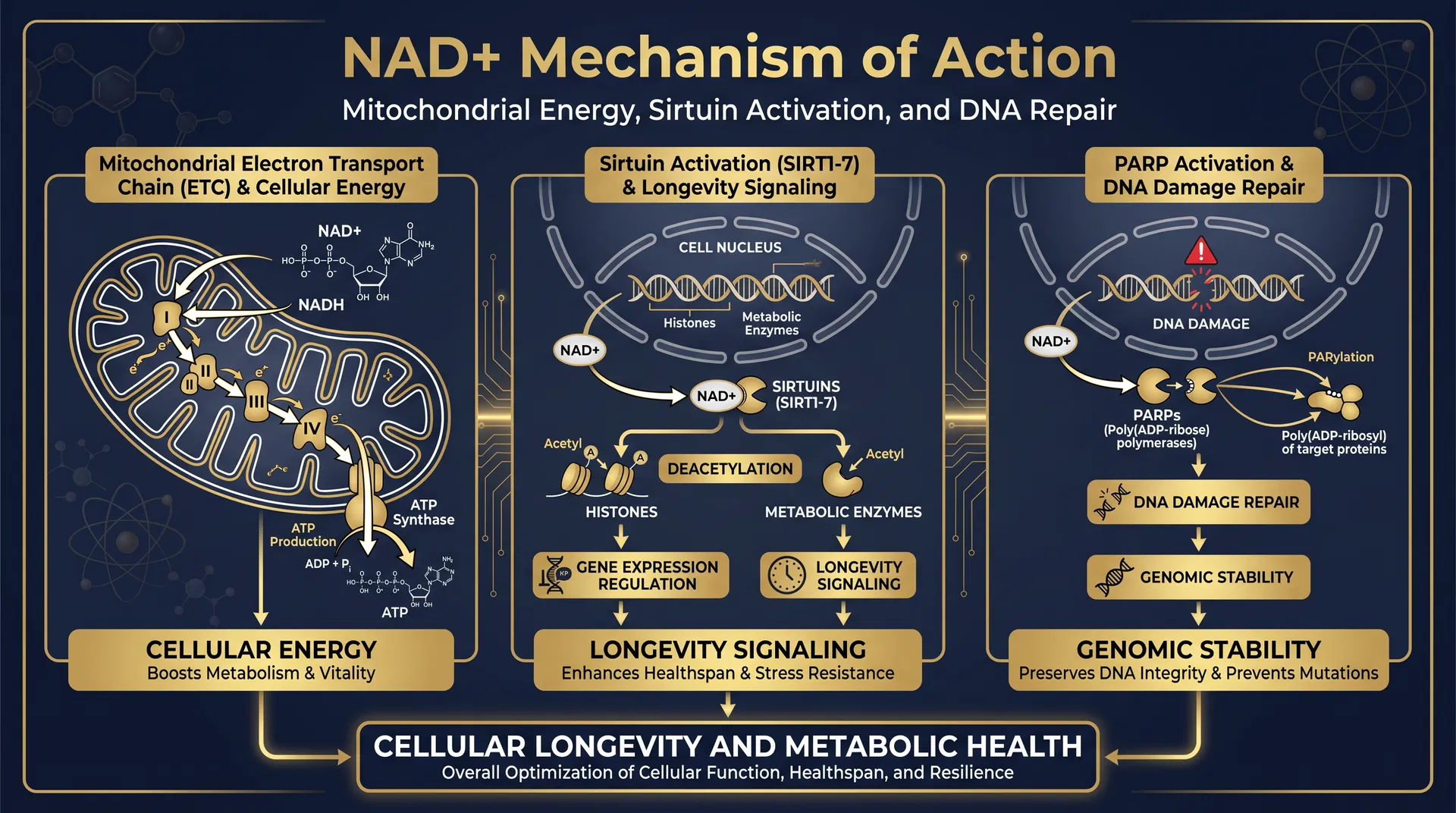
NAD+ restores cellular energy and activates longevity enzymes (sirtuins and PARPs) by replenishing the coenzyme that powers mitochondrial ATP production and DNA repair.
NAD+ functions through two fundamentally distinct mechanisms: as a redox coenzyme in metabolic reactions, and as a substrate for regulatory enzymes that consume it in non-redox reactions.
In its coenzyme role, NAD+ accepts electrons from metabolic substrates during glycolysis, the TCA cycle, and beta-oxidation of fatty acids, becoming NADH. NADH then donates these electrons to the mitochondrial electron transport chain (ETC), driving ATP synthesis via oxidative phosphorylation.
In its substrate role, NAD+ is consumed by three classes of enzymes: (1) Sirtuins (SIRT1-7) — NAD+-dependent deacylases that regulate gene expression, mitochondrial biogenesis, DNA repair, and metabolic adaptation. (2) PARPs — enzymes that consume NAD+ to coordinate the DNA damage response. (3) CD38/CD157 — NAD+ glycohydrolases involved in calcium signaling and immune function, which become increasingly active with age.
Key Research Pathways
Sirtuin Activation (SIRT1–7)
NAD+-dependent deacylases that regulate gene expression, mitochondrial biogenesis, DNA repair, and metabolic adaptation across all tissues.
Mitochondrial Electron Transport
NADH (reduced form) donates electrons to Complex I of the ETC, driving ATP synthesis — the fundamental energy currency of all aerobic cells.
PARP-Mediated DNA Repair
PARPs consume NAD+ to synthesize poly-ADP-ribose chains at DNA damage sites, coordinating the DNA damage response and maintaining genomic integrity.
CD38 / Calcium Signaling
CD38 glycohydrolase consumes NAD+ to produce cyclic ADP-ribose, a second messenger regulating intracellular calcium and immune cell function.
Key Findings from the Literature
- NAD+ levels decline 40–60% between ages 20–60, correlating with hallmarks of aging (Covarrubias et al., 2021)
- Sirtuin activation by NAD+ extends lifespan in C. elegans and improves healthspan in rodent models
- SIRT1/SIRT3 activation promotes mitochondrial biogenesis via PGC-1α pathway
- PARP-dependent DNA repair consumes NAD+; restoration improves genomic stability
- NAD+ supplementation reduces age-related inflammation (inflammaging) in preclinical models
- Cognitive benefits in early Alzheimer's disease models (Science Daily, 2026)
Evidence by Claimed Outcome
Each outcome rated by the highest level of evidence available. Tiers follow our 5-tier methodology.
Study counts reflect peer-reviewed publications in the evidence database below. "Theoretical" outcomes have mechanistic rationale only. Learn about our evidence tiers →
Structured Evidence Table
1 cited study — model, sample size, outcome, and effect size from published literature.
| Study | Model | Sample | Outcome | Effect Size | Level |
|---|---|---|---|---|---|
Yoshino J, et al. (2018) NAD+ Intermediates: The Biology and Therapeutic Potential of NMN and NR PubMed | Review — human + rodent | Review | NAD+ precursors improve mitochondrial function, insulin sensitivity, and aging biomarkers | NAD+ levels: 40–90% increase with NMN/NR supplementation in humans | RCT |
Important Research Context
Research References
Peer-reviewed literature supporting the research profile of NAD+
The following peer-reviewed studies form the primary evidence base for NAD+'s research profile. All references are sourced from PubMed, NCBI, and peer-reviewed scientific journals. Published research is available through PubMed, NCBI, and peer-reviewed biomedical journals.
- 1.
Yoshino J, Baur JA, Imai SI. NAD+ Intermediates: The Biology and Therapeutic Potential of NMN and NR. Cell Metabolism. 2018.PMID: 29249689
Comprehensive review of NAD+ precursor biology and therapeutic potential in aging and metabolic disease.
- 2.
Rajman L, Chwalek K, Sinclair DA. Therapeutic Potential of NAD-Boosting Molecules: The In Vivo Evidence. Cell Metabolism. 2018.PMID: 29514064
In vivo evidence for NAD+ supplementation in longevity, metabolic health, and neuroprotection.
- 3.
Martens CR, et al. Chronic nicotinamide riboside supplementation is well-tolerated and elevates NAD+ in healthy middle-aged and older adults. Nature Communications. 2018.PMID: 29599478
First human clinical trial confirming oral NAD+ precursor supplementation safely elevates blood NAD+ levels.
NAD+
Longevity Research
Purgo Labs list price, read 12 Sep 2026 · per-lot COA on the vendor page
1000mg $69.99 → $55.99 with code HEALTH (20% off; price read 2 Oct 2026)
- 1 certificate verified at the lab1000mg$69.99→ $55.99
- 2 certificates verified at the lab500mg$35.00→ $28.00
- 2 certificates verified at the lab500mg$57.15$39.99→ $35.99
Fast FedEx shipping · Discreet packaging
Technical Specifications
| Compound Class | Dinucleotide coenzyme (not a peptide) |
| Molecular Formula | C₂₁H₂₇N₇O₁₄P₂ |
| Molecular Weight | 663.43 Da |
| Redox Forms | NAD+ (oxidized) / NADH (reduced) |
| Natural Occurrence | All living cells; declines with age |
| Available Sizes | 500mg vials |
| Form | Lyophilized powder |
| Purity | ≥99% (third-party tested) |
View full legal status guide →
Source NAD+ at Purgo Labs
1000mg $69.99 list · $55.99 with code HEALTH · lab-verifiable COA per lot
Other Compounds in This Guide

Related Research Guides
Supporting Research
Human evidence supports NAD+ precursors (nicotinamide riboside, NMN) raising blood NAD+ levels in healthy adults. This does not establish clinical anti-aging outcomes, which remain unproven. IV/injectable NAD+ efficacy is separately unestablished. Distinguish "raises NAD+ in blood" (shown) from "reverses aging / fixes disease" (not shown).
References
- Martens CR, et al.HUMAN RCT, crossoverOral NR supplementation raises blood NAD+ and is well tolerated in healthy middle-aged and older adults. Does not support clinical anti-aging outcomes or IV-NAD+ efficacy.
Research Databases
Ready to Source NAD+?
Purgo Labs offers NAD+ with ≥99% purity, third-party certificates of analysis, and fast FedEx shipping. This is an affiliate link — we may earn a commission at no cost to you.