Wolverine Blend
Synergistic Dual-Peptide Regenerative Stack
Wolverine Blend — BPC-157 + TB-500 Combination
Last reviewed: August 2026
The Wolverine Blend combines two of the most studied recovery peptides — BPC-157 and TB-500 — into a single vial. The name is a nod to the comic book character famous for near-instant healing, and the idea behind the blend is that the two compounds target tissue repair from different angles simultaneously.
BPC-157 works locally — it signals the body to grow new blood vessels at the site of damage, which is the critical first step in any healing process. TB-500 works more systemically — it helps repair cells throughout the body navigate toward the injury. Together, researchers hypothesize that you get both the 'build the roads' signal (BPC-157) and the 'send the workers' signal (TB-500) at the same time.
Most recovery peptides address one part of the healing cascade. The appeal of a dual-compound blend is that it theoretically covers more ground in a single protocol. This is why the BPC-157/TB-500 combination is one of the most discussed stacks in preclinical recovery research — the mechanisms genuinely complement each other rather than overlap.
The Wolverine Blend is a convenient co-formulation of two individually well-studied compounds. The synergy hypothesis is mechanistically sound, though direct studies on the combination specifically are limited. Both components are research-only compounds; no human clinical data exists for this specific blend.
What is Wolverine Blend?
The Wolverine Blend is a pre-combined formulation of two of the most extensively researched recovery peptides available: BPC-157 and TB-500. Named for the comic archetype of rapid, near-instantaneous tissue regeneration, this blend is designed to leverage the complementary and potentially synergistic mechanisms of both compounds in a single reconstitutable vial.
BPC-157 contributes its well-characterized angiogenic and cytoprotective activity — particularly its upregulation of VEGFR2 and modulation of the nitric oxide system — while TB-500 provides systemic actin-regulatory and cell-migratory support through its WH2 domain binding activity. Together, the two peptides address tissue repair from both a local vascular and a systemic cellular migration standpoint.
- Combines BPC-157 (angiogenesis + growth factor upregulation) with TB-500 (actin G/F ratio modulation) in a single vial for synergistic tissue repair.
- BPC-157 component targets the pentadecapeptide sequence of body protection compound, activating VEGF, EGF, and HGF receptor pathways.
- TB-500 component is the synthetic analog of the Tβ4 C-terminal active fragment, promoting cell migration and reducing inflammation via thymosin β4 mechanism.
- The two compounds address complementary repair mechanisms: BPC-157 promotes vascular regrowth while TB-500 facilitates cell migration to injury sites.
- Supplied as research-grade lyophilized powder for laboratory use only; not for human or veterinary use.
Molecular Composition
The Wolverine Blend contains a fixed-ratio combination of BPC-157 (Body Protection Compound 157, a 15-amino-acid pentadecapeptide, MW 1,419.56 Da) and TB-500 (the Ac-LKKTETQ heptapeptide fragment of thymosin beta-4, MW 889.0 Da). Both components are supplied as co-lyophilized powder in a single vial, maintaining ≥99% purity for each constituent as verified by independent third-party certificate of analysis.
The rationale for co-formulation is rooted in the complementary nature of the two peptides' mechanisms: BPC-157 primarily acts at the local tissue level through angiogenic and growth factor signaling, while TB-500 exerts systemic effects on cell migration and cytoskeletal dynamics, potentially enabling a more comprehensive regenerative response than either compound alone.
How Does It Work?
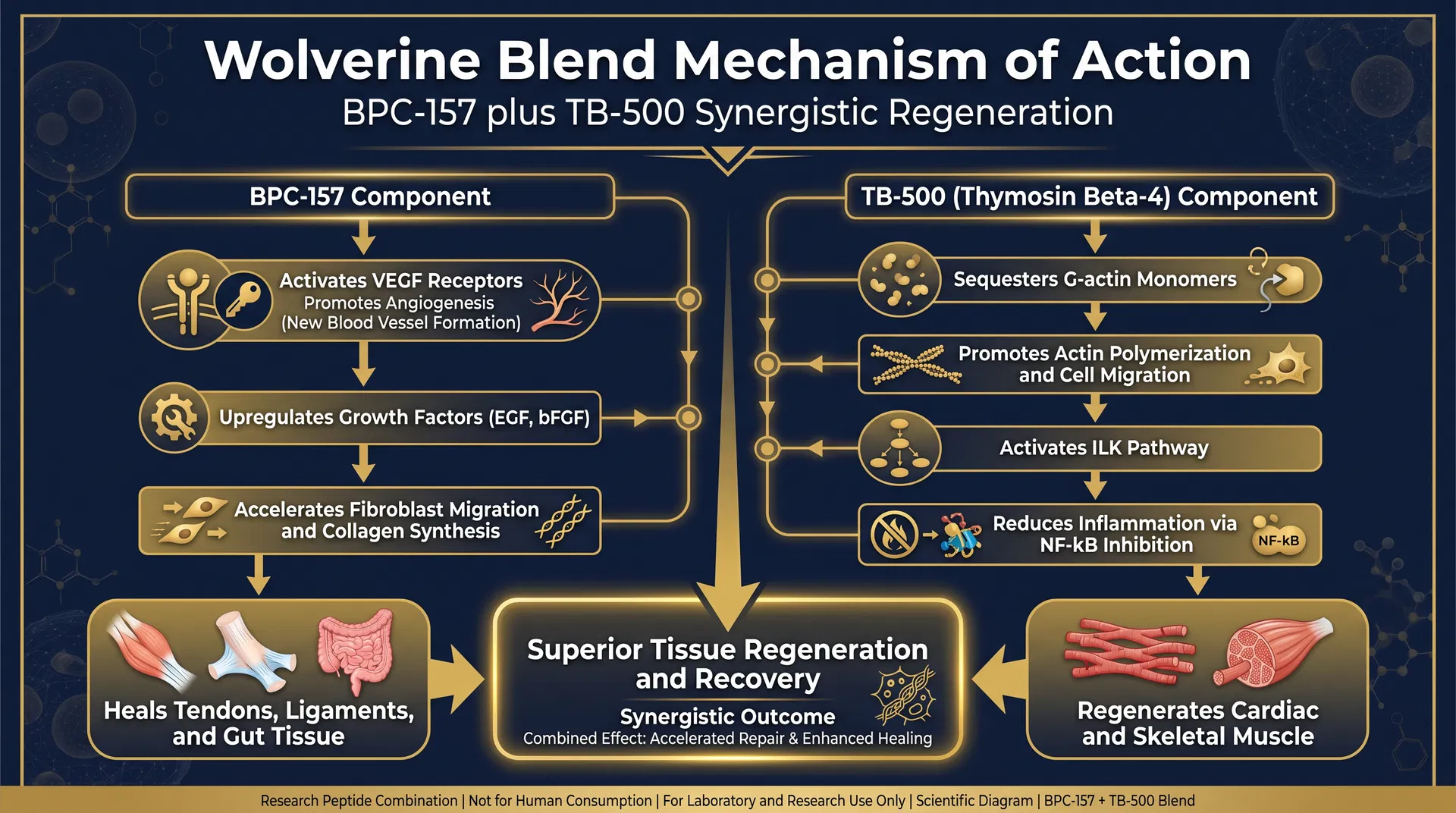
The Wolverine Blend combines BPC-157 and TB-500 to simultaneously accelerate angiogenesis and cell migration, producing faster recovery than either peptide alone.
The Wolverine Blend operates through the combined mechanisms of its two constituent peptides. BPC-157 activates the VEGFR2 pathway to stimulate angiogenesis and upregulates Egr-1 to drive expression of PDGF, FGF, and other repair-associated growth factors. Simultaneously, it modulates the nitric oxide system to provide cytoprotective and vascular tone-regulating effects.
TB-500 complements this by binding monomeric G-actin via its WH2 domain, enabling the directed migration of fibroblasts, endothelial cells, and keratinocytes into the wound bed. It also activates the Akt/PI3K survival pathway and downregulates pro-inflammatory cytokines IL-1β and TNF-α, reducing the inflammatory burden that can impede healing.
The theoretical synergy between these mechanisms — local angiogenesis plus systemic cell migration — has made the BPC-157/TB-500 combination one of the most discussed dual-peptide stacks in preclinical recovery research.
Key Research Pathways
VEGFR2 Angiogenesis (BPC-157)
BPC-157 component upregulates VEGFR2, driving new blood vessel formation and improving perfusion at sites of tissue injury.
G-Actin Sequestration (TB-500)
TB-500 component binds G-actin via WH2 domain, enabling directed migration of repair cells into the wound bed.
Akt / PI3K Cytoprotection
TB-500 activates the Akt survival pathway, protecting cells from ischemic and inflammatory damage during the repair process.
Dual Anti-inflammatory Action
BPC-157 modulates nitric oxide while TB-500 suppresses IL-1β and TNF-α, collectively reducing inflammatory impedance to healing.
Key Findings from the Literature
- Combines VEGFR2-mediated angiogenesis (BPC-157) with WH2-domain actin regulation (TB-500)
- Dual anti-inflammatory action: NO modulation (BPC-157) + IL-1β/TNF-α suppression (TB-500)
- Akt/PI3K survival signaling activated by TB-500 component provides cytoprotection
- BPC-157 component accelerates tendon and ligament repair in rodent models (Sikiric et al.)
- TB-500 component promotes endothelial differentiation and VEGF-independent angiogenesis
- Co-formulation simplifies research protocols requiring both compounds simultaneously
Evidence by Claimed Outcome
Each outcome rated by the highest level of evidence available. Tiers follow our 5-tier methodology.
Study counts reflect peer-reviewed publications in the evidence database below. "Theoretical" outcomes have mechanistic rationale only. Learn about our evidence tiers →
Important Research Context
Research References
Peer-reviewed literature supporting the research profile of Wolverine Blend
The following peer-reviewed studies form the primary evidence base for Wolverine Blend's research profile. All references are sourced from PubMed, NCBI, and peer-reviewed scientific journals. Published research is available through PubMed, NCBI, and peer-reviewed biomedical journals.
- 1.
Sikiric P, et al. Stable gastric pentadecapeptide BPC 157: novel therapy in gastrointestinal tract. Current Pharmaceutical Design. 2011.PMID: 21548867
BPC-157 component: cytoprotective and tissue repair activity across multiple tissue types.
- 2.
Goldstein AL, Hannappel E, Kleinman HK. Thymosin beta4: actin-sequestering protein moonlights to repair injured tissues. Trends in Molecular Medicine. 2005.PMID: 16099219
TB-500 component: established role in actin regulation and tissue repair signaling.
Wolverine Blend
Blends Research
Purgo Labs list price, read 12 Sep 2026 · per-lot COA on the vendor page
Use code HEALTH for 20% off
Fast FedEx shipping · Discreet packaging
Technical Specifications
| Blend Components | BPC-157 (pentadecapeptide) + TB-500 (heptapeptide) |
| BPC-157 MW | 1,419.56 Da |
| TB-500 MW | 889.0 Da |
| Form | Co-lyophilized powder blend |
| Purity (each component) | ≥99% (third-party tested) |
| Reconstitution | Bacteriostatic water (BAC Water) |
View full legal status guide →
Source Wolverine Blend at Purgo Labs
≥99% purity · Third-party COA · Use code HEALTH for 20% off
Other Compounds in This Guide



Related Research Guides
Supporting Research
Wolverine Stack is a proprietary blend of BPC-157 and TB-500. No human or animal clinical trials have been conducted on this specific blend formulation. Evidence for individual constituents is preclinical only.
References
- Sikiric P, et al.PRECLINICAL — BPC-157 constituentCurrent Pharmaceutical Design. 2011. PubMedPreclinical evidence for BPC-157 constituent; does not establish efficacy for the blend formulation.
- Goldstein AL, Hannappel E, Kleinman HK.PRECLINICAL — TB-500 constituentTrends in Molecular Medicine. 2005. PubMedPreclinical evidence for thymosin beta-4 (TB-500 constituent); does not establish efficacy for the blend formulation.
Research Databases
Ready to Source Wolverine Blend?
Purgo Labs offers Wolverine Blend with ≥99% purity, third-party certificates of analysis, and fast FedEx shipping. This is an affiliate link — we may earn a commission at no cost to you.