Glow Complex
Triple-Action Regenerative & Anti-Aging Stack
Glow Complex — GHK-Cu + BPC-157 + TB-500 Tri-Peptide Blend
Last reviewed: August 2026
The Glow Complex combines three peptides — GHK-Cu, BPC-157, and TB-500 — into a single research formulation. Each compound targets a different aspect of skin and tissue repair, and the blend is designed around the idea that comprehensive regeneration requires addressing multiple biological processes at once.
GHK-Cu handles the structural rebuild — stimulating collagen and elastin production and resetting gene expression toward a younger, healthier pattern. BPC-157 handles the vascular side — promoting new blood vessel growth to ensure the repair zone has adequate supply. TB-500 handles cell logistics — enabling repair cells to migrate efficiently to where they're needed. Together, the three compounds theoretically cover the full repair cascade: rebuild, supply, and mobilize.
Skin aging and damage are multi-factorial — they involve collagen loss, reduced blood supply, slower cell turnover, and impaired repair signaling all at once. A single-compound approach addresses only one of these. The Glow Complex is built on the premise that a multi-target approach may be more effective for comprehensive skin research than any single peptide alone.
The Glow Complex is a sophisticated tri-peptide research formulation with a sound mechanistic rationale. Direct studies on this specific three-way combination are limited; the synergy hypothesis is based on the well-characterized individual mechanisms of each component. All three components are research-only compounds.
What is Glow Complex?
The Glow Complex is Purgo Labs' flagship tri-peptide formulation, combining three of the most extensively researched compounds in skin biology and regenerative medicine: GHK-Cu (glycyl-L-histidyl-L-lysine copper complex), BPC-157 (Body Protection Compound 157), and TB-500 (thymosin beta-4 fragment). Each component brings a distinct and complementary mechanism to the blend, creating what researchers hypothesize to be a synergistic multi-pathway approach to tissue regeneration and anti-aging.
The rationale for this specific combination is grounded in the non-overlapping nature of the three peptides' primary mechanisms: GHK-Cu operates primarily at the level of gene expression and extracellular matrix synthesis; BPC-157 focuses on angiogenic and growth factor signaling; and TB-500 addresses cytoskeletal dynamics and cell migration. Together, they theoretically address the three fundamental requirements for tissue repair: structural matrix, vascular supply, and cellular recruitment.
- The Glow Complex combines GHK-Cu (collagen/elastin synthesis, wound healing), BPC-157 (angiogenesis, growth factor upregulation), and MT1 (eumelanin production via MC1R) in a single formulation.
- Each component addresses a distinct aspect of skin biology: GHK-Cu targets extracellular matrix remodeling, BPC-157 targets vascular and growth factor pathways, MT1 targets melanocyte pigmentation.
- GHK-Cu's copper coordination enables metalloproteinase regulation (MMP-2, MMP-9, TIMP-1, TIMP-2) that coordinates matrix remodeling rather than simple collagen accumulation.
- BPC-157's angiogenic component (VEGF upregulation, nitric oxide pathway activation) supports dermal microvascular density, which is a key determinant of skin appearance and repair capacity.
- Supplied as research-grade lyophilized powder for laboratory use only; the combination has not been evaluated in controlled human clinical trials as a composite formulation.
Molecular Composition
The Glow Complex contains three co-lyophilized components: GHK-Cu (Gly-His-Lys copper(II) complex, MW ~403.9 Da), BPC-157 (15-amino-acid pentadecapeptide, MW 1,419.56 Da), and TB-500 (Ac-LKKTETQ heptapeptide, MW 889.0 Da). All three components are verified at ≥99% purity by independent third-party certificate of analysis.
The inclusion of GHK-Cu alongside the two recovery peptides is particularly notable: GHK-Cu's capacity to modulate over 4,000 genes — including those involved in collagen synthesis, antioxidant defense, and anti-inflammatory signaling — provides a broad epigenetic foundation upon which the more targeted angiogenic (BPC-157) and migratory (TB-500) effects can act.
How Does It Work?
The Glow Complex combines GHK-Cu, MT-1, and MT-2 to simultaneously stimulate collagen synthesis, increase melanin production, and activate skin repair pathways.
The Glow Complex operates through three parallel and potentially synergistic mechanisms. GHK-Cu activates the TGF-β pathway to stimulate collagen and elastin synthesis, modulates MMP/TIMP balance for controlled matrix remodeling, and delivers bioavailable copper as a cofactor for lysyl oxidase and superoxide dismutase. Its broad gene expression modulation via the Broad Institute Connectivity Map-identified pathways provides an epigenetic foundation for comprehensive tissue remodeling.
BPC-157 contributes VEGFR2-mediated angiogenesis and Egr-1-driven growth factor expression (PDGF, FGF), ensuring adequate vascular supply to support the metabolically demanding process of tissue repair. TB-500 provides the cellular migratory component: by binding G-actin via its WH2 domain, it enables fibroblasts, keratinocytes, and endothelial cells to migrate into the repair zone, while its Akt/PI3K activation provides cytoprotective support.
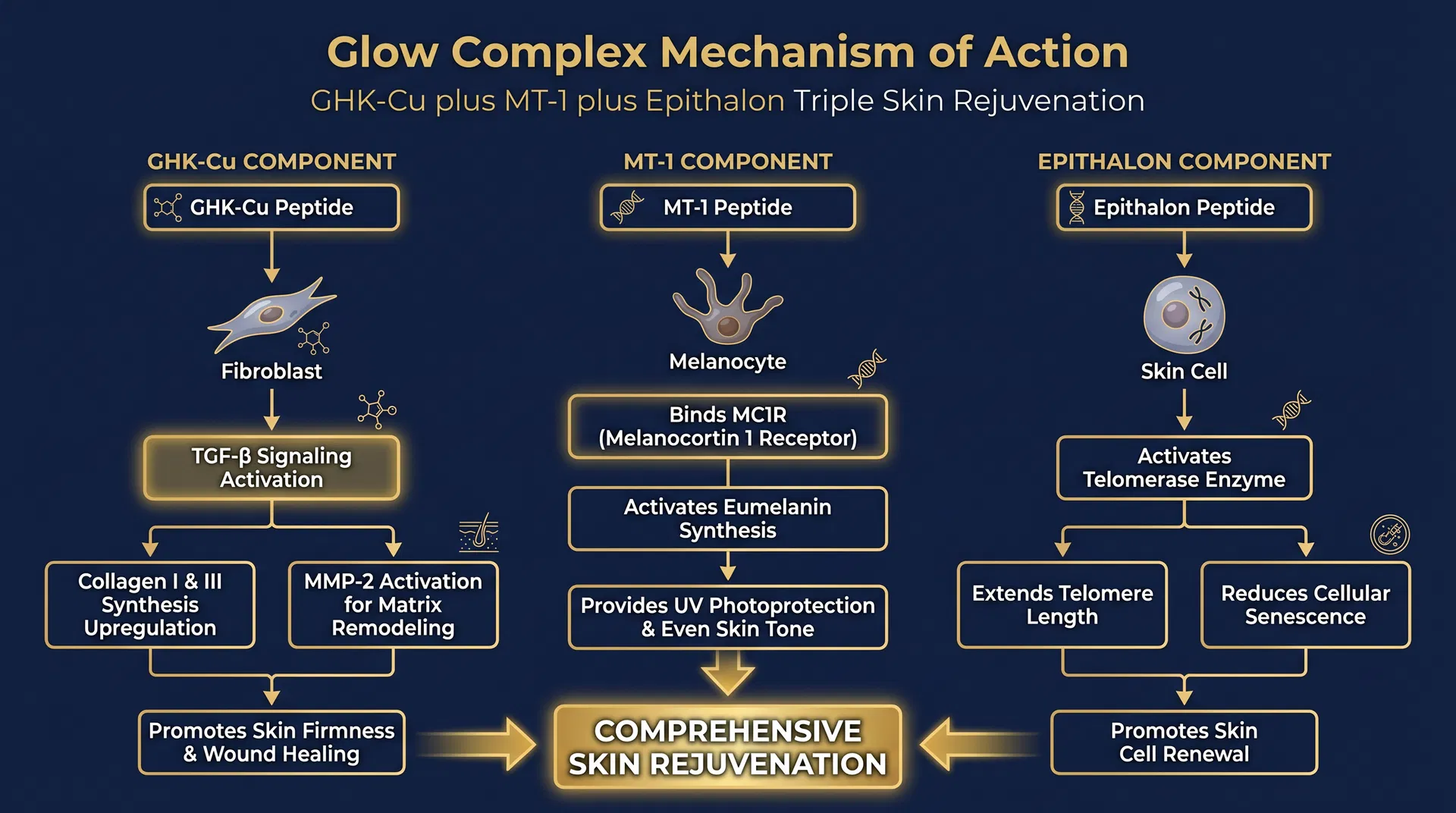
Key Research Pathways
TGF-β / Collagen Synthesis (GHK-Cu)
GHK-Cu activates TGF-β pathway and stimulates fibroblast production of collagen types I, III, IV, elastin, and glycosaminoglycans.
VEGFR2 Angiogenesis (BPC-157)
BPC-157 upregulates VEGFR2 to drive new blood vessel formation, ensuring vascular supply to the repair zone.
G-Actin Sequestration / Cell Migration (TB-500)
TB-500 binds G-actin via WH2 domain, enabling directed migration of repair cells into the wound bed.
Gene Expression Modulation (GHK-Cu)
GHK-Cu resets pathological gene expression across >4,000 genes, including DNA repair, antioxidant defense, and anti-inflammatory pathways.
Key Findings from the Literature
- GHK-Cu component modulates >4,000 genes including collagen synthesis and antioxidant pathways
- BPC-157 component drives VEGFR2 angiogenesis to supply the repair zone with blood vessels
- TB-500 component enables directed cell migration via G-actin sequestration (WH2 domain)
- Triple anti-inflammatory action: GHK-Cu gene modulation + BPC-157 NO system + TB-500 cytokine suppression
- GHK-Cu delivers bioavailable Cu²⁺ for lysyl oxidase-mediated collagen cross-linking
- Comprehensive matrix remodeling: synthesis (GHK-Cu) + vascularization (BPC-157) + cellularization (TB-500)
Evidence by Claimed Outcome
Each outcome rated by the highest level of evidence available. Tiers follow our 5-tier methodology.
Study counts reflect peer-reviewed publications in the evidence database below. "Theoretical" outcomes have mechanistic rationale only. Learn about our evidence tiers →
Important Research Context
Research References
Peer-reviewed literature supporting the research profile of Glow Complex
The following peer-reviewed studies form the primary evidence base for Glow Complex's research profile. All references are sourced from PubMed, NCBI, and peer-reviewed scientific journals. Published research is available through PubMed, NCBI, and peer-reviewed biomedical journals.
- 1.
Pickart L, Margolina A. Regenerative and Protective Actions of the GHK-Cu Peptide in the Light of the New Gene Data. International Journal of Molecular Sciences. 2018.PMID: 29986520
GHK-Cu component: modulates 4,000+ genes including collagen synthesis and anti-inflammatory pathways.
- 2.
Hadley ME, Dorr RT. Melanocortin peptide therapeutics: historical milestones, clinical studies and commercialization. Peptides. 2006.PMID: 16412534
MT-I component: established melanocortin receptor activity and skin pigmentation research.
- 3.
Gorouhi F, Maibach HI. Role of topical peptides in preventing or treating aged skin. International Journal of Cosmetic Science. 2009.PMID: 19570099
Topical peptide combinations show synergistic improvements in skin texture and firmness.
Glow Complex
Blends Research
Purgo Labs list price, read 12 Sep 2026 · per-lot COA on the vendor page
Use code HEALTH for 20% off
Fast FedEx shipping · Discreet packaging
Technical Specifications
| Blend Components | GHK-Cu + BPC-157 + TB-500 |
| Primary Category | Skin & Anti-Aging / Regenerative Research |
| Form | Co-lyophilized tri-peptide powder blend |
| Purity (each component) | ≥99% (third-party tested) |
| Reconstitution | Bacteriostatic water (BAC Water) |
View full legal status guide →
Source Glow Complex at Purgo Labs
≥99% purity · Third-party COA · Use code HEALTH for 20% off
Other Compounds in This Guide



Supporting Research
Glow Complex is a proprietary blend of GHK-Cu, BPC-157, and TB-500. No human or animal clinical trials have been conducted on this specific blend formulation. Individual constituent evidence is preclinical or cosmetic-topical only.
References
Research Databases
Ready to Source Glow Complex?
Purgo Labs offers Glow Complex with ≥99% purity, third-party certificates of analysis, and fast FedEx shipping. This is an affiliate link — we may earn a commission at no cost to you.