MT1
MC1R Agonism & Melanogenesis Stimulation
Afamelanotide (Melanotan-I)
Last reviewed: August 2026
MT1 (Melanotan I, clinically known as afamelanotide) is a synthetic version of a hormone your body naturally produces called alpha-MSH. This hormone is part of your skin's built-in sun protection system — it's what triggers your skin to tan in response to UV exposure.
MT1 works by activating a receptor on melanocytes (the cells that produce skin pigment) called MC1R. When this receptor is activated, it triggers a chain reaction that increases production of eumelanin — the dark, protective form of melanin. Crucially, MT1 can do this without requiring UV exposure first. It's essentially activating the tanning pathway directly.
MT1 is the only peptide in this guide that has received full regulatory approval — it's sold in the EU as Scenesse® for a rare genetic condition called erythropoietic protoporphyria (EPP), where patients experience extreme pain from even brief sun exposure. This means MT1 has completed Phase III clinical trials and has a well-characterized human safety profile, which is rare in the peptide research space.
MT1 stands apart from most research peptides because it has genuine clinical validation behind it. The EU-approved formulation is a subcutaneous implant; Purgo Labs supplies the lyophilized powder format strictly for laboratory research use. The clinical data provides a strong mechanistic foundation for researchers studying melanocortin biology.
What is MT1?
Melanotan I (MT1), clinically known as afamelanotide, is a synthetic analog of alpha-melanocyte-stimulating hormone (α-MSH), a naturally occurring neuropeptide derived from proopiomelanocortin (POMC). Developed initially at the University of Arizona, MT1 was engineered to be a more potent and metabolically stable version of α-MSH, with a half-life of approximately 1.5 hours compared to the native hormone's minutes-long duration.
MT1 is the only melanocortin receptor agonist to have received regulatory approval — it is approved in the European Union under the brand name Scenesse® for the prevention of phototoxicity in adults with erythropoietic protoporphyria (EPP), a rare genetic disorder causing extreme light sensitivity. This clinical validation distinguishes MT1 from most research peptides and provides a robust human safety and efficacy dataset.
- Melanotan I (MT1) is a linear analog of α-MSH (alpha-melanocyte-stimulating hormone) that activates MC1R (melanocortin-1 receptor) on melanocytes to stimulate eumelanin production.
- Unlike MT2, MT1 has high MC1R selectivity with minimal MC3R/MC4R activity, meaning it lacks the aphrodisiac and appetite-suppressing effects associated with MT2.
- The FDA-approved drug afamelanotide (Scenesse®) is a cyclic MT1 analog approved for erythropoietic protoporphyria — providing the strongest clinical validation for MC1R agonism in this catalog.
- Eumelanin (brown/black pigment) produced via MC1R activation provides significantly more UV photoprotection than pheomelanin (red/yellow pigment) produced without MC1R stimulation.
- Research-grade MT1 from Purgo Labs is for laboratory use only and is not the same as the clinical afamelanotide formulation.
Molecular Composition
Afamelanotide is a 13-amino-acid linear peptide with the sequence Ac-Ser-Tyr-Ser-Nle-Glu-His-D-Phe-Arg-Trp-Gly-Lys-Pro-Val-NH2. Key structural modifications compared to native α-MSH include: substitution of Met⁴ with norleucine (Nle) to prevent oxidative degradation, replacement of Phe⁷ with D-Phe to increase receptor binding affinity and metabolic stability, and N-terminal acetylation with C-terminal amidation to further resist enzymatic degradation.
These modifications collectively extend the biological half-life from approximately 2–3 minutes (native α-MSH) to approximately 1.5 hours, while also increasing potency at the melanocortin-1 receptor (MC1R) by approximately 100-fold compared to the native sequence.
How Does It Work?
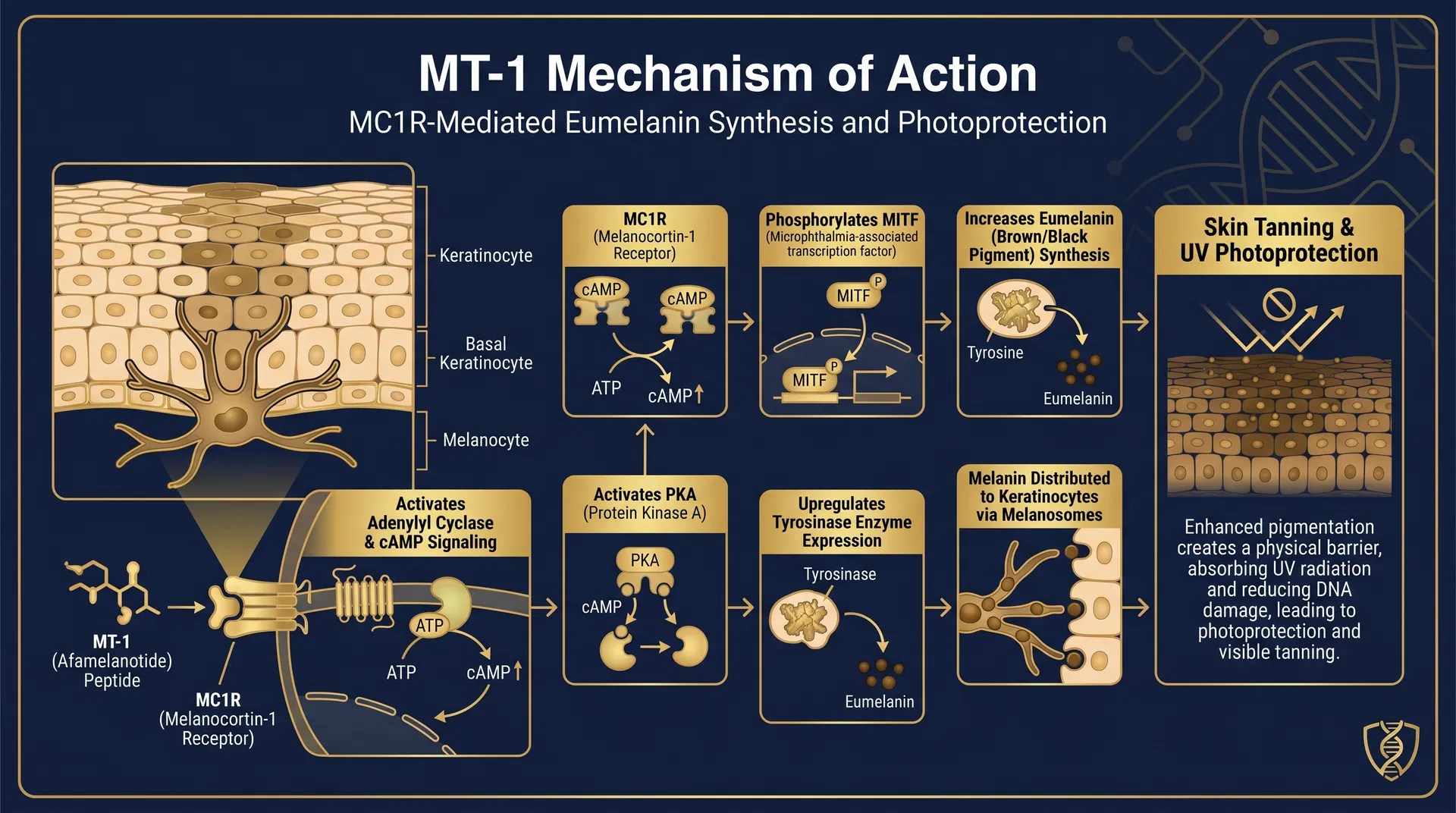
MT-1 reduces UV-induced skin damage by activating MC1R receptors in melanocytes, increasing melanin production before sun exposure.
MT1 functions as a potent agonist of the melanocortin-1 receptor (MC1R), a G-protein coupled receptor expressed predominantly on melanocytes in the skin. Upon binding to MC1R, MT1 activates the Gαs protein, stimulating adenylyl cyclase and increasing intracellular cyclic AMP (cAMP) levels. Elevated cAMP activates protein kinase A (PKA), which phosphorylates the transcription factor CREB (cAMP response element-binding protein).
Phosphorylated CREB activates the microphthalmia-associated transcription factor (MITF), the master regulator of melanocyte biology. MITF drives expression of tyrosinase, tyrosinase-related protein-1 (TRP-1), and TRP-2 — the key enzymes of the melanogenesis pathway — resulting in increased eumelanin production and enhanced photoprotection.
Key Research Pathways
MC1R / cAMP / PKA Signaling
Binds MC1R on melanocytes, activating adenylyl cyclase → cAMP → PKA cascade that drives melanogenesis transcription factors.
MITF Transcription Activation
PKA phosphorylates CREB, which activates MITF — the master regulator of melanocyte biology and eumelanin synthesis.
Melanogenesis (Tyrosinase Pathway)
MITF drives expression of tyrosinase, TRP-1, and TRP-2, the enzymatic machinery of eumelanin production.
NF-κB Anti-inflammatory Signaling
MC1R activation suppresses NF-κB-mediated inflammatory signaling, providing secondary anti-inflammatory effects.
Key Findings from the Literature
- EU-approved (Scenesse®) for prevention of phototoxicity in erythropoietic protoporphyria
- ~100-fold greater MC1R binding affinity than native α-MSH due to D-Phe substitution
- Increases eumelanin production without requiring UV exposure
- Demonstrated significant reduction in phototoxic reactions in EPP clinical trials
- Anti-inflammatory activity via MC1R-mediated suppression of NF-κB signaling
- Potential synergy with narrowband UV-B therapy for vitiligo repigmentation
Evidence by Claimed Outcome
Each outcome rated by the highest level of evidence available. Tiers follow our 5-tier methodology.
Study counts reflect peer-reviewed publications in the evidence database below. "Theoretical" outcomes have mechanistic rationale only. Learn about our evidence tiers →
Important Research Context
Research References
Peer-reviewed literature supporting the research profile of MT1
The following peer-reviewed studies form the primary evidence base for MT1's research profile. All references are sourced from PubMed, NCBI, and peer-reviewed scientific journals. Published research is available through PubMed, NCBI, and peer-reviewed biomedical journals.
- 1.
Hadley ME, Dorr RT. Melanocortin peptide therapeutics: historical milestones, clinical studies and commercialization. Peptides. 2006.PMID: 16412534
Historical overview of melanocortin peptide development including Melanotan I clinical studies.
- 2.
Levine N, et al. Induction of skin tanning by subcutaneous administration of a potent synthetic melanotropin. JAMA. 1991.PMID: 1658407
First human clinical demonstration of Melanotan I-induced skin pigmentation via MC1R activation.
- 3.
Dorr RT, et al. Effects of a superpotent melanotropic peptide in combination with solar UV radiation on tanning of the skin in human volunteers. Archives of Dermatology. 2004.PMID: 15262693
Confirmed photoprotective and tanning effects of Melanotan I in controlled UV exposure studies.
MT1
Skin & Anti-Aging Research
Purgo Labs list price, read 12 Sep 2026 · per-lot COA on the vendor page
Use code HEALTH for 20% off
Fast FedEx shipping · Discreet packaging
Technical Specifications
| Peptide Class | α-MSH analog (13 amino acids) |
| Molecular Weight | 1,646.8 Da |
| Receptor Target | Melanocortin-1 receptor (MC1R) |
| Clinical Status | EU-approved (Scenesse®) for EPP |
| Half-life | ~1.5 hours (vs. 2–3 min for native α-MSH) |
| Available Sizes | 10mg vials |
| Form | Lyophilized powder |
| Purity | ≥99% (third-party tested) |
View full legal status guide →
Source MT1 at Purgo Labs
≥99% purity · Third-party COA · Use code HEALTH for 20% off
Other Compounds in This Guide




Supporting Research
Afamelanotide (Scenesse®) is the only melanocortin agonist with FDA and EMA regulatory approval. Its approved indication is strictly limited to prevention of phototoxicity in adults with erythropoietic protoporphyria (EPP), a rare genetic disorder. This evidence base does NOT support use for tanning, cosmetic melanogenesis, or any other indication. MT1 and MT2 are distinct compounds and must not be treated as interchangeable.
References
- Langendonk JG, et al.HUMAN RCT — Phase 3, pivotalPivotal Phase 3 RCT demonstrating afamelanotide significantly increased pain-free sun exposure time in EPP patients vs placebo. Basis for EMA and FDA approval.
- Biolcati G, et al.HUMAN — observational, n=115Long-term safety and efficacy data in EPP patients over 5+ years; supports sustained benefit with repeated dosing.
- Harms J, et al.HUMAN RCT — Phase 2New England Journal of Medicine. 2009. PubMedPhase 2 RCT supporting photoprotective efficacy in EPP; contributed to Phase 3 design and approval pathway.
Research Databases
Ready to Source MT1?
Purgo Labs offers MT1 with ≥99% purity, third-party certificates of analysis, and fast FedEx shipping. This is an affiliate link — we may earn a commission at no cost to you.