Sermorelin vs Ipamorelin
Head-to-head comparison of Sermorelin and Ipamorelin for GH optimization, sleep, and recovery. Which GH secretagogue is right for your research?
Sermorelin and Ipamorelin are both GH secretagogues, but they work through entirely different mechanisms. Sermorelin is a GHRH analog — it mimics growth hormone-releasing hormone to stimulate the pituitary. Ipamorelin is a GHSR agonist — it triggers the GH pulse receptor directly. Understanding this distinction is key to choosing the right compound or stack.
Our Verdict
Winner: Stack
For most researchers, the answer is not Sermorelin OR Ipamorelin — it's both. Stacking them produces a synergistic GH pulse that is significantly larger than either alone. If forced to choose one: Sermorelin is more physiological and better for long-term GH axis health; Ipamorelin is cleaner and more predictable for short-term sleep and recovery optimization.
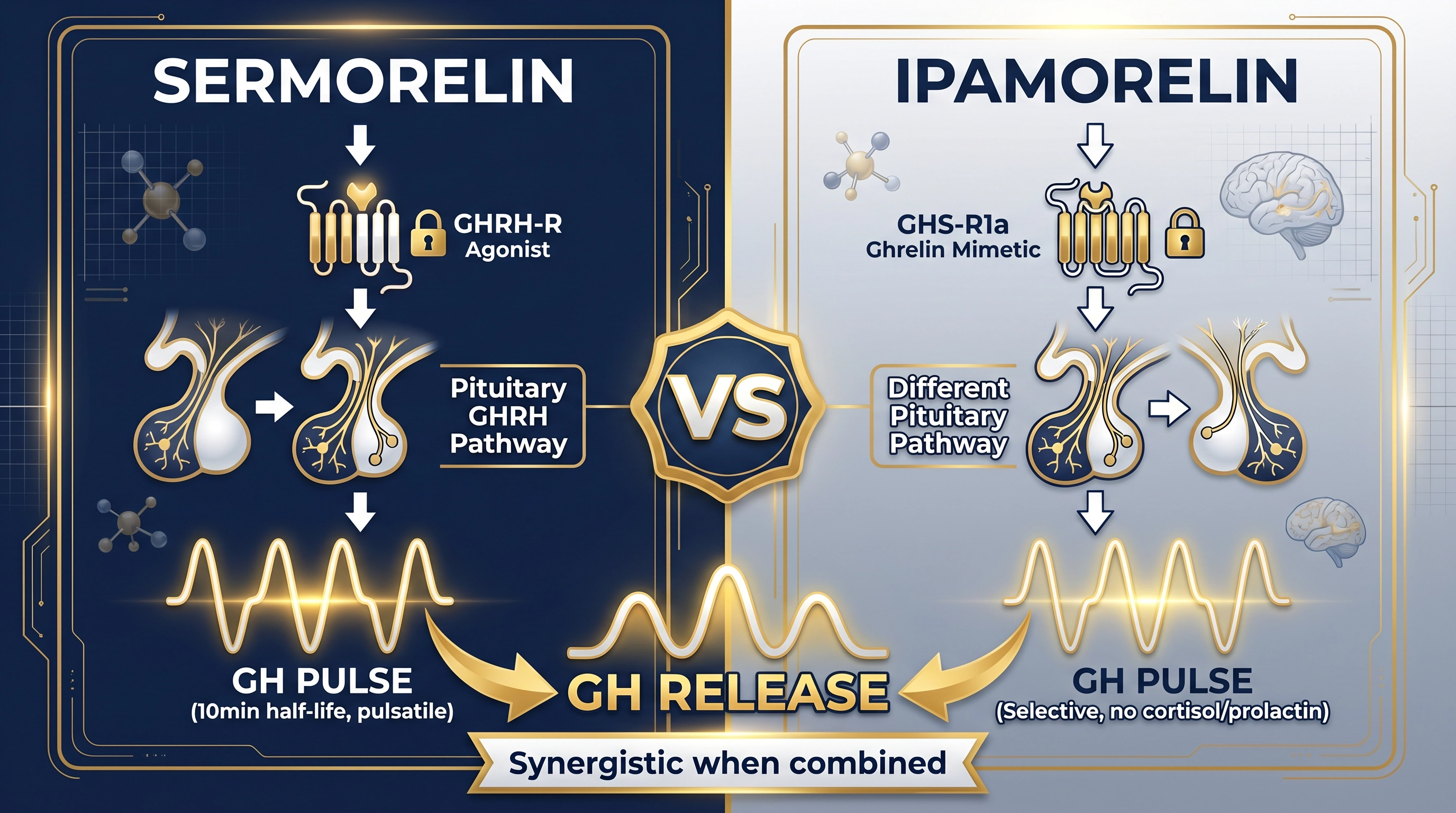
Pathway Comparison Diagram
Sermorelin agonizes GHRH-R (the GHRH receptor); Ipamorelin mimics ghrelin at GHS-R1a — different pituitary receptors that are synergistic when combined in a stack.
What the cited studies used
One row per compound: the amount and schedule administered in a specific indexed study, who received it, and the paper. These are reports of what was done in that study, not recommendations, and several are animal or single-dose studies. Where no indexed human regimen exists we say so rather than print a number. Community "stacks" and cycle schedules are not reproduced on this site.
Research use only. Compound Review scores vendors on documentation — laboratory certificates, lot records, pricing and company identity. Nothing on this page is guidance on human or veterinary use, dosing or health outcomes.
| Compound | Regimen in the study | Population | Source |
|---|---|---|---|
| Sermorelin (GHRH 1-29) | 2 mg subcutaneous, once nightly at bedtime, for 6 weeks | Eleven healthy men aged 64–76 with low baseline IGF-I | PMID 9005976 Vittone et al., Metabolism 1997 |
| Ipamorelin | No human dose-ranging trial in our reference set The 1998 paper characterises GH release in animals and in vitro; the human development programme was discontinued and its dosing is not in the indexed literature we hold. | Rat and pig pharmacology (Raun 1998; Johansen 1999) | PMID 9849822 Raun et al., Eur J Endocrinol 1998 |
Sermorelin vs Ipamorelin: Side-by-Side
| Category | Sermorelin | Ipamorelin |
|---|---|---|
| Mechanism | GHRH analog — stimulates pituitary GHRH receptor | GHSR agonist — triggers GH pulse receptor |
| GH Response | Moderate, physiological | Strong, selective, clean pulse |
| Cortisol/Prolactin | Minimal elevation | No elevation (key advantage) |
| Half-life | ~10–20 minutes | ~2 hours |
| Best For | Long-term GH axis restoration, sleep quality | Short-term GH optimization, clean pulse |
| Stacking | Excellent with Ipamorelin | Excellent with CJC-1295 or Sermorelin |
| Typical Dose | See "What the cited studies used" | See "What the cited studies used" |
| Cycling | 5 on / 2 off | 5 on / 2 off |
Source Both Peptides at Purgo Labs
Purgo Labs carries pharmaceutical-grade Sermorelin and Ipamorelin with third-party COAs. Use code HEALTH for 20% off.
Frequently Asked Questions
Can I stack Sermorelin and Ipamorelin together?
Yes — this is a highly effective combination. Sermorelin provides the GHRH signal while Ipamorelin provides the GHSR trigger. Together they produce a larger, more physiological GH pulse than either alone.
Which is better for sleep: Sermorelin or Ipamorelin?
Both improve sleep quality by restoring GH pulsatility during slow-wave sleep. Ipamorelin tends to produce more noticeable sleep improvements faster; Sermorelin's effects are more gradual but longer-lasting.
Which has fewer side effects?
Ipamorelin has the cleaner side effect profile — it is highly selective and does not elevate cortisol or prolactin. Sermorelin is also well-tolerated but may cause mild water retention at higher doses.
Calculate Your Exact Dose
Use our free peptide calculator to convert your dose into exact syringe units based on your vial concentration.
Related Resources
Related Guides
Ready to Start Your Research?
Purgo Labs provides pharmaceutical-grade research peptides with third-party COAs. Use code HEALTH for 20% off your first order.
Visit Purgo Labs