GLP-2 T
Dual GIP/GLP-1 Receptor Agonism, Glycaemic Control & Weight Reduction
Tirzepatide (sold by Purgo Labs as "GLP-2 T") — Dual GIP/GLP-1 Receptor Agonist
Last reviewed: September 2026
Tirzepatide is the molecule in Mounjaro and Zepbound. Purgo Labs sells it under the name "GLP-2 T" — the T is the only clue — so if you were expecting a GLP-2 gut peptide, this is not that. It is a once-weekly incretin drug in its approved form and a lyophilised research powder in the form sold here.
It switches on two gut-hormone receptors at once. The GLP-1 side makes the pancreas release insulin when glucose is high, damps glucagon, slows the stomach and reduces appetite. The GIP side adds a second insulin signal and appears to help with appetite and with tolerability. A fatty-acid tail keeps the molecule bound to albumin so a single dose lasts around five days.
It produced the largest weight loss of any approved medicine at the time of its approval — around 21% of body weight at the top dose over 72 weeks in SURMOUNT-1 — and beat semaglutide head-to-head in type 2 diabetes. That is why 'GLP-2 T' is one of the most searched products on vendor sites, and why identity checking on research lots matters.
Strong human evidence for the approved drug; none for any research vial. Research-grade tirzepatide is for laboratory use only. Check the lot certificate for identity and measured net content before drawing any conclusion from it.
What is GLP-2 T?
Identity note (12 September 2026): the product Purgo Labs lists as "GLP-2 T" is tirzepatide. Purgo's own listing describes it as an "acylated 39-amino-acid dual-pathway receptor agonist", its certificates carry the lot prefix PL-TR, and it is sold in 10mg and 20mg vials — none of which fits teduglutide, the GLP-2 analog an earlier version of this page described. This profile has been corrected to tirzepatide.
Tirzepatide is a 39-amino-acid synthetic peptide built on the GIP (glucose-dependent insulinotropic polypeptide) backbone and engineered to activate both the GIP receptor and the GLP-1 receptor. A C20 fatty diacid attached through a linker binds albumin and extends the half-life to about five days, which is what allows once-weekly dosing of the approved products.
It is FDA-approved as Mounjaro® (type 2 diabetes, 2022) and Zepbound® (chronic weight management, 2023; obstructive sleep apnoea in obesity, 2024). Research-grade tirzepatide sold as a lyophilised powder is not the approved product and is supplied for laboratory use only.
- "GLP-2 T" on Purgo Labs is tirzepatide (39-aa acylated dual GIP/GLP-1 agonist, lot prefix PL-TR) — not teduglutide and not a GLP-2 analog.
- FDA-approved as Mounjaro® (type 2 diabetes) and Zepbound® (obesity); the research powder sold here is not the approved product.
- SURMOUNT-1: −20.9% mean body weight at 15 mg over 72 weeks vs −3.1% placebo (Jastreboff 2022, NEJM).
- SURPASS-2: greater HbA1c and weight reduction than semaglutide 1 mg (Frías 2021, NEJM).
- Gastrointestinal adverse effects (nausea, diarrhoea, vomiting, constipation) were the most common in trials and were dose-related.
Molecular Composition
Tirzepatide is a 39-residue linear peptide based on native GIP(1-42) with substitutions taken from GLP-1 and exendin-4 sequence, α-aminoisobutyric acid (Aib) at positions 2 and 13 for protease resistance, and a C20 fatty diacid attached at Lys20 through a γ-glutamate and two 8-amino-3,6-dioxaoctanoic acid (OEG) units. Molecular weight 4,813.5 Da (C225H348N48O68). The lipid side chain is the albumin-binding element responsible for its roughly five-day half-life.
How Does It Work?
Tirzepatide activates both the GIP and GLP-1 receptors — combining glucose-dependent insulin release, appetite suppression and slowed gastric emptying with a second incretin signal — and its fatty-acid side chain keeps it in circulation for about five days.
Tirzepatide is an agonist at two incretin receptors. At the GLP-1 receptor it behaves like other GLP-1 agonists — glucose-dependent stimulation of insulin secretion, suppression of glucagon, slowed gastric emptying and reduced appetite through hypothalamic and hindbrain GLP-1 receptors. At the GIP receptor it adds a second incretin signal: GIP potentiates insulin secretion, acts on adipose tissue, and in the brain appears to contribute to reduced food intake and to blunting of GLP-1-related nausea.
Tirzepatide has an imbalanced profile — its affinity for the GIP receptor is comparable to native GIP while its GLP-1 receptor potency is roughly five-fold lower than native GLP-1, and it shows biased signalling at GLP-1R (favouring cAMP generation over β-arrestin recruitment, which reduces receptor internalisation). Whether the GIP component explains the larger weight loss seen versus semaglutide is still debated; the head-to-head trial evidence is in the references below.
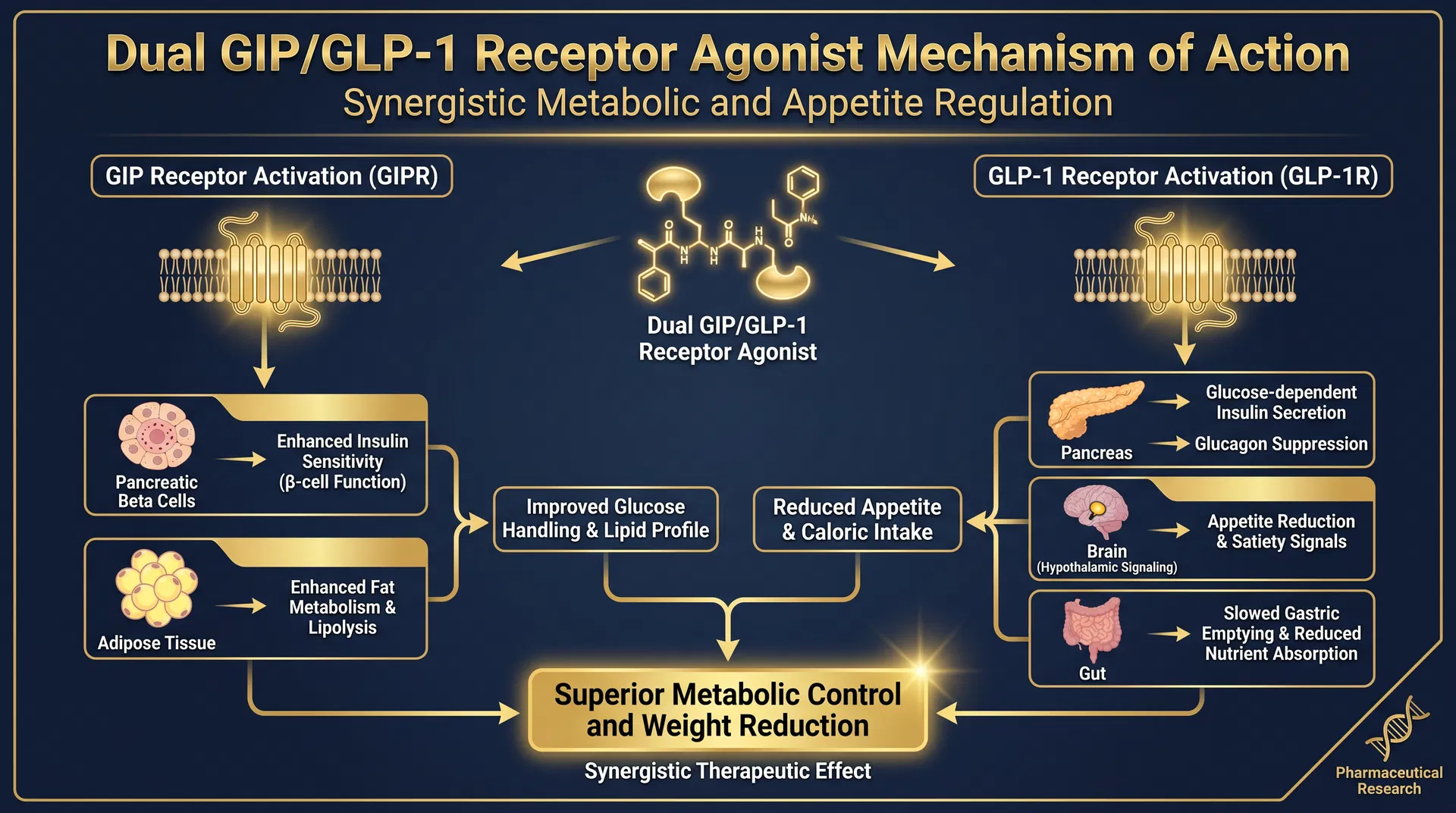
Key Research Pathways
GLP-1R / cAMP signalling
Glucose-dependent potentiation of insulin secretion, glucagon suppression, slowed gastric emptying and central appetite reduction.
GIPR signalling
Second incretin input on β-cells and adipose tissue; central GIPR activity is implicated in food-intake reduction and in reducing GLP-1-related nausea.
Biased GLP-1R agonism
Favours cAMP over β-arrestin recruitment, reducing receptor internalisation and prolonging signalling.
Albumin binding
The C20 fatty-diacid side chain binds serum albumin, giving a half-life of about five days and once-weekly dosing in the approved products.
Key Findings from the Literature
- FDA-approved as Mounjaro® (type 2 diabetes, 2022) and Zepbound® (chronic weight management, 2023)
- SURMOUNT-1 (n=2,539, 72 weeks): mean weight change −15.0%, −19.5% and −20.9% at 5, 10 and 15 mg vs −3.1% placebo
- SURPASS-2: superior HbA1c and weight reduction versus semaglutide 1 mg in type 2 diabetes
- Dual GIP/GLP-1 receptor agonism with a C20 fatty-diacid albumin anchor (half-life ≈5 days)
- Most common adverse effects in trials were gastrointestinal (nausea, diarrhoea, constipation), dose-related and mostly transient
- Research-grade product is not the approved formulation; identity and net content should be confirmed on the lot certificate
Evidence by Claimed Outcome
Each outcome rated by the highest level of evidence available. Tiers follow our 5-tier methodology.
Study counts reflect peer-reviewed publications in the evidence database below. "Theoretical" outcomes have mechanistic rationale only. Learn about our evidence tiers →
Important Research Context
Research References
Peer-reviewed literature supporting the research profile of GLP-2 T
The following peer-reviewed studies form the primary evidence base for GLP-2 T's research profile. All references are sourced from PubMed, NCBI, and peer-reviewed scientific journals. Published research is available through PubMed, NCBI, and peer-reviewed biomedical journals.
- 1.
Frias JP, et al. Tirzepatide versus Semaglutide Once Weekly in Patients with Type 2 Diabetes. New England Journal of Medicine. 2021.PMID: 34170647
Tirzepatide (GLP-2-T) demonstrated superior HbA1c reduction and weight loss versus semaglutide in SURPASS-2 trial.
- 2.
Jastreboff AM, et al. Tirzepatide Once Weekly for the Treatment of Obesity. New England Journal of Medicine. 2022.PMID: 35658024
SURMOUNT-1: tirzepatide achieved up to 22.5% body weight reduction — among the highest reported for any pharmacological intervention.
- 3.
Nauck MA, D'Alessio DA. Tirzepatide, a dual GIP/GLP-1 receptor co-agonist for the treatment of type 2 diabetes with unmatched effectiveness. Cardiovascular Diabetology. 2022.PMID: 36050763
Mechanistic review of dual GIP/GLP-1 receptor co-agonism explaining tirzepatide's superior efficacy.
GLP-2 T
Metabolic Research
Purgo Labs list price, read 12 Sep 2026 · per-lot COA on the vendor page
10mg $49.99 → $39.99 with code HEALTH (20% off; price read 2 Oct 2026)
- 1 certificate verified at the lab10mg$49.99→ $39.99
- 2 certificates verified at the lab10mg$57.15$39.99→ $35.99
- 1 certificate verified at the lab30mg$59.99→ $47.99
Fast FedEx shipping · Discreet packaging
Technical Specifications
| Peptide Class | Dual GIP/GLP-1 receptor agonist (39 amino acids, lipidated) |
| Molecular Weight | 4,813.5 Da |
| FDA Approval | Mounjaro® (T2D, 2022) · Zepbound® (obesity, 2023) |
| Receptor Targets | GIP receptor and GLP-1 receptor |
| Key Modification | Aib2/Aib13 + C20 diacid on Lys20 (albumin binding) |
| Available Sizes | 10mg and 20mg vials |
| Form | Lyophilized powder |
| Purity | 99%+ per lot certificate (Freedom Diagnostics; e.g. lot PL-TR10-06) |
View full legal status guide →
Source GLP-2 T at Purgo Labs
10mg $49.99 list · $39.99 with code HEALTH · lab-verifiable COA per lot
Other Compounds in This Guide



Related Research Guides
Supporting Research
Tirzepatide has large Phase 3 human RCT support (SURPASS in type 2 diabetes, SURMOUNT in obesity) including a head-to-head trial against semaglutide. Claims about the approved drug can be stated with confidence when cited; none of it validates a research-grade vial.
References
- Jastreboff AM, et al. (SURMOUNT-1)[HUMAN RCT, n=2539]Up to 22.5% (15 mg) mean weight loss at 72 weeks in adults with obesity.
- Frías JP, et al. (SURPASS-2)[HUMAN RCT, head-to-head]Superior HbA1c and body-weight reduction vs semaglutide 1 mg in type 2 diabetes.
Research Databases
Ready to Source GLP-2 T?
Purgo Labs offers GLP-2 T with ≥99% purity, third-party certificates of analysis, and fast FedEx shipping. This is an affiliate link — we may earn a commission at no cost to you.