Research Purposes Only. Semaglutide is sold by research vendors strictly for qualified laboratory research use only. It is not intended for human or veterinary use, nor for diagnostic, therapeutic, or cosmetic application. Statements on this page have not been evaluated by the FDA.
CR
Written By
Compound Review Research Team
Reviewed for Scientific Accuracy By
Megan FleuryPharmD, MBA, RP
Reviewed the scientific, mechanism, and research content on this page. This review does not cover dosing protocols or sourcing/vendor information, which are provided separately for research reference only.
Semaglutide is the compound inside Ozempic, Wegovy and Rybelsus. It copies the gut hormone GLP-1 but lasts a week instead of minutes, which is why it became the most prescribed weight-management drug in the world. Research vendors sell a lyophilised version under codes like GLP-1 S; it is not the approved product.
What It Does
It makes the pancreas release insulin when blood sugar is high, lowers glucagon, slows how fast food leaves the stomach, and acts on the brain to reduce appetite. The trials of the approved drug measured about 15% body weight loss at 68 weeks in obesity and a 20% reduction in major cardiovascular events.
Why It Matters
It is the reference compound every other GLP-class peptide is compared against, and the one with the deepest evidence. That evidence belongs to the pharmaceutical product; the research vial has none of its own.
The Bottom Line
Strong human evidence for the approved drug; none for any research vial. If you are sourcing it for laboratory work, the only things you can verify are what the vendor says it is, what the lab certificate says is in it, and what it costs — which is what the rest of this page is for.
Overview
What is Semaglutide?
Semaglutide is a once-weekly GLP-1 receptor agonist developed by Novo Nordisk. It is FDA-approved as Ozempic (type 2 diabetes, 2017), Rybelsus (oral, 2019) and Wegovy (chronic weight management, 2021; cardiovascular risk reduction in adults with overweight or obesity, 2024). Those are prescription medicines made under pharmaceutical controls. Research-grade semaglutide sold as a lyophilised powder is a different product: it is not approved, not reviewed for quality, and sold for in-vitro laboratory use only.
Identity note (updated 14 October 2026): since the 2025–26 enforcement wave most research vendors do not list semaglutide by name. Purgo Labs sells it as "GLP-1" (product handle /products/semaglutide, certificate lot prefix PL-SM); other vendors use GLP-1 S, GLP-1 SM, VRC-1S, PS-S1 and similar house codes. The decoder on this page shows what each vendor calls it and whether the vendor itself states the identity.
Semaglutide is a 31-residue analogue of native GLP-1(7-37). Two substitutions and a C18 fatty diacid side chain protect it from DPP-4 cleavage and bind it to albumin, taking the half-life from about two minutes for the native hormone to roughly one week.
Key Takeaways
Semaglutide is a once-weekly GLP-1 receptor agonist; FDA-approved as Ozempic (2017), Rybelsus (2019) and Wegovy (2021), with a cardiovascular indication added in 2024.
STEP 1: −14.9% body weight at 68 weeks on 2.4 mg vs −2.4% placebo (n=1,961). SELECT: 20% relative reduction in major adverse cardiovascular events (n=17,604).
Mechanism: glucose-dependent insulin secretion, glucagon suppression, slowed gastric emptying and central appetite reduction through GLP-1R; a C18 fatty diacid side chain gives it a one-week half-life.
Research vendors sell it under codes (GLP-1 S, GLP-1 SM, VRC-1S, PS-S1); a code is only an identity when the vendor states it on the listing, on its COA page or in its FAQ.
Research-grade semaglutide is not the approved product and the trial evidence does not transfer to it. Verify the lot certificate at the laboratory before relying on it.
Composition
Molecular Composition
Amino Acid Sequence
His-Aib-Glu-Gly-Thr-Phe-Thr-Ser-Asp-Val-Ser-Ser-Tyr-Leu-Glu-Gly-Gln-Ala-Ala-Lys(C18 diacid via γGlu-2×OEG)-Glu-Phe-Ile-Ala-Trp-Leu-Val-Arg-Gly-Arg-Gly (31 AA; Aib8, Arg34 vs native GLP-1)
Semaglutide is a 31-residue analog of GLP-1(7-37) with two substitutions — α-aminoisobutyric acid at position 8 (blocking DPP-IV cleavage) and arginine at position 34 — and a C18 fatty diacid attached to Lys26 through a γ-glutamate/OEG linker, which binds albumin and extends the half-life to about one week. Molecular weight 4,113.6 Da.
For background: GLP-1 (7-36 amide) is the biologically active form of native GLP-1, consisting of 30 amino acids (residues 7–36 of the full proglucagon-derived peptide) with a C-terminal amide group. The amide group is essential for full GLP-1 receptor binding activity. The molecular weight is 3,297.7 Daltons.
Native GLP-1 has an extremely short half-life of approximately 1–2 minutes in vivo due to rapid cleavage by dipeptidyl peptidase IV (DPP-IV) at the His⁷-Ala⁸ bond, and by neutral endopeptidase (NEP). This rapid degradation is the primary limitation of native GLP-1 as a therapeutic agent and has driven the development of DPP-IV-resistant analogs.
Mechanism of Action
How Does It Work?
!
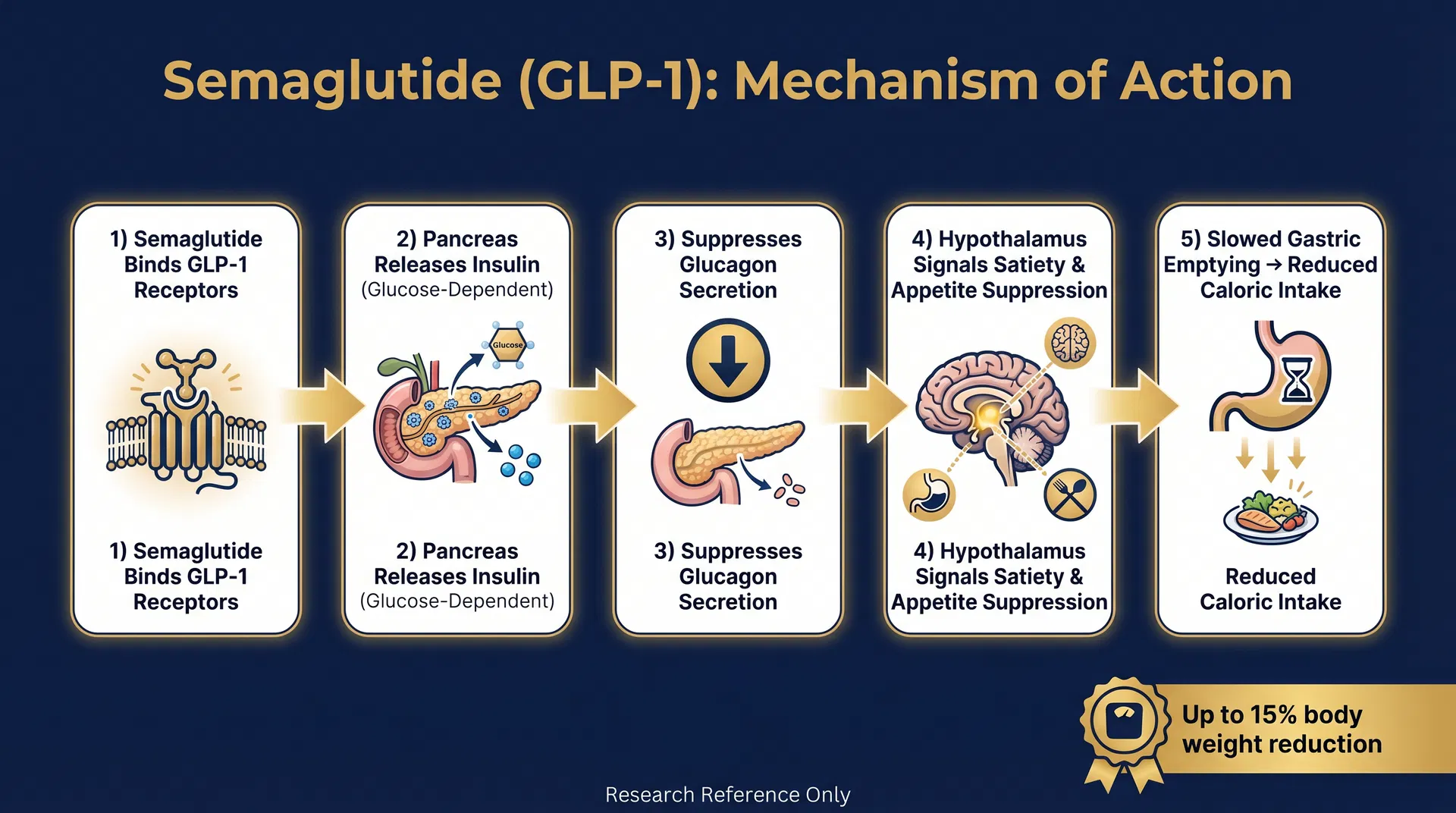
Semaglutide activates GLP-1 receptors in the pancreas, gut and brain: insulin rises only when glucose is high, glucagon falls, gastric emptying slows, and appetite drops — for a week per dose.
Semaglutide binds the GLP-1 receptor (GLP-1R), a class B G-protein-coupled receptor on pancreatic beta cells, in the gut, heart, kidney and central nervous system. Receptor activation stimulates adenylyl cyclase through Gαs, raising intracellular cAMP and engaging PKA and EPAC signalling.
In beta cells this potentiates glucose-stimulated insulin secretion only when glucose is elevated, which is why GLP-1 receptor agonists carry low intrinsic hypoglycaemia risk. Semaglutide also suppresses glucagon release from alpha cells, slows gastric emptying, and acts on hypothalamic and brainstem GLP-1R to reduce appetite and food intake. The albumin-bound depot created by the fatty diacid chain is what makes once-weekly exposure possible; native GLP-1 is cleared within minutes.
Semaglutide Mechanism of Action — Simplified signaling pathway diagram. For research reference only.
"In participants with overweight or obesity, 2.4 mg of semaglutide once weekly plus lifestyle intervention was associated with sustained, clinically relevant reduction in body weight." — Wilding et al., STEP 1, New England Journal of Medicine, 2021
Signaling Pathways
Key Research Pathways
GLP-1R / cAMP / PKA Signaling
Activates GLP-1R on beta cells, stimulating adenylyl cyclase → cAMP → PKA/EPAC cascade that potentiates glucose-stimulated insulin secretion.
Glucose-Dependent Insulin Secretion
Insulin secretion is potentiated only in the presence of elevated blood glucose, providing an inherent safety mechanism against hypoglycemia.
Glucagon Suppression
Inhibits alpha cell glucagon secretion, reducing hepatic glucose output and contributing to postprandial glucose control.
Central Appetite Regulation
Hypothalamic GLP-1R activation reduces food intake and body weight through central satiety signaling pathways.
Research Highlights
Key Findings from the Literature
STEP 1 (Wilding et al., NEJM 2021, n=1,961): −14.9% mean body weight at 68 weeks on 2.4 mg weekly vs −2.4% placebo
SELECT (Lincoff et al., NEJM 2023, n=17,604): 20% relative reduction in major adverse cardiovascular events in adults with overweight or obesity without diabetes
SUSTAIN-6 (Marso et al., NEJM 2016, n=3,297): 26% relative reduction in the primary cardiovascular composite in type 2 diabetes
STEP 2 (Davies et al., Lancet 2021, n=1,210): −9.6% body weight at 68 weeks in type 2 diabetes on 2.4 mg
Glucose-dependent insulin secretion and glucagon suppression; slowed gastric emptying; central appetite reduction
Once-weekly exposure from a C18 fatty diacid side chain that binds albumin; native GLP-1 half-life is about two minutes
Outcome Matrix
Evidence by Claimed Outcome
Each outcome rated by the highest level of evidence available. Tiers follow our 5-tier methodology.
StrongModeratePreliminaryPreclinicalTheoretical
Claimed Outcome
Evidence Tier
Studies
Key Evidence Note
Weight reduction (≥5% body weight)
Strong
18
Multiple Phase III RCTs (SUSTAIN, STEP trials) confirm 10–15% weight loss
Glycemic control (T2D)
Strong
25
FDA-approved indication; HbA1c reduction of 1.5–2.0%
Cardiovascular risk reduction
Strong
8
LEADER trial (n=9,340) showed 13% reduction in MACE
Appetite suppression
Strong
12
GLP-1R agonism in hypothalamus confirmed in multiple mechanistic studies
Non-alcoholic fatty liver disease
Moderate
4
Phase II data shows liver fat reduction; Phase III ongoing
Study counts reflect peer-reviewed publications in the evidence database below. "Theoretical" outcomes have mechanistic rationale only. Learn about our evidence tiers →
How Long It Lasts & How It Works in the Body
Semaglutide — half-life, bioavailability, onset, and duration data
Subcutaneous (SC)
Parameter
Value
Source
Half-Life (t½)
~168 hours (7 days)
Range: 155–184 hours
Enables once-weekly dosing
Prescribing Information
Time to Peak (Tmax)
1–3 days
After subcutaneous injection
Prescribing Information
Bioavailability (F)
~89%
Subcutaneous injection; oral semaglutide is ~1%
Prescribing Information
Protein Binding
>99%
Primarily albumin-bound
Prescribing Information
Volume of Distribution (Vd)
~12.5 L
Prescribing Information
Elimination
Proteolytic cleavage; renal/fecal excretion
Prescribing Information
Onset of Action
1–2 weeks
Meaningful glucose reduction; weight loss effects emerge over 4–12 weeks
—
Duration of Action
7 days per dose
Steady state reached after 4–5 weeks
—
Steady-state plasma concentration achieved after 4–5 weekly doses. Half-life is the longest of approved GLP-1 agonists, enabling once-weekly dosing.
References:
• Ozempic US Prescribing Information 2023
• Wegovy US Prescribing Information 2023
Researcher Notes
Important Research Context
Semaglutide has the largest human evidence base of any compound on this site: the STEP programme in obesity, the SUSTAIN programme in type 2 diabetes, and the SELECT cardiovascular outcomes trial. Every efficacy figure on this page comes from those trials of the approved pharmaceutical product. None of it was generated with a research-grade vial, and none of it transfers to one.
What a research buyer can check is identity and content: whether the vendor states that its coded product is semaglutide (CAS 910463-68-2), whether the certificate for the lot names the laboratory and is viewable on that laboratory's own site, and whether the measured net content matches the label. The vendor rows below are ordered by our evidence rubric, not by price.
Regulatory context: the FDA has issued public warnings about unapproved and compounded semaglutide and has sent warning letters to online sellers; enforcement escalated through 2025–26. Research-grade semaglutide is not a substitute for a prescribed medicine.
Research References
Peer-reviewed literature supporting the research profile of Semaglutide
The following peer-reviewed studies form the primary evidence base for Semaglutide's research profile. All references are sourced from PubMed, NCBI, and peer-reviewed scientific journals. Published research is available through PubMed, NCBI, and peer-reviewed biomedical journals.
1.
Wilding JPH, et al. Once-Weekly Semaglutide in Adults with Overweight or Obesity (STEP 1). New England Journal of Medicine. 2021.PMID: 33567185
−14.9% mean body weight at 68 weeks on semaglutide 2.4 mg weekly vs −2.4% with placebo; 86.4% achieved ≥5% loss.
2.
Lincoff AM, et al. Semaglutide and Cardiovascular Outcomes in Obesity without Diabetes (SELECT). New England Journal of Medicine. 2023.PMID: 37952131
20% relative reduction in major adverse cardiovascular events over a mean 39.8 months in 17,604 adults with overweight or obesity.
3.
Marso SP, et al. Semaglutide and Cardiovascular Outcomes in Patients with Type 2 Diabetes (SUSTAIN-6). New England Journal of Medicine. 2016.PMID: 27633186
26% relative reduction in the primary composite of cardiovascular death, non-fatal MI or non-fatal stroke.
4.
Davies M, et al. Semaglutide 2.4 mg once a week in adults with overweight or obesity, and type 2 diabetes (STEP 2). The Lancet. 2021.PMID: 33667417
−9.6% body weight at 68 weeks on 2.4 mg vs −3.4% placebo in adults with type 2 diabetes.
5.
Holst JJ. The physiology of glucagon-like peptide 1. Physiological Reviews. 2007.PMID: 17928588
Reference review of GLP-1 physiology: pancreatic, gastrointestinal, cardiovascular and central effects.
Both are GLP-1 receptor agonists. Combining significantly increases risk of severe hypoglycemia, pancreatitis, and GI adverse effects. Contraindicated.
Both affect fat metabolism. AOD-9604 via lipolysis; semaglutide via appetite suppression and metabolic effects. Theoretical additive effect — monitor for excessive fat loss.
BPC-157 may support GI health and reduce nausea during GLP-1 therapy. Different primary targets with no known negative interaction.
Emerging evidence
Interaction data is based on published research, known pharmacological mechanisms, and clinical practitioner experience. Evidence tiers: Clinical = human data; Emerging = preclinical/case reports; Theoretical = mechanism-based inference. Always consult a qualified healthcare provider before combining compounds.
Since the 2025–26 enforcement wave almost no vendor lists semaglutide by name. These are the 17 house codes we have read on vendor pages. 9 of them come with a stated identity (a CAS number, a lab lot prefix on the vendor's certificate page, or the vendor's own FAQ); the rest are codes only, and we keep those out of the price table.
Approved drug (Ozempic / Wegovy) with large randomised trials — figures below are from those trials, not from research-grade vials
Semaglutide has one of the best-characterised safety profiles of any compound on this site because it is an approved medicine studied in tens of thousands of trial participants. The dominant adverse effects are gastrointestinal and dose-related. None of that data was generated with research-grade vials, whose identity and dose are not verified by any regulator.
Research-use information only. Research-grade Semaglutide is not an approved medicine; where trial or label figures appear below they belong to the pharmaceutical product studied, not to any research vial. This section does not give dosing or medical advice.
What is reported
Every rate carries its source. Where no source exists, no rate is printed.
Effect
Rate (sourced)
Detail
Source
Nausea
44.2% vs 17.0% placebo
Most frequent during dose escalation; mostly mild-to-moderate.
STEP 1, Wilding et al. 2021
Diarrhoea
31.5% vs 15.9%
Typically transient.
STEP 1
Vomiting
24.8% vs 6.6%
Dose-related.
STEP 1
Constipation
23.4% vs 9.5%
—
STEP 1
Discontinuation for GI events
4.5% vs 0.8%
—
STEP 1
Gallbladder events, pancreatitis
not quantified
Uncommon but recognised class risks carried on the label.
Wegovy prescribing information
Diabetic retinopathy complications
not quantified
Signal seen in SUSTAIN-6 in people with diabetes and pre-existing retinopathy.
Marso et al. 2016
What is not known
•Whether a given research vial contains semaglutide at the labelled dose — research-grade products are not the studied medicine.
•Long-term effects beyond the trial durations (up to ~2 years).
Mechanism-based cautions
•Boxed warning for thyroid C-cell tumours (rodent finding; contraindicated with personal or family history of MTC / MEN2).
•Hypoglycaemia when combined with insulin or sulfonylureas.
•Acute kidney injury reported secondary to dehydration from GI effects.
Regulatory status: FDA-approved as Ozempic (T2D, 2017) and Wegovy (chronic weight management, 2021). Research-grade semaglutide is not approved for any use.
Side-effect references
Wilding JPH, et al. Once-weekly semaglutide in adults with overweight or obesity (STEP 1). New England Journal of Medicine, 2021. PMID 33567185.
Marso SP, et al. Semaglutide and cardiovascular outcomes in patients with type 2 diabetes (SUSTAIN-6). New England Journal of Medicine, 2016.
What is actually in a research vial
Everything above describes Semaglutide the molecule. The risk specific to a research vial is different: it may not contain Semaglutide at the labelled amount, and it may contain what the synthesis left behind. Identity (mass spectrometry), purity (HPLC), measured net content and an endotoxin result are the four lines on a certificate that bear on adverse effects, and only a certificate you can check at the laboratory tells you any of them. This is what we have verified for Semaglutide so far.
Who sells Semaglutide, and what they document
12 of the 80 vendors on our scoreboard list Semaglutide with a price we read on the product page (5 Sept 2026–10 Oct 2026). Of those, 11 name their testing laboratory, 10 publish certificates that resolve on the lab's own site, and 11 publish measured milligrams against the label. The full ranking, with every dated price, is on Best Semaglutide Vendors.
Top 5 by rubric score; 7 more on the ranking page.
Semaglutide certificates we have opened
1 certificate for Semaglutide in the COA library: 0 checkable on the laboratory's own site, 0 stating measured mass against the label, 1 carrying a flag.
Simple Peptide· 10mg · lot P24102404 · Freedom Diagnostics Search Code simp2503240009 (accession 2503240009)· 99.92% purity· vendor-hosted onlyTested >12 months before we read itNo measured mass on the certificate
Side-effect questions
Do research-grade semaglutide vials have the same side effects as Wegovy?
The pharmacology is the same if the vial contains what it claims. The difference is that nobody has verified that: a research vial may be under- or over-dosed or misidentified, which changes the risk in ways no trial has measured. Our vendor pages show which sellers publish lab-verified net content.
How long do the GI effects last?
In STEP 1 they clustered around dose-escalation steps and mostly resolved; a minority discontinued for GI reasons (4.5%).
Side-effect section last reviewed 2026-09-12. Moved from the standalone side-effects page on 10 October 2026; text unchanged.
Regulatory
Is Semaglutide legal?
FDA-approved (prescription only)
Semaglutide is FDA-approved as Ozempic (type 2 diabetes), Wegovy (weight management), and Rybelsus (oral, type 2 diabetes). Research-grade semaglutide is available as a research chemical. It is not a controlled substance but requires a prescription for clinical human use.
US Status
Research Chemical
Legal to purchase for research
DEA Schedule
Not Scheduled
Not a controlled substance
FDA Status
Not Approved
FDA-approved as Ozempic, Wegovy, Rybelsus (prescription required)
Status by country
Jurisdiction
Status as stated
United States
FDA-approved as Ozempic, Wegovy, and Rybelsus. Not a controlled substance. Research-grade semaglutide is available as a research chemical for laboratory research. The FDA has issued guidance on compounded semaglutide.
Canada
Approved by Health Canada as Ozempic and Wegovy. Available by prescription.
United Kingdom
Licensed by the MHRA as Ozempic and Wegovy. Available by prescription.
Australia
Approved by the TGA as Ozempic and Wegovy. Available by prescription.
European Union
Approved by the EMA as Ozempic and Wegovy. Available by prescription across EU member states.
Statements above are as our legal-status page for Semaglutide stated them in 2025; they were moved here on 10 October 2026 and were not re-verified in the move. Regulations change. This is general information, not legal advice; check the current position with your own jurisdiction's regulator before relying on it.
Legal questions
Is semaglutide a controlled substance?
No. Semaglutide is not listed as a controlled substance under the DEA Controlled Substances Act. It is a prescription drug but not scheduled.
Is research semaglutide legal?
Yes. Research-grade semaglutide is available as a research chemical for legitimate laboratory research purposes. It is not the same as prescription Ozempic or Wegovy.
Can compounding pharmacies make semaglutide?
The FDA has issued guidance on this. During drug shortages, compounding pharmacies were permitted to compound semaglutide. As the shortage resolves, the FDA has moved to restrict compounding of semaglutide.
Is semaglutide the same as Ozempic?
Semaglutide is the active ingredient in Ozempic, Wegovy, and Rybelsus. Research-grade semaglutide has the same molecular structure but is produced for laboratory research purposes only.
Is semaglutide legal in the UK?
Yes. Semaglutide is licensed as Ozempic and Wegovy in the UK and is available by prescription. Research-grade semaglutide is available for research purposes.
Strong Human Evidencelarge human RCTs — multiple Phase 3 trials
GLP-1 receptor agonists are among the most rigorously studied compounds in modern endocrinology. Large randomized controlled trials in humans establish both weight-loss efficacy and cardiovascular benefit for GLP-1R agonists. Claims about GLP-1 receptor biology can be stated with high confidence when tied to these trials.
~20% reduction in major adverse cardiovascular events vs placebo in adults with overweight/obesity without diabetes.
Research Databases
PubMedNCBIClinicalTrials.gov
Ready to Source Semaglutide?
Purgo Labs offers Semaglutide with ≥99% purity, third-party certificates of analysis, and fast FedEx shipping. This is an affiliate link — we may earn a commission at no cost to you.