Glutathione
Cellular Redox Homeostasis & Detoxification
L-Glutathione Reduced — Master Cellular Antioxidant
Last reviewed: August 2026
Glutathione is often called the body's 'master antioxidant' — and that's not marketing language, it's biochemistry. It's a tripeptide (three amino acids: glutamate, cysteine, and glycine) that your body produces in every cell, and it's the primary molecule your cells use to neutralize oxidative stress, detoxify harmful compounds, and recycle other antioxidants like vitamins C and E.
Glutathione works through two main mechanisms. First, it directly neutralizes reactive oxygen species (ROS) — the unstable molecules that damage DNA, proteins, and cell membranes. Second, it's the primary substrate for glutathione S-transferase enzymes, which are your liver's main detoxification machinery. It also regenerates oxidized vitamin C back to its active form. Glutathione levels decline with age, chronic illness, and environmental toxin exposure, which is why it's a key biomarker in aging and disease research.
Oxidative stress is implicated in virtually every major chronic disease — cardiovascular disease, neurodegeneration, cancer, and diabetes. Glutathione is the frontline defense against it. Research into glutathione depletion and supplementation is relevant to understanding aging, liver disease, immune function, and the mechanisms of many drug toxicities (acetaminophen overdose, for example, kills liver cells by depleting glutathione).
Glutathione is the most abundant antioxidant in the human body and one of the most important molecules in cellular health. Its role in detoxification, immune function, and oxidative stress management makes it a cornerstone of longevity and disease research. The research-grade lyophilized form supplied by Purgo Labs is for laboratory use only.
What is Glutathione?
Glutathione (GSH) is a tripeptide consisting of glutamic acid, cysteine, and glycine, connected by an unusual gamma-peptide bond between the glutamate and cysteine residues. It is the most abundant intracellular antioxidant in mammalian cells, with concentrations ranging from 1–10 mM in the cytoplasm, and is often referred to as the "master antioxidant" due to its central role in cellular redox homeostasis.
Unlike most antioxidants, glutathione is synthesized endogenously by virtually all cell types and can be regenerated from its oxidized form (GSSG) by glutathione reductase using NADPH as a cofactor. This regeneration capacity makes glutathione a renewable, catalytic antioxidant system rather than a consumable one — a key distinction in understanding its biological significance.
- Glutathione (GSH) is the most abundant intracellular antioxidant, present at 1–10 mM concentrations in most cells, existing in reduced (GSH) and oxidized (GSSG) forms — the GSH:GSSG ratio is a primary indicator of cellular redox status.
- Functions as a cofactor for glutathione peroxidases (GPx1-8) that neutralize hydrogen peroxide and lipid hydroperoxides, and for glutathione S-transferases (GSTs) that conjugate electrophilic toxins for excretion.
- Nrf2 (nuclear factor erythroid 2-related factor 2) is the master transcription factor regulating glutathione synthesis genes (GCLC, GCLM, GSS) — Nrf2 activation is a key upstream target for boosting endogenous GSH.
- Oral glutathione has poor bioavailability due to intestinal hydrolysis by γ-glutamyltranspeptidase; IV, liposomal, and subcutaneous routes bypass this limitation and are the primary delivery methods in research.
- N-acetylcysteine (NAC) is a glutathione precursor that provides cysteine (the rate-limiting amino acid for GSH synthesis) and is often compared to direct GSH administration in research protocols.
Molecular Composition
Reduced glutathione (GSH) is a tripeptide with the sequence γ-Glu-Cys-Gly. The gamma-peptide bond between glutamate and cysteine (rather than the standard alpha-peptide bond) is a critical structural feature: it protects glutathione from degradation by most intracellular peptidases, which cleave alpha-peptide bonds. This unusual linkage is also why glutathione synthesis requires two dedicated enzymes (glutamate-cysteine ligase and glutathione synthetase) rather than the ribosomal machinery used for standard protein synthesis.
The thiol group (-SH) of the cysteine residue is the functionally active site of glutathione, serving as the electron donor in antioxidant reactions. The molecular weight is 307.32 Daltons.
How Does It Work?
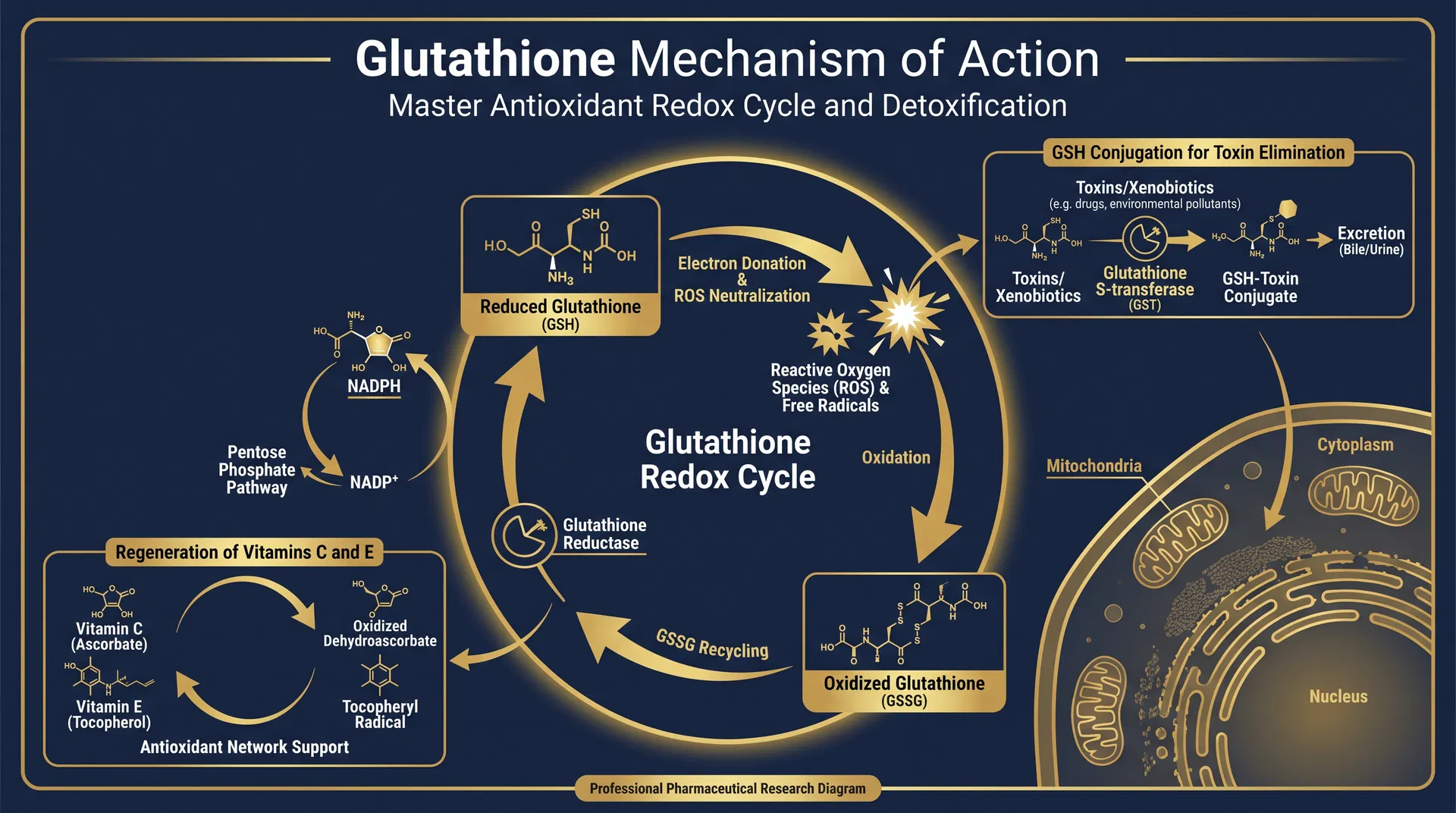
Glutathione neutralizes free radicals and regenerates other antioxidants by donating electrons to reactive oxygen species, then recycling itself using NADPH.
Glutathione exerts its antioxidant effects through multiple mechanisms. In its primary antioxidant role, GSH donates electrons to neutralize reactive oxygen species (ROS) and reactive nitrogen species (RNS), becoming oxidized to glutathione disulfide (GSSG). GSSG is then reduced back to GSH by glutathione reductase using NADPH, completing the catalytic cycle.
As a cofactor for glutathione peroxidases (GPx), GSH facilitates the reduction of hydrogen peroxide (H₂O₂) and organic hydroperoxides to water and alcohols, respectively — a critical defense against lipid peroxidation and oxidative DNA damage. As a substrate for glutathione S-transferases (GSTs), GSH is conjugated to electrophilic xenobiotics and endogenous metabolites, facilitating their excretion and detoxification.
GSH also maintains the redox state of protein thiol groups through thiol-disulfide exchange reactions, protecting enzymes and structural proteins from oxidative inactivation.
Key Research Pathways
ROS/RNS Neutralization
Donates electrons to neutralize reactive oxygen and nitrogen species, becoming GSSG; regenerated by glutathione reductase/NADPH.
Glutathione Peroxidase (GPx) Cofactor
Enables GPx-mediated reduction of H₂O₂ and organic hydroperoxides, protecting against lipid peroxidation and oxidative DNA damage.
Phase II Detoxification (GST)
Conjugated to electrophilic xenobiotics and endogenous metabolites by glutathione S-transferases, facilitating renal and biliary excretion.
Protein Thiol Protection
Maintains protein cysteine residues in reduced state via thiol-disulfide exchange, preserving enzyme activity and structural protein integrity.
Key Findings from the Literature
- Most abundant intracellular antioxidant (1–10 mM cytoplasmic concentration) — the 'master antioxidant'
- Catalytic antioxidant system: regenerated from GSSG by glutathione reductase/NADPH
- GSH/GSSG ratio is a primary indicator of cellular redox state and oxidative stress
- Cofactor for glutathione peroxidases (GPx) — critical defense against lipid peroxidation and oxidative DNA damage
- Substrate for glutathione S-transferases (GSTs) — primary phase II detoxification enzyme system
- GSH depletion is a hallmark of aging, neurodegeneration, and chronic inflammatory disease
- Maintains protein thiol redox state, protecting enzymes from oxidative inactivation
Evidence by Claimed Outcome
Each outcome rated by the highest level of evidence available. Tiers follow our 5-tier methodology.
Study counts reflect peer-reviewed publications in the evidence database below. "Theoretical" outcomes have mechanistic rationale only. Learn about our evidence tiers →
Important Research Context
Research References
Peer-reviewed literature supporting the research profile of Glutathione
The following peer-reviewed studies form the primary evidence base for Glutathione's research profile. All references are sourced from PubMed, NCBI, and peer-reviewed scientific journals. Published research is available through PubMed, NCBI, and peer-reviewed biomedical journals.
- 1.
Pizzorno J. Glutathione!. Integrative Medicine: A Clinician's Journal. 2014.PMID: 26770075
Comprehensive review of glutathione's role as the body's master antioxidant and detoxification agent.
- 2.
Weschawalit S, et al. Glutathione and its antiaging and antimelanogenic effects. Clinical, Cosmetic and Investigational Dermatology. 2017.PMID: 28490897
Oral glutathione supplementation reduced melanin index and improved skin elasticity in a randomized controlled trial.
- 3.
Sinha R, et al. Oral supplementation with liposomal glutathione elevates body stores of glutathione and markers of immune function. European Journal of Clinical Nutrition. 2018.PMID: 28853742
Liposomal glutathione delivery significantly elevated blood glutathione levels versus standard oral supplementation.
Glutathione
Longevity Research
Purgo Labs list price, read 12 Sep 2026 · per-lot COA on the vendor page
Use code HEALTH for 20% off
Fast FedEx shipping · Discreet packaging
Technical Specifications
| Compound Class | Tripeptide (γ-Glu-Cys-Gly) — not a standard peptide bond |
| Molecular Weight | 307.32 Da |
| Active Site | Cysteine thiol group (-SH) |
| Intracellular Concentration | 1–10 mM (cytoplasm) |
| Redox Forms | GSH (reduced) / GSSG (oxidized) |
| Available Sizes | 200mg vials |
| Form | Lyophilized powder |
| Purity | ≥99% (third-party tested) |
View full legal status guide →
Source Glutathione at Purgo Labs
≥99% purity · Third-party COA · Use code HEALTH for 20% off
Other Compounds in This Guide


Related Research Guides
Supporting Research
Oral glutathione precursors (N-acetyl cysteine, liposomal GSH) have moderate human evidence for raising intracellular glutathione levels. IV glutathione efficacy claims for skin whitening, detoxification, and systemic disease are not established by rigorous human RCTs.
References
- Richie JP Jr, et al.HUMAN RCTOral glutathione supplementation (250-1000 mg/day) significantly increased glutathione levels in blood, erythrocytes, and lymphocytes vs placebo over 6 months.
- Sinha R, et al.HUMAN RCTEuropean Journal of Clinical Nutrition. 2018. PubMedLiposomal glutathione delivery significantly elevated blood glutathione levels and immune markers versus standard oral supplementation.
- Teskey G, et al.REVIEWReview of glutathione supplementation approaches; oral precursors (NAC, liposomal GSH) show efficacy for raising GSH; IV glutathione evidence base is weak and skin-whitening claims are not supported.
Research Databases
Ready to Source Glutathione?
Purgo Labs offers Glutathione with ≥99% purity, third-party certificates of analysis, and fast FedEx shipping. This is an affiliate link — we may earn a commission at no cost to you.