Testagen
HPG/HPT Axis Epigenetic Bioregulation (Animal Models Only)
Testagen — KEDG Tetrapeptide Bioregulator
Last reviewed: August 2026
Testagen (KEDG) is a 4-amino-acid peptide bioregulator developed by Russian longevity researcher Vladimir Khavinson. It is studied for its potential to restore hormonal signaling in aging tissues — specifically the systems that control testosterone and thyroid hormone production.
Unlike most peptides that work by binding to receptors on the cell surface, Testagen is small enough to enter the cell nucleus directly and interact with DNA. Research suggests it can influence which genes are turned on in testosterone-producing and thyroid-regulating tissues, potentially helping those tissues function more like they did when younger.
Testosterone and thyroid hormone decline with age, and both declines are linked to fatigue, body composition changes, cognitive decline, and reduced quality of life. Most interventions either replace the hormones directly (with dependency risks) or stimulate receptors upstream. Testagen's proposed epigenetic mechanism is a fundamentally different approach — it targets the gene expression machinery itself rather than the signaling cascade.
Testagen is a peptide bioregulator with a plausible epigenetic mechanism and a substantial (if concentrated) research base. The majority of studies come from Khavinson's group in Russia; independent replication is limited. All cited mechanistic studies are in animal models (primarily hypophysectomized chickens) — no human clinical trials of Testagen exist, and testosterone or thyroid benefits are not established in humans. It remains a research compound with no FDA approval.
What is Testagen?
Testagen (KEDG) is a synthetic tetrapeptide bioregulator developed within the framework of Professor Vladimir Khavinson's peptide bioregulator research program at the St. Petersburg Institute of Bioregulation and Gerontology. The compound consists of four amino acids — Lysine, Glutamic acid, Aspartic acid, and Glycine — arranged in a sequence that mirrors naturally occurring regulatory peptides originally isolated from testicular and anterior pituitary tissue.
Unlike most peptide therapeutics that bind to cell surface receptors to trigger downstream signaling cascades, Testagen belongs to a class of short regulatory peptides hypothesized to operate at the epigenetic level. Research suggests these tetrapeptides can penetrate cellular and nuclear membranes, interacting directly with histone proteins and chromatin to influence gene expression patterns. This mechanism positions Testagen as a potential modulator of the hypothalamic-pituitary-gonadal (HPG) axis and hypothalamic-pituitary-thyroid (HPT) axis — the two primary neuroendocrine systems governing testosterone and thyroid hormone production respectively.
- Testagen (KEDG) is a 4-amino-acid tetrapeptide bioregulator (Lys-Glu-Asp-Gly, MW 447.4 Da) developed by Professor Vladimir Khavinson at the St. Petersburg Institute of Bioregulation and Gerontology.
- Proposed mechanism: epigenetic regulation via direct chromatin interaction — penetrates cell nuclei to interact with histone proteins and modify gene accessibility in HPG and HPT axis tissues.
- Research in hypophysectomized animal models showed Testagen stimulates anterior pituitary release of LH (luteinizing hormone) and TSH (thyroid-stimulating hormone), supporting both testosterone and thyroid hormone production pathways.
- At 432 Da, Testagen falls below the ~500 Da threshold for passive nuclear membrane penetration, supporting the hypothesis that it can access chromatin without active transport — a key structural feature of the Khavinson bioregulator class.
- Research base is substantial (40+ years) but concentrated within Khavinson's group; independent Western replication is limited. Mechanism is biologically plausible but not fully characterized by independent molecular biology studies.
Molecular Composition
Testagen is a tetrapeptide with the confirmed amino acid sequence Lys-Glu-Asp-Gly (KEDG). The compound has a molecular weight of approximately 447.4 Daltons, making it among the smallest peptide bioregulators studied in the Khavinson research program. Its compact size is considered functionally significant: at 432 Da, Testagen falls well below the typical threshold for passive nuclear membrane penetration (~500 Da), supporting the hypothesis that it can access chromatin directly without requiring active transport mechanisms.
The peptide is supplied as a lyophilized (freeze-dried) powder to preserve structural integrity during storage. Each vial contains 20mg of Testagen at ≥99% purity as verified by independent third-party certificate of analysis.
How Does It Work?
Testagen operates at the epigenetic level, penetrating cell nuclei to interact with chromatin and restore more youthful gene expression patterns in HPG and HPT axis tissues.
Testagen's proposed mechanism of action operates at the epigenetic level rather than through conventional receptor-ligand binding. Research by Khavinson and colleagues suggests that short peptide bioregulators of this class interact with histone proteins — the structural scaffolding around which DNA is coiled — potentially modifying chromatin accessibility and thereby influencing which genes are transcriptionally active.
In the context of the HPG axis, Testagen appears to influence gene expression in both anterior pituitary tissue and testicular Leydig cells. Studies in hypophysectomized chicken models demonstrated that Testagen could stimulate the anterior pituitary to increase release of luteinizing hormone (LH) and thyroid-stimulating hormone (TSH), suggesting activity at the pituitary level of both the HPG and HPT axes. LH, in turn, acts on testicular Leydig cells to drive testosterone biosynthesis through the steroidogenesis pathway.
For the HPT axis, Testagen-stimulated TSH release promotes thyroid hormone synthesis (T3 and T4). This dual-axis activity is clinically relevant because thyroid function and testosterone production are intimately linked — hypothyroidism commonly suppresses testosterone levels, and the two systems share regulatory overlap at the hypothalamic level.
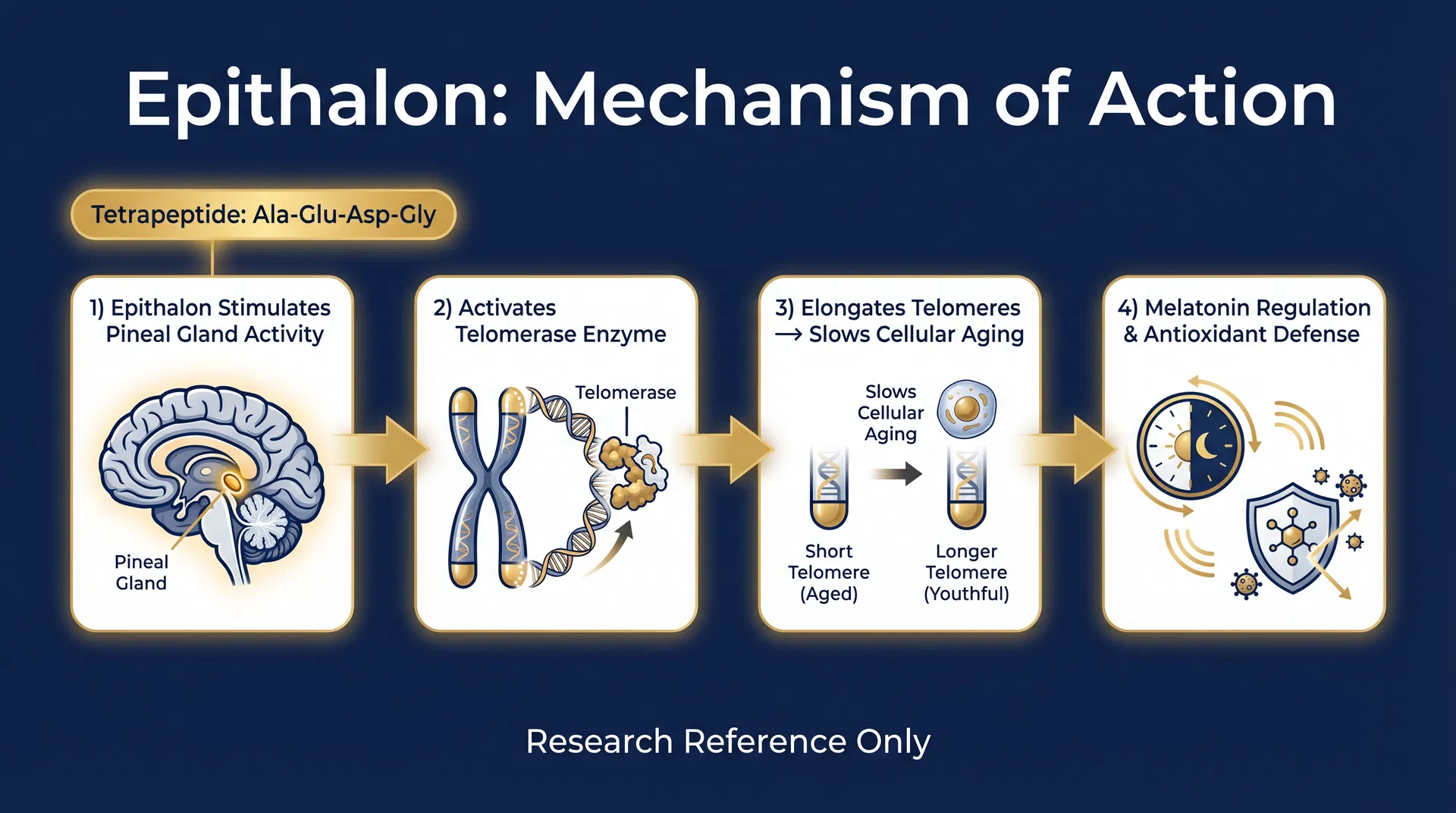
Additionally, some research has examined Testagen's potential to activate telomerase in target tissues. Telomerase is the enzyme responsible for maintaining telomere length — the protective caps on chromosomes that shorten with each cell division. Telomere shortening is considered a primary molecular marker of cellular aging, and compounds that preserve telomerase activity are of significant interest in longevity research.
Key Research Pathways
HPG Axis Modulation / LH Stimulation
Influences anterior pituitary gene expression to promote luteinizing hormone (LH) release, which drives Leydig cell testosterone biosynthesis through the steroidogenesis pathway.
HPT Axis Modulation / TSH Stimulation
Stimulates thyroid-stimulating hormone (TSH) release from the anterior pituitary, promoting T3 and T4 thyroid hormone synthesis — supporting the metabolic and hormonal environment required for optimal testosterone production.
Epigenetic / Chromatin Remodeling
Proposed to interact with histone proteins and chromatin structure, modifying gene accessibility to restore more youthful transcriptional patterns in target tissues — the defining mechanism of the Khavinson peptide bioregulator class.
Telomerase Activation
Preliminary research suggests Testagen may upregulate telomerase activity in target tissues, potentially slowing the telomere shortening that drives cellular senescence and age-related functional decline.
Key Findings from the Literature
- Stimulates anterior pituitary LH and TSH release in hypophysectomized animal models (Khavinson et al., 2002)
- Interacts with histone proteins and chromatin to modulate gene expression patterns (Khavinson et al., 2012)
- Proposed telomerase activation in target tissues — a key mechanism in cellular aging research
- Dual HPG/HPT axis activity: supports both testosterone and thyroid hormone regulatory pathways
- Molecular weight of 432 Da facilitates passive nuclear membrane penetration without active transport
Important Research Context
Research References
Peer-reviewed literature supporting the research profile of Testagen
The following peer-reviewed studies form the primary evidence base for Testagen's research profile. All references are sourced from PubMed, NCBI, and peer-reviewed scientific journals. Published research is available through PubMed, NCBI, and peer-reviewed biomedical journals.
- 1.
Khavinson VKh, Malinin VV. Peptide regulation of gene expression: a systematic review. Molecules. 2021.PMID: 34834147
Comprehensive review of the epigenetic mechanism by which short peptide bioregulators interact with histone proteins and chromatin to modulate gene expression.
- 2.
Khavinson VKh, et al. Epigenetic aspects of peptide regulation of aging. Advances in Gerontology. 2012.PMID: 22708439
Demonstrated that tetrapeptide bioregulators including Testagen interact with histone proteins and chromatin, supporting the epigenetic mechanism of action.
Testagen
Longevity Research
Purgo Labs list price, read 12 Sep 2026 · per-lot COA on the vendor page
Use code HEALTH for 20% off
Fast FedEx shipping · Discreet packaging
Technical Specifications
| Compound Name | Testagen (KEDG) |
| Sequence | Lys-Glu-Asp-Gly |
| Molecular Weight | 447.4 Da |
| Amino Acid Count | 4 (tetrapeptide) |
| Class | Peptide bioregulator (Khavinson class) |
| Primary Research Target | HPG axis, HPT axis, telomerase |
| Regulatory Status | Research chemical; not FDA-approved |
| Available Sizes | 20mg vial |
| Form | Lyophilized powder |
| Purity | ≥99% (third-party tested) |
Source Testagen at Purgo Labs
≥99% purity · Third-party COA · Use code HEALTH for 20% off
Other Compounds in This Guide



Supporting Research
Testagen is a tetrapeptide from the Khavinson peptide bioregulator class. Evidence consists primarily of Russian-language studies, many non-randomized, from a single research group. No modern peer-reviewed RCTs have been published in Western literature.
References
Research Databases
Ready to Source Testagen?
Purgo Labs offers Testagen with ≥99% purity, third-party certificates of analysis, and fast FedEx shipping. This is an affiliate link — we may earn a commission at no cost to you.