SS-31
Cardiolipin Stabilization & Mitochondrial Cristae Restoration
SS-31 (Elamipretide) — Mitochondria-Targeted Tetrapeptide
Last reviewed: August 2026
SS-31 (Elamipretide) is a 4-amino-acid peptide that targets cardiolipin in the inner mitochondrial membrane. Phase II trials showed encouraging signals, but the pivotal Phase 3 MMPOWER-HF trial (n=360, 2023) did not meet its primary endpoint. Efficacy is not demonstrated in humans. Anti-aging and longevity effects are preclinical only.
SS-31 concentrates 1,000-fold in the inner mitochondrial membrane, stabilizing cardiolipin and the electron transport chain complexes that produce ATP. This reduces ROS production, improves energy output, and protects against mitochondrial dysfunction.
Mitochondrial dysfunction is a hallmark of aging and a driver of heart failure and neurodegeneration. SS-31 concentrates at the exact site of ROS generation — a precision that conventional antioxidants lack.
SS-31 is a mitochondria-targeted tetrapeptide with a well-characterized mechanism and the most advanced clinical program of any mitochondria-targeted peptide. However, the Phase 3 MMPOWER-HF trial failed its primary endpoint. Human efficacy is not demonstrated. Anti-aging effects are preclinical only.
What is SS-31?
SS-31 (also known as Elamipretide or MTP-131) is a tetrapeptide that selectively concentrates in the inner mitochondrial membrane, where it binds cardiolipin — a phospholipid essential for electron transport chain function. The proposed mechanism involves stabilizing cardiolipin and restoring cristae architecture. Phase II trials in heart failure showed encouraging signals, but the pivotal Phase 3 MMPOWER-HF trial (n=360, 2023) did not meet its primary endpoint. Efficacy is not demonstrated in humans. Anti-aging and longevity effects are preclinical only.
- SS-31 (Szeto-Schiller peptide 31, also known as Elamipretide) is a tetrapeptide (D-Arg-Dmt-Lys-Phe-NH2) developed by Hazel Szeto at Weill Cornell Medicine, designed to selectively target the inner mitochondrial membrane.
- Mechanism: the alternating aromatic-cationic structure enables SS-31 to selectively concentrate in the inner mitochondrial membrane (IMM) where it binds cardiolipin — a phospholipid essential for electron transport chain (ETC) organization and cristae structure.
- Cardiolipin binding stabilizes cytochrome c in the ETC, reduces electron leak (and thus reactive oxygen species production), and preserves mitochondrial cristae architecture during ischemia-reperfusion injury.
- Clinical translation: Elamipretide has been evaluated in Phase 2 and Phase 3 trials. The pivotal Phase 3 MMPOWER-HF trial (n=360, 2023) did not meet its primary endpoint. The Barth syndrome Phase 3 program (MMPOWER-3) also did not meet its primary endpoint. Efficacy is not demonstrated; SS-31 is not FDA-approved.
- Unlike MOTS-c (which acts via AMPK signaling), SS-31 acts directly at the mitochondrial membrane level — making it a complementary tool for studying mitochondrial biology from a structural vs. signaling perspective.
Molecular Composition
SS-31 is a 4-amino-acid tetrapeptide with an alternating aromatic-cationic motif (D-Arg-2',6'-Dmt-Lys-Phe-NH2). The dimethyltyrosine (Dmt) residue provides antioxidant activity, while the cationic residues (D-Arg, Lys) drive electrostatic concentration in the inner mitochondrial membrane, achieving 1,000-fold enrichment relative to cytoplasm.
How Does It Work?
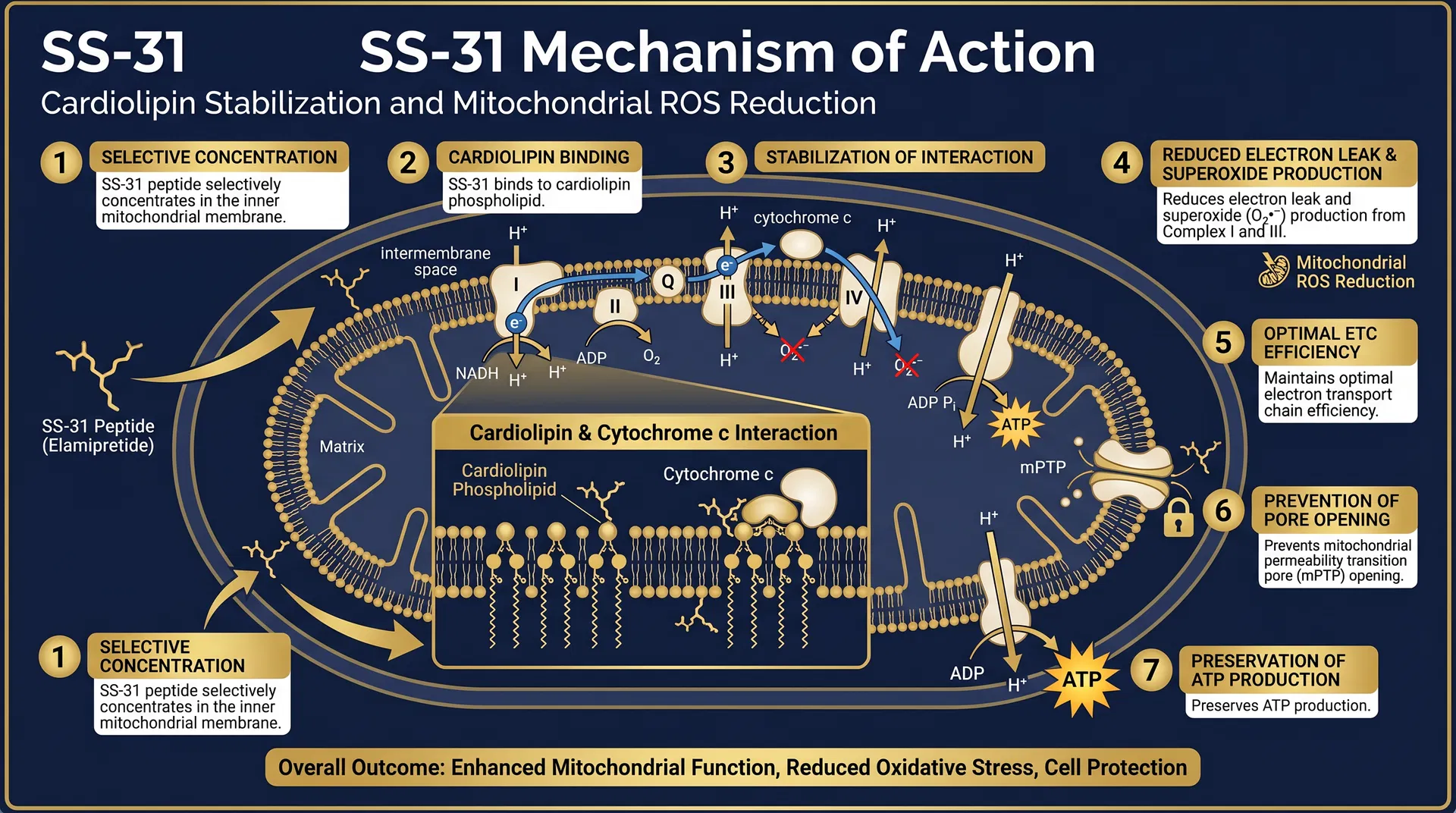
SS-31 restores mitochondrial function by stabilizing cardiolipin in the inner mitochondrial membrane, improving ATP production efficiency and reducing damaging free radical leakage.
SS-31 concentrates in the inner mitochondrial membrane via electrostatic interactions, where it binds cardiolipin — a phospholipid that anchors electron transport chain complexes. By stabilizing cardiolipin, SS-31 maintains optimal cristae architecture and ETC complex conformation, improving ATP synthesis efficiency and reducing electron leak (and consequent ROS generation).
Key Research Pathways
Cardiolipin Stabilization / Cristae Architecture
Binds cardiolipin in the inner mitochondrial membrane, stabilizing cristae structure and maintaining optimal conformation of electron transport chain complexes for efficient ATP synthesis.
ROS Scavenging / Mitochondrial Antioxidant Defense
Reduces mitochondrial superoxide and hydrogen peroxide production by preventing electron leak from the electron transport chain.
Ischemia-Reperfusion Protection
Protects against ischemia-reperfusion injury by maintaining mitochondrial membrane potential and preventing mPTP opening during reperfusion.
Key Findings from the Literature
- Phase 2 trials showed encouraging signals; pivotal Phase 3 MMPOWER-HF trial (n=360, 2023) did not meet its primary endpoint
- Phase 3 Barth syndrome program (MMPOWER-3): primary endpoint not met; some secondary endpoints improved
- Reversed age-related decline in skeletal muscle function in old mice (Science, 2020)
- 1,000-fold concentration in inner mitochondrial membrane vs. cytoplasm
- Reduces mitochondrial ROS by stabilizing cardiolipin and preventing electron leak
Evidence by Claimed Outcome
Each outcome rated by the highest level of evidence available. Tiers follow our 5-tier methodology.
Study counts reflect peer-reviewed publications in the evidence database below. "Theoretical" outcomes have mechanistic rationale only. Learn about our evidence tiers →
Important Research Context
Research References
Peer-reviewed literature supporting the research profile of SS-31
The following peer-reviewed studies form the primary evidence base for SS-31's research profile. All references are sourced from PubMed, NCBI, and peer-reviewed scientific journals. Published research is available through PubMed, NCBI, and peer-reviewed biomedical journals.
- 1.
Szeto HH. First-in-class cardiolipin-protective compound as a therapeutic agent to restore mitochondrial bioenergetics. British Journal of Pharmacology. 2014.PMID: 24117165
SS-31 (Elamipretide) protects cardiolipin and restores mitochondrial cristae structure and ATP production.
- 2.
Chatfield KC, et al. Elamipretide improves mitochondrial function in the failing human heart. JACC: Basic to Translational Science. 2019.PMID: 31061916
SS-31 improved mitochondrial respiration in human failing heart tissue ex vivo.
- 3.
Daubert MA, et al. Novel Mitochondria-Targeting Peptide in Heart Failure Treatment: A Randomized, Placebo-Controlled Trial of Elamipretide. Circulation: Heart Failure. 2017.PMID: 29217757
Phase II trial: SS-31 (elamipretide) improved cardiac function and exercise capacity in heart failure patients.
SS-31
Longevity Research
Purgo Labs list price, read 12 Sep 2026 · per-lot COA on the vendor page
Purgo Labs does not list SS-31 (checked 26 Sep 2026)
Fast FedEx shipping · Discreet packaging
Technical Specifications
| Peptide Class | Szeto-Schiller tetrapeptide (4 amino acids) |
| Molecular Weight | 639.8 Da |
| Regulatory Status | Phase 3 MMPOWER-HF failed primary endpoint (2023); not FDA-approved |
| Available Sizes | 5mg, 10mg vials |
| Form | Lyophilized powder |
| Purity | ≥99% (third-party tested) |
View full legal status guide →
Where to buy SS-31
Purgo Labs does not list this compound — every scored vendor that does, with dated prices
Other Compounds in This Guide



Related Research Guides
Supporting Research
SS-31 (elamipretide) had encouraging Phase 2 cardiac data, but the pivotal Phase 3 trial (MMPOWER-HF, n=360) failed its primary endpoint in 2023 — no significant improvement in 6-minute walk distance vs placebo. The Barth syndrome program continues. Anti-aging, exercise, and longevity claims are preclinical only. Present the Phase 3 failure honestly.
References
- Daubert MA, et al.HUMAN RCT, Phase 2Novel Mitochondria-Targeting Peptide in Heart Failure Treatment: A Randomized, Placebo-Controlled Trial of Elamipretide. Circulation: Heart Failure. 2017. PubMedSS-31 (elamipretide) improved cardiac function and exercise capacity in heart failure patients.
- Chatfield KC, et al.HUMAN EX VIVOElamipretide improves mitochondrial function in the failing human heart. JACC Basic Transl Sci. 2019. PubMedSS-31 improved mitochondrial respiration in human failing heart tissue ex vivo.
- Szeto HH, Schiller PW.REVIEWStealth peptides target cellular powerhouses and enable a new era of medicine. Pharmaceutical Research. 2011. PubMedSS-31 selectively concentrates in the inner mitochondrial membrane via cardiolipin binding, reducing ROS and improving ATP production.
Research Databases
Ready to Source SS-31?
Purgo Labs does not currently list SS-31. The ranking below covers every scored vendor that does, with dated product-page prices.