TB-500
Actin Regulation & Cell Migration Pathways (Preclinical)
Thymosin Beta-4 Synthetic Fragment (Ac-LKKTETQ)
Last reviewed: August 2026
TB-500 is a synthetic version of a small fragment of a protein your body already produces naturally, called Thymosin Beta-4. This protein is found in virtually every cell in your body and plays a key role in how cells move and organize themselves during repair.
TB-500's main job in research models is enabling cells to move. Specifically, it interacts with actin — the internal scaffolding protein that gives cells their shape and allows them to crawl. By regulating actin dynamics, TB-500 appears to help repair cells migrate from where they're stored to where they're needed. Imagine a city after a storm: TB-500 is studied for its potential role in clearing the roads so repair crews can actually reach the damage.
Many tissues fail to heal properly not because the body lacks repair cells, but because those cells can't efficiently navigate to the injury site. TB-500's actin-regulating mechanism is particularly interesting to researchers because it works systemically — meaning it may influence cell movement throughout the body, not just at a specific local site. This distinguishes it from more locally-acting compounds like BPC-157.
TB-500 has a stronger clinical research foundation than most peptides in this category — its parent molecule (full-length Thymosin Beta-4) entered human trials for wound healing and dry eye. TB-500 itself is a shorter, more targeted fragment. All current TB-500 research is preclinical; it is a research compound only.
What is TB-500?
TB-500 (also referenced in research literature as TB500, tb-500 peptide, or Thymosin Beta-4 fragment) is a synthetic heptapeptide corresponding to the N-acetylated active fragment (amino acids 17–23) of thymosin beta-4 (Tβ4), a naturally occurring 43-amino-acid protein found ubiquitously in human and animal tissues. Thymosin beta-4 was first isolated from thymic tissue in the 1960s and has since been recognized as a master regulator of actin dynamics — the cytoskeletal processes that govern cell shape, movement, and division.
The TB-500 fragment (Ac-LKKTETQ) retains the actin-binding domain of the full-length thymosin beta-4 molecule, which is responsible for the peptide's primary biological activities in preclinical research models.
- TB-500 is the synthetic fragment (Ac-LKKTETQ) of Thymosin Beta-4, a naturally occurring 43-amino-acid protein found in virtually all human and animal cells
- Primary mechanism: regulates actin dynamics (G-actin sequestration), enabling repair cells to migrate efficiently from storage sites to injury locations
- Works systemically — unlike locally-acting compounds, TB-500 may influence cell migration throughout the body, making it particularly studied for widespread or multi-site tissue repair
- Parent molecule (full-length Thymosin Beta-4) has entered human clinical trials for wound healing and dry eye disease, providing a stronger translational foundation than most research peptides
- Research-only compound; all TB-500-specific data is preclinical (animal models); not approved for human use
Molecular Composition
TB-500 consists of seven amino acids: Leucine-Lysine-Lysine-Threonine-Glutamate-Threonine-Glutamine, with an N-terminal acetyl group (Ac-LKKTETQ). This acetylation is functionally significant — it protects the peptide from aminopeptidase degradation and is required for full actin-sequestering activity.
The compound has a molecular weight of approximately 889.0 Daltons. Despite its reduced size compared to the full thymosin beta-4 molecule, TB-500 retains the critical WH2 (Wiskott-Homology 2) actin-binding motif, which is the structural basis for its primary mechanism of action.
How Does It Work?
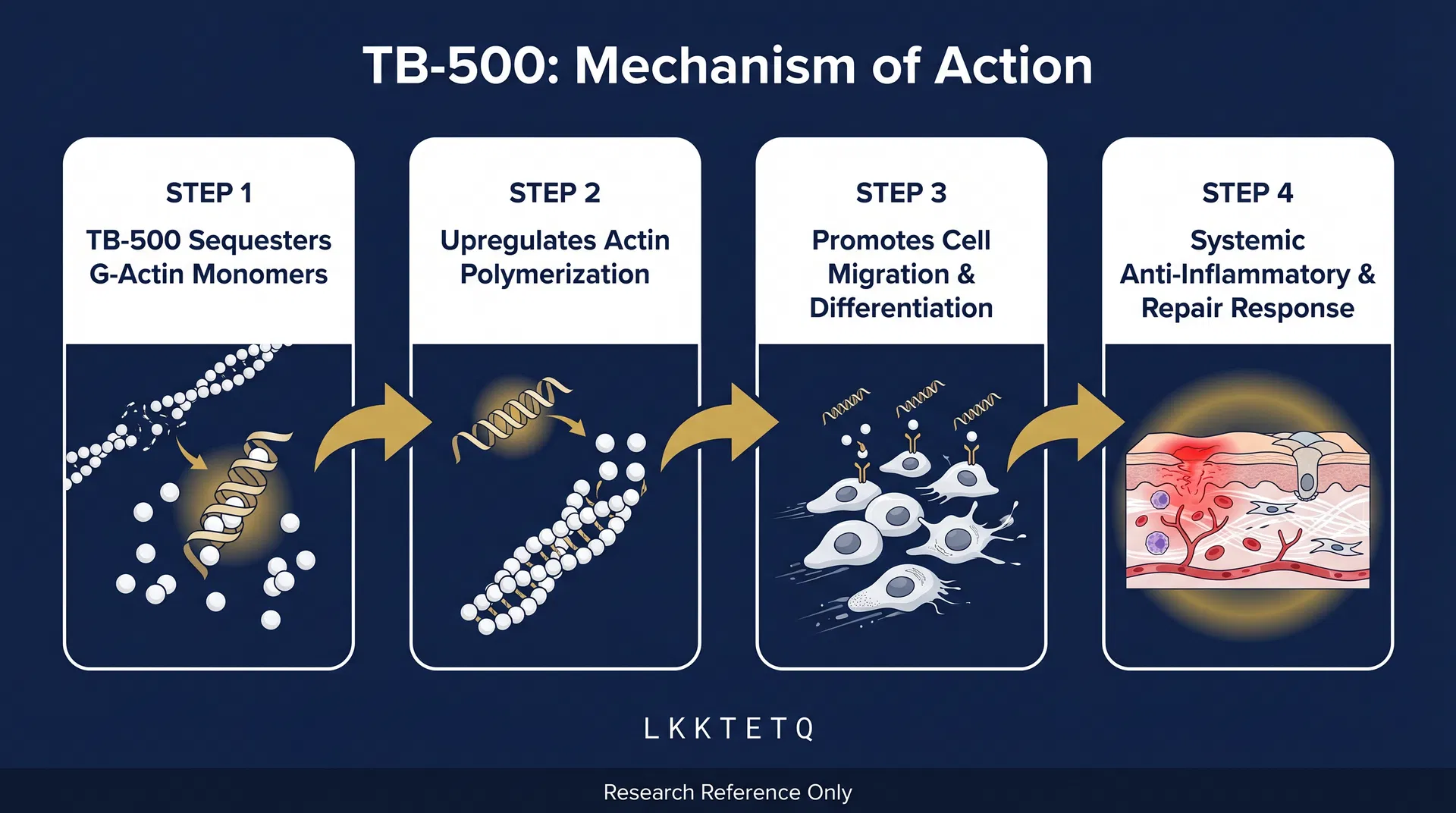
TB-500 promotes healing by sequestering actin monomers to regulate cell migration and stimulate new blood vessel growth at injury sites.
The central mechanism of TB-500 revolves around its capacity to bind monomeric G-actin (globular actin) and thereby regulate the equilibrium between G-actin and filamentous F-actin. Actin dynamics are essential for virtually every aspect of cell motility, including the directed migration of repair cells to sites of tissue injury.
By sequestering G-actin, TB-500 reduces the pool available for F-actin polymerization in a spatially controlled manner, effectively enabling cells to extend lamellipodia and migrate toward chemotactic gradients. This mechanism is particularly relevant to wound healing, where fibroblasts, endothelial cells, and keratinocytes must migrate into the wound bed to initiate repair.
Beyond actin regulation, preclinical research has identified additional activities of TB-500, including promotion of endothelial cell differentiation and angiogenesis, inhibition of inflammatory cytokine expression (notably IL-1β and TNF-α), and activation of the Akt survival signaling pathway, which confers cytoprotective effects in ischemic tissue models.
Key Research Pathways
Actin Sequestration (G-actin / F-actin)
Binds monomeric G-actin via the WH2 domain, regulating cytoskeletal dynamics and enabling directed cell migration.
Akt / PI3K Survival Signaling
Activates the Akt pathway, promoting cellular survival and providing cytoprotection in ischemic and inflammatory conditions.
Angiogenesis (VEGF-independent)
Promotes endothelial cell differentiation and new vessel formation through mechanisms partially independent of classical VEGF signaling.
Anti-inflammatory Cytokine Modulation
Downregulates pro-inflammatory cytokines including IL-1β and TNF-α, reducing inflammatory burden at sites of tissue injury.
Key Findings from the Literature
- Binds G-actin via WH2 domain, regulating cytoskeletal dynamics and cell migration (Goldstein, 2012)
- Promotes endothelial cell differentiation and angiogenesis in dermal tissue models
- Inhibits inflammatory cytokines IL-1β and TNF-α in preclinical inflammation models
- Activates Akt survival pathway, providing cytoprotection in ischemic tissue models
- Accelerates full-thickness wound closure in rodent models (Malinda et al., 1999)
- Anti-fibrotic activity observed through inhibition of Akt signaling in fibrotic pathways
Evidence by Claimed Outcome
Each outcome rated by the highest level of evidence available. Tiers follow our 5-tier methodology.
Study counts reflect peer-reviewed publications in the evidence database below. "Theoretical" outcomes have mechanistic rationale only. Learn about our evidence tiers →
Structured Evidence Table
2 cited studies — model, sample size, outcome, and effect size from published literature.
| Study | Model | Sample | Outcome | Effect Size | Level |
|---|---|---|---|---|---|
Goldstein AL, et al. (2012) Thymosin β4: a multi-functional regenerative peptide PubMed | Rodent + human cardiac (Phase II) | Phase II: n=44 | Improved cardiac function post-MI; reduced fibrosis; stem cell mobilization | Significant improvement in ejection fraction vs. placebo (Phase II) | Phase II |
Huff T, et al. (2001) Thymosin β4 is released from human blood platelets and attached to actin filamen… PubMed | Human platelet — in vitro | In vitro | Confirmed Tβ4 sequestration of G-actin; mechanism of actin polymerization modulation | Quantitative G-actin binding demonstrated | In Vitro |
How Long It Lasts & How It Works in the Body
TB-500 (Thymosin Beta-4 Fragment) — half-life, bioavailability, onset, and duration data
| Parameter | Value | Source |
|---|---|---|
| Half-Life (t½) | ~4–6 hours (estimated) Preclinical data; no published human PK studies for the fragment | Preclinical Data |
| Time to Peak (Tmax) | ~30–90 minutes Subcutaneous injection; preclinical estimates | Preclinical Data |
| Bioavailability (F) | Estimated >75% (SC/IM) No direct human bioavailability data | Preclinical Data |
| Onset of Action | Days to weeks Tissue repair and anti-inflammatory effects | — |
| Duration of Action | Variable Tissue-level effects persist beyond plasma half-life | — |
TB-500 is a synthetic fragment of Thymosin Beta-4 (Tβ4). Full-length Tβ4 has a half-life of ~2–4 hours in plasma. The fragment's PK profile is estimated from preclinical data. No human pharmacokinetic studies have been published.
References:
• Goldstein AL et al. Ann N Y Acad Sci 2012
• Huff T et al. Int J Biochem Cell Biol 2001
Important Research Context
Research References
Peer-reviewed literature supporting the research profile of TB-500
The following peer-reviewed studies form the primary evidence base for TB-500's research profile. All references are sourced from PubMed, NCBI, and peer-reviewed scientific journals. Published research is available through PubMed, NCBI, and peer-reviewed biomedical journals.
- 1.
Goldstein AL, Hannappel E, Kleinman HK. Thymosin beta4: actin-sequestering protein moonlights to repair injured tissues. Trends in Molecular Medicine. 2005.PMID: 16099219
Established Thymosin β4's dual role as actin-sequestering protein and tissue repair mediator.
- 2.
Bock-Marquette I, et al. Thymosin beta4 activates integrin-linked kinase and promotes cardiac cell migration, survival and cardiac repair. Nature. 2004.PMID: 15565145
Thymosin β4 activates ILK signaling to promote cardiac cell survival and migration in repair models.
- 3.
Sosne G, et al. Thymosin beta 4 promotes corneal wound healing and decreases inflammation in vivo following alkali injury. Experimental Eye Research. 2002.PMID: 11950239
Anti-inflammatory and wound-healing effects confirmed in corneal injury model.
- 4.
Huff T, et al. Beta-thymosins, small acidic peptides with multiple functions. International Journal of Biochemistry & Cell Biology. 2001.PMID: 11311852
Comprehensive review of beta-thymosin family functions including actin dynamics and cell motility.
TB-500
Recovery Research
Purgo Labs list price, read 12 Sep 2026 · per-lot COA on the vendor page
10mg $49.99 → $39.99 with code HEALTH (20% off; price read 2 Oct 2026)
- 1 certificate verified at the lab10mg$49.99→ $39.99
- 2 certificates verified at the lab10mg$25.00→ $20.00
- 2 certificates verified at the lab10mg$68.57$48.00→ $43.20
Fast FedEx shipping · Discreet packaging
Technical Specifications
| Peptide Class | Synthetic heptapeptide (7 amino acids) |
| Molecular Weight | 889.0 Da |
| Amino Acid Sequence | Ac-LKKTETQ |
| Parent Molecule | Thymosin beta-4 (residues 17–23) |
| Key Structural Feature | N-terminal acetylation; WH2 actin-binding domain |
| Available Sizes | 10mg vials |
| Form | Lyophilized peptide powder |
| Purity | ≥99% (third-party tested) |
View full legal status guide →
Known Interactions
15 documented interactions for TB-500
BPC-157 promotes angiogenesis while TB-500 modulates actin. Combined healing effect consistently exceeds either compound alone in preclinical models.
Both support tissue remodeling and wound healing via different mechanisms — TB-500 via actin modulation, GHK-Cu via collagen synthesis.
IGF-1 LR3 for muscle growth and hypertrophy; TB-500 for accelerated tissue repair and recovery.
Thymosin Alpha-1 immune modulation may complement TB-500 tissue repair in post-injury recovery protocols.
Interaction data is based on published research, known pharmacological mechanisms, and clinical practitioner experience. Evidence tiers: Clinical = human data; Emerging = preclinical/case reports; Theoretical = mechanism-based inference. Always consult a qualified healthcare provider before combining compounds.
Source TB-500 at Purgo Labs
10mg $49.99 list · $39.99 with code HEALTH · lab-verifiable COA per lot
Other Compounds in This Guide



Related Research Guides
Supporting Research
TB-500 is a synthetic fragment of thymosin beta-4. The regenerative evidence is preclinical (animal/in vitro). There are no human efficacy RCTs for TB-500 as used in the research-peptide market. Distinguish clearly between thymosin beta-4 in animal studies and TB-500 in humans — the latter has no clinical trials.
References
- Bock-Marquette I, Saxena A, et al.[PRECLINICAL — mouse + in vitro]Cardiomyocyte migration/survival and improved cardiac function after coronary ligation — in mice.
- Malinda KM, et al.[PRECLINICAL — mouse wound model]Journal of Investigative Dermatology. 1999. PubMedThymosin beta-4 accelerated wound healing in mouse excisional wound model.
Research Databases
Ready to Source TB-500?
Purgo Labs offers TB-500 with ≥99% purity, third-party certificates of analysis, and fast FedEx shipping. This is an affiliate link — we may earn a commission at no cost to you.