MT2
Multi-Receptor Melanocortin Agonism
Melanotan II — Cyclic Melanocortin Analog
Last reviewed: August 2026
MT2 (Melanotan II) is a synthetic peptide related to MT1, but with a key structural difference: it's cyclic (ring-shaped) rather than linear. This structural change gives it a broader range of receptor targets, making it a more pharmacologically complex compound with a wider range of studied effects.
While MT1 primarily targets one receptor (MC1R) for melanogenesis, MT2 activates four melanocortin receptors: MC1R (skin pigmentation), MC3R and MC4R (in the brain, affecting appetite and energy), and MC5R. The MC4R activation in the hypothalamus is of particular research interest because MC4R is a well-validated target in obesity and metabolic research — it's one of the most studied receptors in appetite regulation.
MT2's broader receptor profile makes it a valuable research tool for studying the melanocortin system as a whole, rather than just skin biology. The fact that a single structural modification (cyclization) dramatically changes which receptors a peptide activates is exactly the kind of structure-activity relationship that makes MT2 scientifically interesting beyond its surface-level effects.
MT2 has a more complex and less clinically validated profile than MT1. Unlike MT1, it has not received regulatory approval for any indication. Its broader receptor activity means researchers need to account for a wider range of potential effects. It is supplied strictly for qualified laboratory research use only.
What is MT2?
**Important: Melanotan II (MT2) has not received regulatory approval from the FDA, EMA, or any other major regulatory body for any indication.** It is not approved for tanning, sexual function, weight loss, or any other use. It is a research compound only.
Melanotan II (MT2) is a synthetic cyclic heptapeptide analog of alpha-melanocyte-stimulating hormone (α-MSH), developed at the University of Arizona in the 1980s. Unlike MT1 (afamelanotide/Scenesse®, which is EU-approved for the rare condition erythropoietic protoporphyria), MT2 has no regulatory approval. Its broader receptor profile (MC1R, MC3R, MC4R, MC5R) produces multiple simultaneous effects that cannot be easily separated, and its safety profile in humans is not established through controlled clinical trials. Researchers should approach MT2 with awareness of its unapproved status and the significant difference between it and the approved drug afamelanotide (MT1).
- Melanotan II (MT2) is a cyclic heptapeptide analog of α-MSH with broad melanocortin receptor activity: MC1R (pigmentation), MC3R (energy homeostasis), MC4R (sexual function, appetite), and MC5R (exocrine glands).
- MC4R agonism is responsible for MT2's pro-erectile and aphrodisiac effects observed in research models — the same receptor targeted by the FDA-approved drug bremelanotide (Vyleesi®).
- The cyclic structure (disulfide bridge between Cys4 and Cys10) confers resistance to enzymatic degradation compared to linear α-MSH, extending the half-life from minutes to hours.
- MT2's broad receptor profile means it produces multiple simultaneous effects (tanning, appetite suppression, sexual arousal, nausea) that cannot be easily separated — a key limitation for targeted research.
- Bremelanotide (Vyleesi®), an FDA-approved MC4R agonist for hypoactive sexual desire disorder in women, shares MT2's core mechanism and provides clinical validation for the MC4R pathway.
Molecular Composition
MT2 is a cyclic 7-amino-acid peptide with the sequence Ac-Nle-cyclo[Asp-His-D-Phe-Arg-Trp-Lys]-NH2. The cyclic structure is formed by a lactam bond between the side chains of aspartate (position 2) and lysine (position 7). This cyclization is a key structural feature that increases receptor binding affinity and metabolic stability compared to linear analogs.
Additional structural modifications include: norleucine (Nle) substitution at position 1 to prevent oxidative degradation, D-phenylalanine at position 4 to enhance receptor binding, and N-terminal acetylation with C-terminal amidation. The molecular weight is 1,024.18 Daltons.
How Does It Work?
MT-2 drives tanning and sexual arousal by activating MC1R in melanocytes and MC3R/MC4R in the hypothalamus, producing effects through a single receptor family.
MT2 exerts its primary effects through agonism at multiple melanocortin receptor subtypes. At MC1R on melanocytes, it stimulates the cAMP/PKA/MITF pathway to increase eumelanin production, similar to MT1. At MC3R and MC4R in the central nervous system — particularly in the hypothalamus — MT2 modulates appetite, energy homeostasis, and sexual function through pathways involving the melanocortin system's interaction with neuropeptide Y (NPY) and agouti-related protein (AgRP) signaling.
The MC4R-mediated effects are of particular research interest: MC4R activation in the hypothalamus reduces food intake and increases energy expenditure, and has been extensively studied in the context of obesity research. MC4R is also expressed in the spinal cord and peripheral nervous system, where its activation has been linked to pro-erectile signaling through nitric oxide pathways.
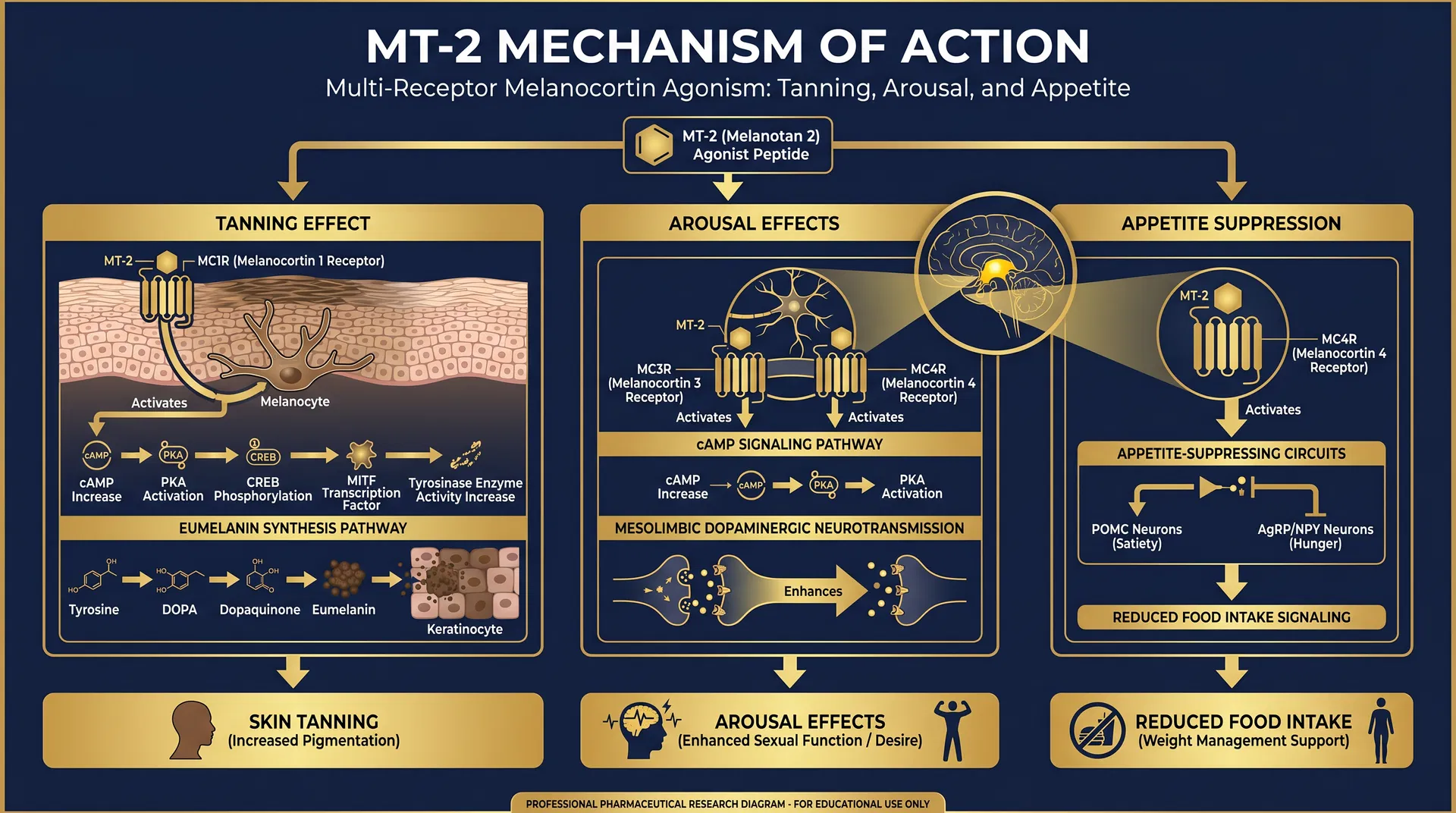
Key Research Pathways
MC1R / Melanogenesis
Activates MC1R on melanocytes, driving cAMP/PKA/MITF cascade and increasing eumelanin production.
MC4R / Hypothalamic Energy Regulation
MC4R agonism in the hypothalamus modulates NPY/AgRP signaling to reduce food intake and increase energy expenditure.
MC4R / Pro-erectile NO Signaling
Spinal and peripheral MC4R activation stimulates nitric oxide pathways associated with erectile function in preclinical models.
MC3R / Anti-inflammatory Modulation
MC3R activation contributes to anti-inflammatory and immune-modulatory effects observed in preclinical studies.
Key Findings from the Literature
- Activates MC1R, MC3R, MC4R, and MC5R — broader receptor profile than MT1
- MC4R agonism in hypothalamus modulates appetite and energy homeostasis
- Stimulates melanogenesis via MC1R/cAMP/MITF pathway without UV requirement
- Pro-erectile signaling through MC4R/nitric oxide pathways studied in rodent models
- Cyclic structure confers enhanced metabolic stability vs. linear α-MSH analogs
- MC3R activation involved in anti-inflammatory and immune modulation research
Evidence by Claimed Outcome
Each outcome rated by the highest level of evidence available. Tiers follow our 5-tier methodology.
Study counts reflect peer-reviewed publications in the evidence database below. "Theoretical" outcomes have mechanistic rationale only. Learn about our evidence tiers →
Important Research Context
Research References
Peer-reviewed literature supporting the research profile of MT2
The following peer-reviewed studies form the primary evidence base for MT2's research profile. All references are sourced from PubMed, NCBI, and peer-reviewed scientific journals. Published research is available through PubMed, NCBI, and peer-reviewed biomedical journals.
- 1.
Wessells H, et al. Effect of an alpha-melanocyte stimulating hormone analog on penile erection and sexual desire in men with organic erectile dysfunction. Urology. 2000.PMID: 11018622
MT-II demonstrated pro-erectile effects via MC4R in men with organic erectile dysfunction.
- 2.
Dorr RT, et al. Evaluation of melanotan-II, a superpotent cyclic melanotropic peptide in a pilot phase-I clinical study. Life Sciences. 1996.PMID: 8637402
Phase I safety data for Melanotan II with characterization of pharmacological effects.
- 3.
King SH, et al. Melanocortin receptors, melanotropic peptides and penile erection. Current Topics in Medicinal Chemistry. 2007.PMID: 17584130
Review of MC3R/MC4R mechanisms underlying MT-II's pro-erectile and libido-modulating effects.
MT2
Skin & Anti-Aging Research
Purgo Labs list price, read 12 Sep 2026 · per-lot COA on the vendor page
10mg $36.99 → $29.59 with code HEALTH (20% off; price read 2 Oct 2026)
- 1 certificate verified at the lab10mg$36.99→ $29.59
- 1 certificate verified at the lab10mg$49.99$39.99→ $33.99
- 1 certificate verified at the lab10mg$30.00$20.00→ $18.00
Fast FedEx shipping · Discreet packaging
Technical Specifications
| Peptide Class | Cyclic heptapeptide α-MSH analog |
| Molecular Weight | 1,024.18 Da |
| Receptor Targets | MC1R, MC3R, MC4R, MC5R |
| Key Structural Feature | Lactam bridge cyclization (Asp²–Lys⁷) |
| Available Sizes | 10mg vials |
| Form | Lyophilized powder |
| Purity | ≥99% (third-party tested) |
View full legal status guide →
Source MT2 at Purgo Labs
10mg $36.99 list · $29.59 with code HEALTH · lab-verifiable COA per lot
Other Compounds in This Guide




Supporting Research
Small early human studies exist for erectile function and tanning, but Melanotan II is not approved anywhere. Regulators have issued safety warnings including nausea, cardiovascular effects, and reports of changing moles and melanoma concern. Safety must be foregrounded, not buried.
References
- Wessells H, et al.HUMAN — small crossover, n≈20Erectile response vs placebo in a small early double-blind crossover study; not a basis for broad efficacy claims.
Research Databases
Ready to Source MT2?
Purgo Labs offers MT2 with ≥99% purity, third-party certificates of analysis, and fast FedEx shipping. This is an affiliate link — we may earn a commission at no cost to you.