Ipamorelin
Selective Growth Hormone Secretagogue Receptor Agonism
Ipamorelin (NNC-26-0161) — Selective GHS-R Agonist
Last reviewed: August 2026
Ipamorelin is a growth hormone secretagogue — a compound that stimulates the release of growth hormone from the pituitary gland. Unlike CJC-1295 (which mimics the 'go' signal from the hypothalamus), Ipamorelin mimics a different signal called ghrelin, often called the 'hunger hormone.' But Ipamorelin is engineered to trigger GH release without most of ghrelin's other effects.
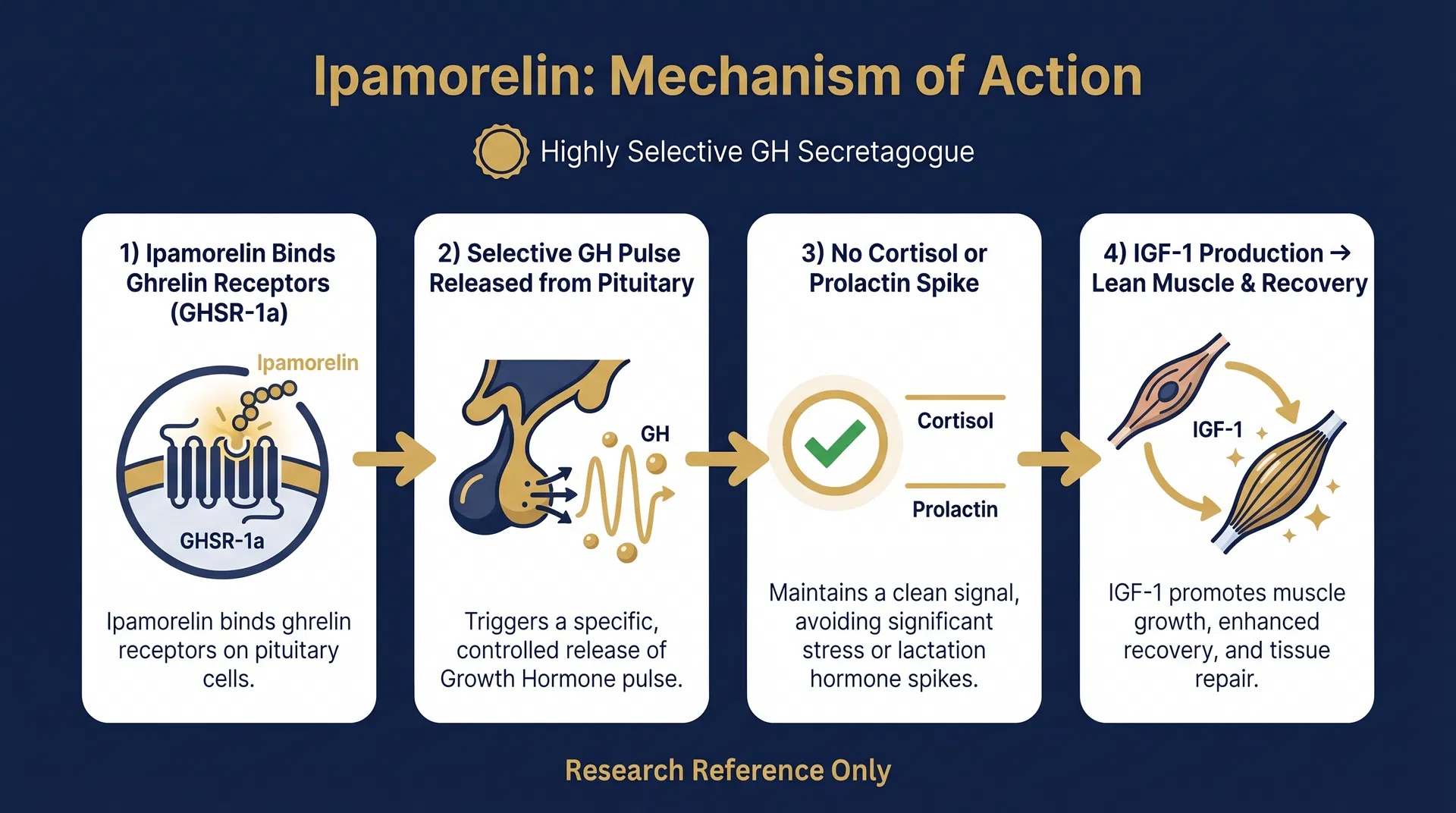
Ipamorelin binds to the GHS-R1a receptor on pituitary cells — the same receptor that ghrelin uses — and triggers a pulse of growth hormone release. What makes it notable in research is its selectivity: it stimulates GH release without significantly raising cortisol, prolactin, or ACTH levels, which are common side effects of other GH secretagogues. This clean selectivity profile makes it a useful research tool for studying GH biology in isolation.
In research, Ipamorelin is often paired with CJC-1295 because they work through complementary pathways — CJC-1295 amplifies the GH pulse, while Ipamorelin triggers it. Together, they're studied as a way to produce a more robust GH response than either compound alone. The combination is one of the most discussed stacks in GH axis research.
Ipamorelin's standout quality is its selectivity — it's one of the cleanest GH secretagogues studied to date, with minimal effects on other hormonal axes. It's a research-only compound and is prohibited by WADA. Purgo Labs supplies it in research-grade lyophilized form for laboratory use only.
What is Ipamorelin?
Ipamorelin (NNC-26-0161) is a synthetic pentapeptide and highly selective agonist of the growth hormone secretagogue receptor (GHS-R), also known as the ghrelin receptor. Developed by Novo Nordisk in the 1990s, ipamorelin was designed to stimulate growth hormone release with greater selectivity and a cleaner hormonal profile than earlier growth hormone-releasing peptides (GHRPs) such as GHRP-2 and GHRP-6.
The defining characteristic of ipamorelin in the research literature is its selectivity: unlike GHRP-2 and GHRP-6, which significantly elevate cortisol, prolactin, and ACTH alongside GH, ipamorelin stimulates GH release with minimal effect on these other hormones. This selectivity has made it a preferred research tool for studying the GH/IGF-1 axis in isolation.
- Ipamorelin is a pentapeptide GH secretagogue that activates the GHS-R1a (ghrelin) receptor in the pituitary to trigger pulsatile GH release
- Exceptional selectivity: stimulates GH release without significantly raising cortisol, prolactin, or ACTH — a key advantage over older GH secretagogues like GHRP-6
- Complementary mechanism to CJC-1295: Ipamorelin triggers the GH pulse (GHRP pathway) while CJC-1295 amplifies it (GHRH pathway) — the most studied GH axis research stack
- Half-life ~2 hours; typically studied at 100–300 mcg per injection in animal models
- WADA-prohibited research compound; not approved for human use
Molecular Composition
Ipamorelin is a pentapeptide with the sequence Aib-His-D-2-Nal-D-Phe-Lys-NH2, where Aib is alpha-aminoisobutyric acid and D-2-Nal is D-2-naphthylalanine. These non-natural amino acid residues are critical to the compound's pharmacological profile: Aib at the N-terminus confers resistance to aminopeptidase degradation, while the D-amino acids at positions 3 and 4 prevent cleavage by endopeptidases and enhance GHS-R binding affinity.
The molecular weight is 711.85 Daltons, making ipamorelin one of the smallest GHS-R agonists. The C-terminal amide group is required for full receptor binding activity.
How Does It Work?
Ipamorelin triggers growth hormone release by activating the ghrelin receptor in the pituitary, producing clean GH pulses without raising cortisol or prolactin.
Ipamorelin acts as a selective agonist at the growth hormone secretagogue receptor (GHS-R1a), a G-protein coupled receptor expressed primarily on somatotroph cells in the anterior pituitary gland and on neurons in the hypothalamus. GHS-R1a activation by ipamorelin initiates a Gαq/11-mediated signaling cascade, increasing intracellular inositol trisphosphate (IP3) and diacylglycerol (DAG) levels, which in turn elevate intracellular calcium concentrations and activate protein kinase C (PKC).
This signaling cascade triggers the exocytosis of GH-containing secretory granules from somatotroph cells, producing a rapid, pulsatile GH release. Ipamorelin also attenuates the inhibitory effects of somatostatin on GH secretion, effectively amplifying the GH pulse. The resulting GH elevation stimulates hepatic IGF-1 production, which mediates the downstream anabolic effects.
Key Research Pathways
GHS-R1a / Gαq/11 Signaling
Binds GHS-R1a on pituitary somatotrophs, activating Gαq/11 → IP3/DAG → Ca²⁺ → PKC cascade that triggers GH exocytosis.
Somatostatin Attenuation
Reduces the inhibitory effect of somatostatin on GH secretion, amplifying the amplitude of GH pulses.
GH / IGF-1 Axis
Secreted GH drives hepatic IGF-1 production, mediating downstream anabolic effects on muscle, bone, and metabolism.
Enteric GHS-R Signaling
GHS-R activation in the enteric nervous system modulates gastrointestinal motility, an area of active research investigation.
Key Findings from the Literature
- Highly selective GHS-R1a agonist — minimal effect on cortisol, prolactin, or ACTH (Raun et al., 1998)
- Produces rapid, pulsatile GH release comparable to GHRP-6 but with superior hormonal selectivity
- Attenuates somatostatin inhibition of GH secretion, amplifying GH pulse amplitude
- Long-term administration associated with increased bone mineral content in rodent models
- Studied for gastrointestinal motility effects via GHS-R activation in enteric nervous system
- Gαq/11 signaling pathway distinguishes it mechanistically from GHRH analogs (cAMP-dependent)
Evidence by Claimed Outcome
Each outcome rated by the highest level of evidence available. Tiers follow our 5-tier methodology.
Study counts reflect peer-reviewed publications in the evidence database below. "Theoretical" outcomes have mechanistic rationale only. Learn about our evidence tiers →
Structured Evidence Table
2 cited studies — model, sample size, outcome, and effect size from published literature.
| Study | Model | Sample | Outcome | Effect Size | Level |
|---|---|---|---|---|---|
Raun K, et al. (1998) Ipamorelin, the first selective growth hormone secretagogue PubMed | Rodent + human (Phase I) | Rodent: n=8–12/group; Human Phase I: n=24 | Selective GH release without significant cortisol, prolactin, or ACTH elevation | GH peak: 6–8× baseline; cortisol/prolactin: no significant change | Phase II |
Johansen PB, et al. (1999) Ipamorelin, a new growth-hormone-releasing peptide, induces longitudinal bone gr… PubMed | Rodent (rat) — tibial growth plate | n=30 | Significant increase in tibial growth plate width and longitudinal bone growth | ~15% increase in bone growth vs. control | Animal |
How Long It Lasts & How It Works in the Body
Ipamorelin — half-life, bioavailability, onset, and duration data
| Parameter | Value | Source |
|---|---|---|
| Half-Life (t½) | ~2 hours Range: 1.5–3 hours Preclinical and early human data | Preclinical Data |
| Time to Peak (Tmax) | ~15–30 minutes Rapid GH pulse after SC injection | Preclinical Data |
| Bioavailability (F) | Estimated 60–80% (SC) No published human bioavailability data | Preclinical Data |
| Onset of Action | 15–30 minutes GH pulse begins within 15–30 min of injection | — |
| Duration of Action | 3–4 hours GH pulse duration; multiple daily dosing required for sustained effect | — |
| Peak Effect | 30–60 minutes Peak GH plasma concentration | — |
Short half-life requires 2–3x daily dosing for sustained GH stimulation. Commonly combined with CJC-1295 (GHRH analog) for amplified, sustained GH release.
References:
• Raun K et al. Eur J Endocrinol 1998
• Bowers CY. J Pediatr Endocrinol Metab 1996
Important Research Context
Research References
Peer-reviewed literature supporting the research profile of Ipamorelin
The following peer-reviewed studies form the primary evidence base for Ipamorelin's research profile. All references are sourced from PubMed, NCBI, and peer-reviewed scientific journals. Published research is available through PubMed, NCBI, and peer-reviewed biomedical journals.
- 1.
Raun K, et al. Ipamorelin, the first selective growth hormone secretagogue. European Journal of Endocrinology. 1998.PMID: 9849822
Ipamorelin selectively stimulates GH release without affecting cortisol, prolactin, or ACTH — establishing its selectivity profile.
- 2.
Johansen PB, et al. Ipamorelin, a new growth-hormone-releasing peptide, induces longitudinal bone growth in rats. Growth Hormone & IGF Research. 1999.PMID: 10373343
Ipamorelin stimulated longitudinal bone growth in rodent models comparable to GHRP-6 without side effects.
- 3.
Svensson J, et al. Two-month treatment of obese subjects with the oral growth hormone (GH) secretagogue MK-677 increases GH secretion, fat-free mass, and energy expenditure. Journal of Clinical Endocrinology & Metabolism. 1998.PMID: 9467542
GHS receptor agonism (shared mechanism with ipamorelin) increases fat-free mass and energy expenditure.
Ipamorelin
Growth Research
Purgo Labs list price, read 12 Sep 2026 · per-lot COA on the vendor page
10mg $54.99 → $43.99 with code HEALTH (20% off; price read 2 Oct 2026)
- 1 certificate verified at the lab10mg$54.99→ $43.99
- 2 certificates verified at the lab10mg$25.00→ $20.00
- 1 certificate verified at the lab10mg$49.99→ $39.99
Fast FedEx shipping · Discreet packaging
Technical Specifications
| Peptide Class | Synthetic pentapeptide GHS-R agonist |
| Molecular Weight | 711.85 Da |
| Receptor Target | GHS-R1a (ghrelin receptor) |
| Key Selectivity | GH-specific; minimal cortisol/prolactin elevation |
| Available Sizes | 10mg vials |
| Form | Lyophilized powder |
| Purity | ≥99% (third-party tested) |
View full legal status guide →
Known Interactions
8 documented interactions for Ipamorelin
Both stimulate GH secretion via ghrelin receptor. Combining may cause excessive GH/IGF-1 elevation. Use lower doses if combining.
CJC-1295 (GHRH analog) + Ipamorelin (ghrelin mimetic) is the gold-standard GH-releasing combination. Dual-pathway stimulation produces amplified, pulsatile GH release.
Both stimulate GH release via complementary pathways. Commonly co-administered in anti-aging protocols.
Ipamorelin stimulates endogenous GH; IGF-1 LR3 provides direct anabolic signaling downstream. Complementary anabolic stack.
Commonly co-administered in clinical settings for recovery. Different primary targets — no known negative interaction.
Interaction data is based on published research, known pharmacological mechanisms, and clinical practitioner experience. Evidence tiers: Clinical = human data; Emerging = preclinical/case reports; Theoretical = mechanism-based inference. Always consult a qualified healthcare provider before combining compounds.
Source Ipamorelin at Purgo Labs
10mg $54.99 list · $43.99 with code HEALTH · lab-verifiable COA per lot
Other Compounds in This Guide




Related Research Guides
Supporting Research
Ipamorelin's selectivity profile (GH release without cortisol/prolactin elevation) is established in preclinical studies. No human RCTs have been published for ipamorelin specifically. Human data on GH secretagogues generally comes from MK-677 (oral GHS-R1a agonist) studies, which share the receptor mechanism but are not the same compound.
References
- Raun K, et al.ANIMAL STUDY (rat)Ipamorelin, the first selective growth hormone secretagogue. Eur J Endocrinol. 1998. PubMedIpamorelin selectively stimulates GH release without affecting cortisol, prolactin, or ACTH — establishing its selectivity profile.
- Johansen PB, et al.ANIMAL STUDY (rat)Ipamorelin, a new growth-hormone-releasing peptide, induces longitudinal bone growth in rats. Growth Horm IGF Res. 1999. PubMedIpamorelin stimulated longitudinal bone growth in rodent models comparable to GHRP-6 without side effects.
Research Databases
Ready to Source Ipamorelin?
Purgo Labs offers Ipamorelin with ≥99% purity, third-party certificates of analysis, and fast FedEx shipping. This is an affiliate link — we may earn a commission at no cost to you.