IGF-1 LR3 — IGF1 LR3 Muscle Growth Research
PI3K/Akt & MAPK Anabolic Signaling (Preclinical — No Human Trials)
Insulin-like Growth Factor 1 Long Arginine 3
Last reviewed: August 2026
IGF-1 LR3 is a modified version of Insulin-like Growth Factor 1 (IGF-1), a hormone your liver naturally produces in response to growth hormone. Think of it this way: growth hormone is the command, and IGF-1 is the messenger that actually carries out most of the instructions throughout the body. LR3 is an engineered version designed to stay active much longer than natural IGF-1.
Natural IGF-1 is quickly deactivated in the bloodstream by binding proteins (IGFBPs). IGF-1 LR3 has a modified sequence that dramatically reduces this binding, extending its active half-life from about 15 minutes to approximately 20–30 hours. During that extended window, it activates IGF-1 receptors on muscle, bone, and organ cells, triggering protein synthesis, cell growth, and glucose uptake.
IGF-1 is one of the most important anabolic hormones in the human body — it's the primary mediator of growth hormone's effects on tissue. By creating a version that stays active far longer than the natural form, researchers can study IGF-1 signaling with much greater experimental control. It's also a key tool in muscle biology and metabolic research.
IGF-1 LR3 is a potent research compound that operates at the intersection of growth hormone biology, muscle physiology, and metabolic regulation. Its extended half-life makes it a powerful research tool but also means its effects persist much longer than natural IGF-1. It is a research-only compound prohibited by WADA.
What is IGF-1 LR3?
IGF-1 LR3 (Insulin-like Growth Factor 1 Long Arginine 3) is a recombinant analog of human insulin-like growth factor 1 (IGF-1). It is engineered to have significantly enhanced potency and a dramatically extended half-life compared to the native hormone. The "LR3" designation refers to two key modifications: an N-terminal extension of 13 amino acids and a glutamate-to-arginine substitution at position 3.
Native IGF-1 is rapidly sequestered by IGF-binding proteins (IGFBPs) in the circulation, resulting in a half-life of approximately 10–20 minutes. IGF-1 LR3's modifications reduce its affinity for IGFBPs by approximately 1,000-fold. This extends its effective half-life to approximately 20–30 hours and dramatically amplifies its biological activity compared to the native hormone.
- IGF-1 LR3 has a ~1,000-fold reduced affinity for IGF-binding proteins (IGFBPs) compared to native IGF-1, extending its active half-life from ~15 minutes to approximately 20–30 hours
- The LR3 modification consists of a 13-amino-acid N-terminal extension and a Glu³→Arg substitution — both engineered specifically to reduce IGFBP sequestration without disrupting receptor binding
- Primary anabolic signaling occurs through PI3K/Akt/mTORC1 (protein synthesis, GLUT4 translocation) and MAPK/ERK (cell proliferation, satellite cell activation) pathways
- IGF-1 LR3 is the downstream effector of growth hormone: GH stimulates hepatic IGF-1 production, and IGF-1 LR3 mimics this signal with far greater persistence
- WADA-prohibited in competitive sport; supplied by Purgo Labs strictly for qualified laboratory research use only
Molecular Composition
IGF-1 LR3 is an 83-amino-acid recombinant protein consisting of the full 70-amino-acid sequence of human IGF-1 with a 13-amino-acid N-terminal extension and a Glu³ → Arg substitution. The molecular weight is 9,117.60 Daltons, making it considerably larger than most research peptides in this catalog.
The N-terminal extension and Arg³ substitution are the structural basis for the compound's reduced IGFBP binding: the extension sterically interferes with IGFBP interaction, while the Arg³ substitution disrupts a key IGFBP binding epitope. These modifications preserve full IGF-1 receptor (IGF-1R) binding affinity while dramatically reducing sequestration.
How Does It Work?
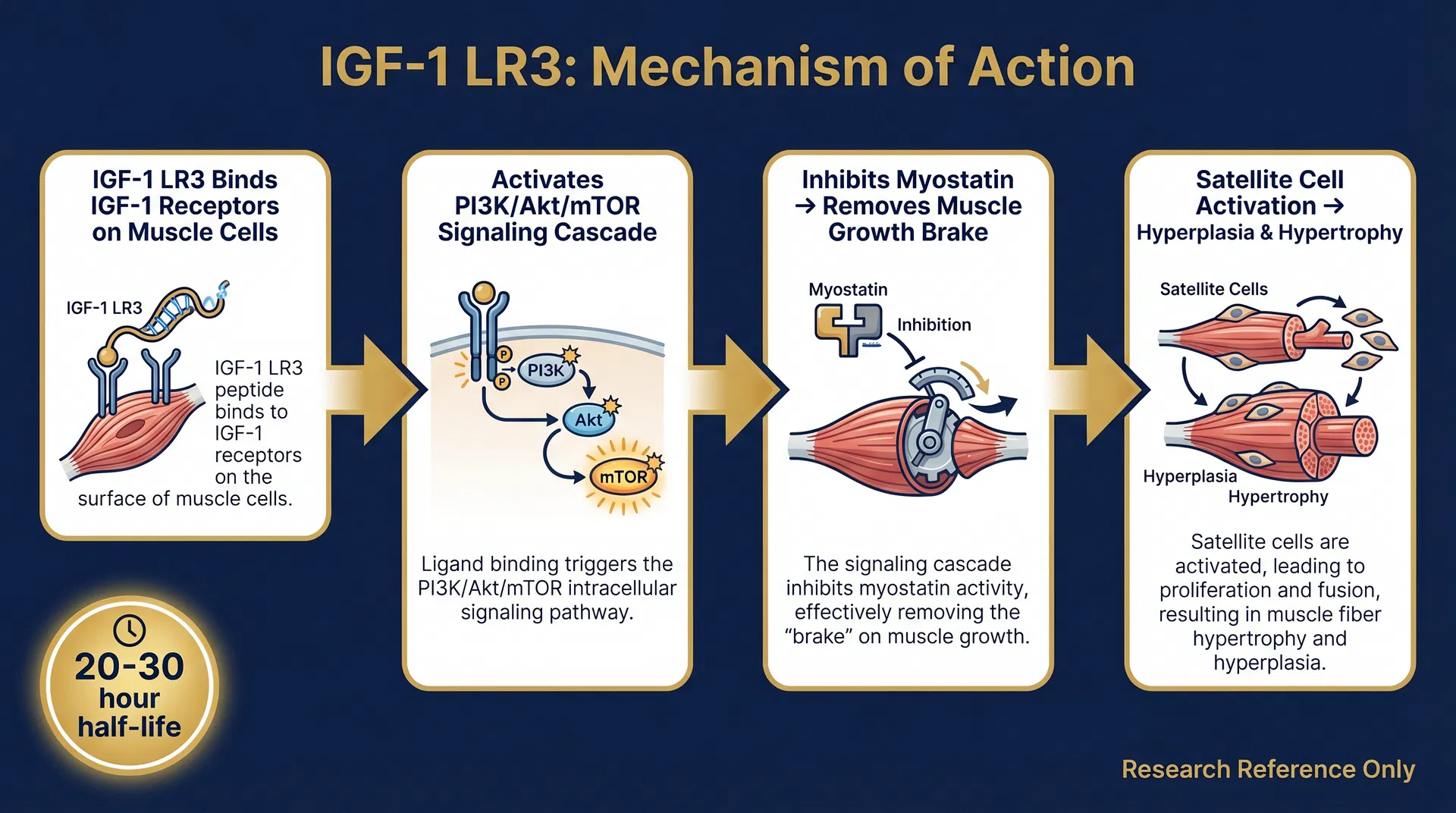
IGF-1 LR3 drives muscle growth and fat loss by activating IGF-1 receptors throughout the body, with a 20–30× longer half-life than natural IGF-1.
IGF-1 LR3 exerts its effects by binding to the IGF-1 receptor (IGF-1R), a receptor tyrosine kinase expressed on virtually all cell types. IGF-1R binding triggers receptor autophosphorylation and activation of two major downstream signaling cascades: the PI3K/Akt pathway and the MAPK/ERK pathway.
The PI3K/Akt pathway is the primary mediator of IGF-1's anabolic effects. Akt activation phosphorylates and inhibits FOXO transcription factors, reducing protein catabolism. It also activates mTORC1, stimulating protein synthesis and cell growth, and promotes glucose uptake via GLUT4 translocation. The MAPK/ERK pathway drives cell proliferation and differentiation, particularly in muscle satellite cells and other progenitor populations.
The combination of reduced protein catabolism, increased protein synthesis, and enhanced glucose uptake creates a strongly anabolic cellular environment that has made IGF-1 LR3 a widely used tool in cell culture and preclinical research.
Key Research Pathways
PI3K / Akt / mTORC1 Anabolic Signaling
Activates mTORC1 to stimulate protein synthesis, inhibits FOXO-mediated catabolism, and promotes GLUT4-mediated glucose uptake.
MAPK / ERK Cell Proliferation
Drives cell proliferation and differentiation, particularly in muscle satellite cells and other progenitor populations.
FOXO Inhibition / Anti-catabolism
Akt-mediated FOXO phosphorylation suppresses the expression of atrophy genes (MuRF1, atrogin-1), reducing protein catabolism.
Reduced IGFBP Sequestration
N-terminal extension and Arg³ substitution dramatically reduce IGFBP binding, extending bioavailability and receptor engagement duration.
Key Findings from the Literature
- ~1,000-fold reduced IGFBP binding vs. native IGF-1, extending half-life to ~20–30 hours
- Activates PI3K/Akt/mTORC1 pathway, stimulating protein synthesis and inhibiting catabolism
- MAPK/ERK activation drives muscle satellite cell proliferation and differentiation
- Promotes GLUT4 translocation and enhanced glucose uptake in muscle cells
- Widely used in cell culture optimization to enhance proliferation and viability
- Activates lipolysis in adipocytes, contributing to favorable body recomposition in animal models
Evidence by Claimed Outcome
Each outcome rated by the highest level of evidence available. Tiers follow our 5-tier methodology.
Study counts reflect peer-reviewed publications in the evidence database below. "Theoretical" outcomes have mechanistic rationale only. Learn about our evidence tiers →
Structured Evidence Table
1 cited study — model, sample size, outcome, and effect size from published literature.
| Study | Model | Sample | Outcome | Effect Size | Level |
|---|---|---|---|---|---|
Tomas FM, et al. (1993) Insulin-like growth factor-I (IGF-I) and especially IGF-I variants are anabolic … PubMed | Rodent (rat) — catabolic model | n=40 | IGF-1 LR3 produced greater muscle mass preservation than native IGF-1 | ~2× greater anabolic effect vs. native IGF-1 at equivalent doses | Animal |
How Long It Lasts & How It Works in the Body
IGF-1 LR3 — half-life, bioavailability, onset, and duration data
| Parameter | Value | Source |
|---|---|---|
| Half-Life (t½) | ~20–30 hours LR3 modification dramatically extends half-life vs. native IGF-1 (~12 min) | Preclinical Data |
| Time to Peak (Tmax) | ~2–4 hours After SC injection; preclinical data | Preclinical Data |
| Bioavailability (F) | Estimated >80% (SC/IM) LR3 modification reduces IGFBP binding | Preclinical Data |
| Onset of Action | Hours Anabolic effects emerge over days to weeks | — |
| Duration of Action | 20–30 hours per dose Once-daily dosing sufficient | — |
The LR3 modification (Arg3 substitution + 13 amino acid N-terminal extension) reduces binding to IGF-binding proteins (IGFBPs) by >1000-fold, extending half-life from ~12 minutes (native IGF-1) to 20–30 hours.
References:
• Francis GL et al. J Mol Endocrinol 1992
• Tomas FM et al. Biochem J 1993
Important Research Context
Research References
Peer-reviewed literature supporting the research profile of IGF-1 LR3
The following peer-reviewed studies form the primary evidence base for IGF-1 LR3's research profile. All references are sourced from PubMed, NCBI, and peer-reviewed scientific journals. Published research is available through PubMed, NCBI, and peer-reviewed biomedical journals.
- 1.
Tomas FM, et al. Insulin-like growth factor-I (IGF-I) and especially IGF-I variants are anabolic in dexamethasone-treated rats. Biochemical Journal. 1993.PMID: 7683875
IGF-1 LR3 demonstrated superior anabolic activity compared to native IGF-1 in catabolic rodent models.
- 2.
Francis GL, et al. Insulin-like growth factors 1 and 2 in bovine colostrum. Sequences and biological activities compared with those of a potent truncated form. Biochemical Journal. 1988.PMID: 3390164
Established the structural basis for IGF-1 variants including the LR3 modification.
IGF-1 LR3
Growth Research
Purgo Labs list price, read 12 Sep 2026 · per-lot COA on the vendor page
Use code HEALTH for 20% off
Fast FedEx shipping · Discreet packaging
Technical Specifications
| Peptide Class | Recombinant IGF-1 analog (83 amino acids) |
| Molecular Weight | 9,117.60 Da |
| Key Modifications | 13-AA N-terminal extension; Glu³→Arg substitution |
| IGFBP Binding | ~1,000-fold reduced vs. native IGF-1 |
| Half-life | ~20–30 hours (vs. 10–20 min for native IGF-1) |
| Available Sizes | 1mg vials |
| Form | Lyophilized powder |
| Purity | ≥99% (third-party tested) |
View full legal status guide →
Known Interactions
10 documented interactions for IGF-1 LR3
Both affect glucose metabolism via different pathways. Monitor blood glucose closely if combining. Theoretical additive hypoglycemic risk.
Both affect glucose metabolism. Monitor blood glucose if combining.
Both affect glucose metabolism. Monitor blood glucose if combining.
Both significantly increase IGF-1 levels. Combining may cause excessive IGF-1 elevation with potential for insulin resistance.
IGF-1 LR3 drives muscle hypertrophy and protein synthesis; BPC-157 accelerates recovery and reduces injury risk between sessions.
IGF-1 LR3 for muscle growth and hypertrophy; TB-500 for accelerated tissue repair and recovery.
Interaction data is based on published research, known pharmacological mechanisms, and clinical practitioner experience. Evidence tiers: Clinical = human data; Emerging = preclinical/case reports; Theoretical = mechanism-based inference. Always consult a qualified healthcare provider before combining compounds.
Source IGF-1 LR3 at Purgo Labs
≥99% purity · Third-party COA · Use code HEALTH for 20% off
Other Compounds in This Guide



Related Research Guides
Supporting Research
IGF-1 LR3 is primarily a laboratory research reagent used in cell culture. It has no human clinical trial data for any indication. Claims about human muscle growth or performance are not supported by clinical evidence. The compound's anabolic effects in rodent models and cell culture do not translate to established human efficacy.
References
- Tomas FM, et al.ANIMAL STUDY (rat)Insulin-like growth factor-I (IGF-I) and especially IGF-I variants are anabolic in dexamethasone-treated rats. Biochemical Journal. 1993. PubMedIGF-1 LR3 demonstrated superior anabolic activity compared to native IGF-1 in catabolic rodent models.
Research Databases
Ready to Source IGF-1 LR3?
Purgo Labs offers IGF-1 LR3 with ≥99% purity, third-party certificates of analysis, and fast FedEx shipping. This is an affiliate link — we may earn a commission at no cost to you.