Tesamorelin — Tesamorelin Mechanism of Action
GHRH Receptor Activation & Visceral Fat Reduction
Tesamorelin — Trans-3-Hexenoic Acid Modified GHRH Analog
Last reviewed: August 2026
Tesamorelin is a synthetic version of GHRH (growth hormone-releasing hormone) that has actually been FDA-approved since 2010. It's sold under the brand name Egrifta® for reducing excess abdominal fat in HIV patients on antiretroviral therapy. This makes it one of the few peptides in this guide with genuine FDA approval and published Phase III clinical trial data.
Like CJC-1295, Tesamorelin stimulates the pituitary gland to release growth hormone by mimicking the natural GHRH signal. The key difference is its specific clinical validation for visceral fat reduction. In FDA-approved trials, Tesamorelin produced statistically significant reductions in trunk fat in HIV patients, with effects maintained over 52 weeks of treatment. It works through the GH/IGF-1 axis, which regulates fat metabolism alongside muscle and bone effects.
Visceral fat (the fat stored around internal organs) is metabolically distinct from subcutaneous fat and is strongly associated with cardiovascular and metabolic disease risk. Tesamorelin's FDA approval for visceral fat reduction gives it a level of clinical credibility that most research peptides lack. Researchers studying metabolic syndrome, lipodystrophy, or GH axis biology have a robust clinical dataset to reference.
Tesamorelin is unique in this catalog because it has FDA approval for a specific indication, meaning it has completed the full clinical trial process. The research-grade lyophilized powder supplied by Purgo Labs is for laboratory use only and differs from the clinical formulation. Its approval status makes it one of the most clinically validated GHRH analogs available for research.
What is Tesamorelin?
Tesamorelin is a synthetic analog of human growth hormone-releasing hormone (GHRH) consisting of the full 44-amino-acid sequence of GHRH with a trans-3-hexenoic acid group conjugated to the N-terminus. This modification significantly enhances metabolic stability compared to native GHRH while preserving full biological activity at the GHRH receptor.
Tesamorelin is notable for being the only GHRH analog to receive FDA approval. It is approved under the brand name Egrifta® for the reduction of excess visceral adipose tissue (VAT) in HIV-infected patients with antiretroviral therapy-associated lipodystrophy. This clinical validation provides a robust human pharmacokinetic, pharmacodynamic, and safety dataset that distinguishes tesamorelin from most research peptides. By stimulating GH release and downstream insulin-like growth factor (IGF-1) production, tesamorelin supports improvements in body composition. This includes reductions in fat stored around the abdomen and preservation of lean muscle mass, making it a subject of interest in metabolic and anti-aging research.
- Tesamorelin is a stabilized synthetic GHRH analog — the only GHRH analog with FDA approval (Egrifta®, 2010) for reducing excess visceral abdominal fat in HIV-associated lipodystrophy
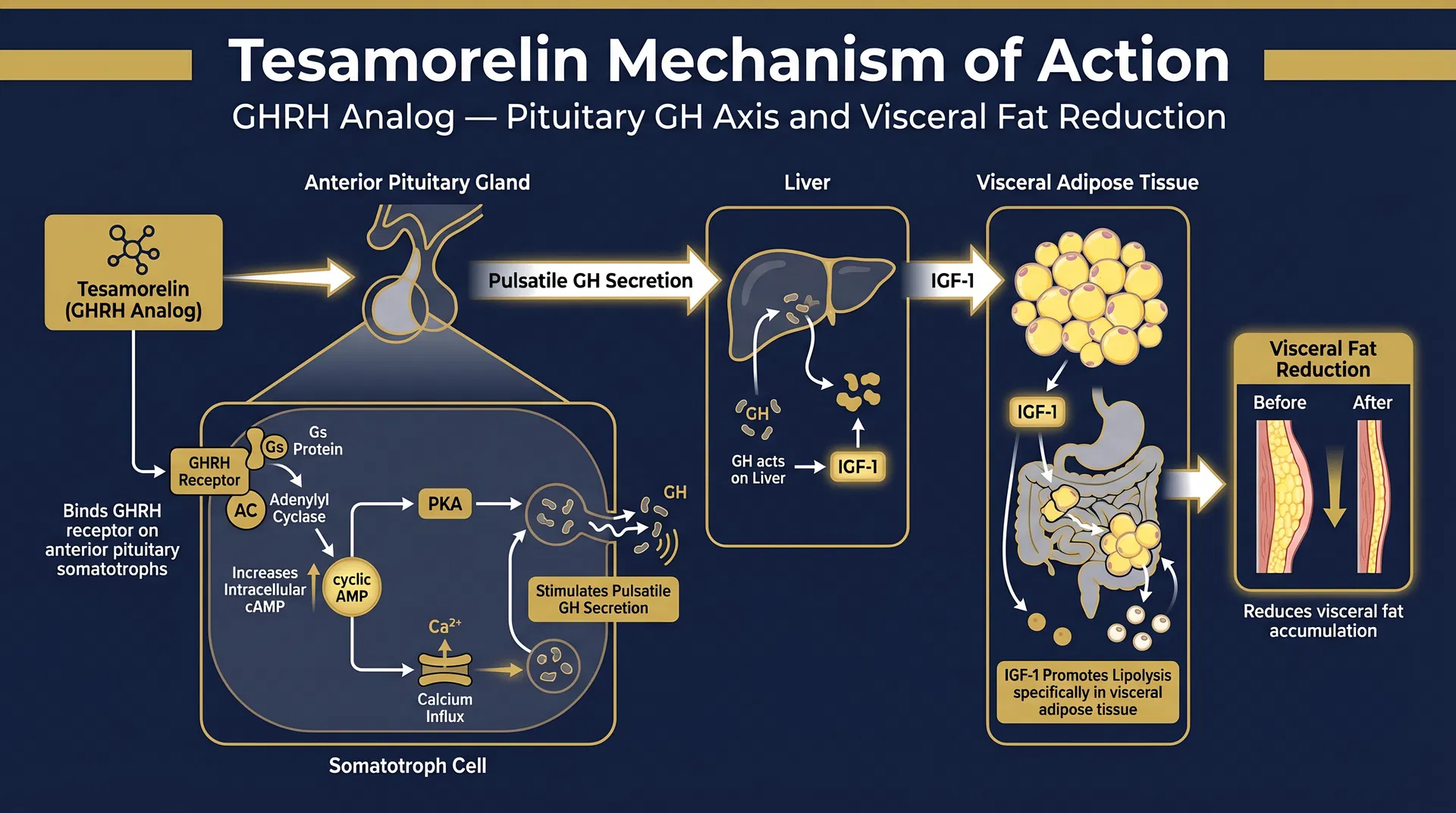
- Mechanism: binds pituitary GHRH receptors to stimulate pulsatile GH release, which drives IGF-1 production and preferential visceral fat lipolysis
- Phase III clinical data: statistically significant trunk fat reduction maintained over 52 weeks; one of the most robust clinical datasets for any GHRH analog
- Half-life ~26 minutes (shorter than CJC-1295 DAC); requires daily subcutaneous injection in clinical use
- Research-grade lyophilized powder for laboratory use only; differs from the clinical Egrifta® formulation; WADA-prohibited
Molecular Composition
Tesamorelin consists of the complete 44-amino-acid sequence of human GHRH (hGHRH[1-44]-NH2) with a trans-3-hexenoic acid moiety conjugated to the alpha-amino group of the N-terminal tyrosine residue. This N-terminal modification is the key structural feature that confers enhanced stability against dipeptidyl peptidase IV (DPP-IV) cleavage — the primary mechanism of native GHRH degradation.
The molecular weight is 5,135.9 Daltons. Unlike CJC-1295, which achieves stability through amino acid substitutions, tesamorelin achieves stability through the N-terminal fatty acid conjugation while retaining the complete native GHRH sequence.
How Does It Work?
Tesamorelin reduces visceral fat by stimulating pulsatile growth hormone release, which activates lipolysis specifically in abdominal adipose tissue.
Tesamorelin acts as a selective agonist at the GHRH receptor (GHRHR) on pituitary somatotroph cells, activating the same adenylyl cyclase → cAMP → PKA signaling cascade as native GHRH. This triggers the synthesis and pulsatile release of endogenous growth hormone, which in turn stimulates hepatic IGF-1 production.
The mechanism underlying tesamorelin's specific effect on visceral adipose tissue (VAT) involves GH-mediated stimulation of lipolysis in visceral fat depots. GH activates hormone-sensitive lipase (HSL) in adipocytes, promoting the breakdown of stored triglycerides. Visceral adipocytes are particularly sensitive to GH-mediated lipolysis due to their higher density of GH receptors and lower sensitivity to insulin's anti-lipolytic effects compared to subcutaneous adipocytes.
Key Research Pathways
GHRHR / cAMP / PKA Signaling
Activates GHRH receptor on pituitary somatotrophs, triggering adenylyl cyclase → cAMP → PKA cascade and pulsatile GH release.
GH-Mediated Lipolysis (HSL Activation)
GH activates hormone-sensitive lipase in visceral adipocytes, promoting triglyceride breakdown and VAT reduction.
IGF-1 Axis Activation
Secreted GH drives hepatic IGF-1 production, mediating downstream anabolic and metabolic effects.
DPP-IV Resistance
N-terminal trans-3-hexenoic acid modification prevents DPP-IV cleavage, extending biological half-life vs. native GHRH.
Key Findings from the Literature
- FDA-approved (Egrifta®) for HIV-associated lipodystrophy — only approved GHRH analog
- Reduces visceral adipose tissue by ~15–20% in clinical trials (Falutz et al., 2010)
- Increases serum IGF-1 levels, confirming GH axis activation in human subjects
- Preserves pulsatile GH secretion pattern, maintaining physiological GH dynamics
- Potential cognitive benefits investigated in mild cognitive impairment studies (Baker et al., 2021)
- N-terminal trans-3-hexenoic acid modification confers DPP-IV resistance
Evidence by Claimed Outcome
Each outcome rated by the highest level of evidence available. Tiers follow our 5-tier methodology.
Study counts reflect peer-reviewed publications in the evidence database below. "Theoretical" outcomes have mechanistic rationale only. Learn about our evidence tiers →
Structured Evidence Table
1 cited study — model, sample size, outcome, and effect size from published literature.
| Study | Model | Sample | Outcome | Effect Size | Level |
|---|---|---|---|---|---|
Falutz J, et al. (2010) Effects of tesamorelin (TH9507), a growth hormone-releasing factor analog, in HI… PubMed | Human — Phase III RCT | n=412 | Significant reduction in visceral adipose tissue (VAT) in HIV-lipodystrophy | VAT reduction: ~15% vs. placebo; statistically significant (p<0.001) | Phase III |
Important Research Context
Research References
Peer-reviewed literature supporting the research profile of Tesamorelin
The following peer-reviewed studies form the primary evidence base for Tesamorelin's research profile. All references are sourced from PubMed, NCBI, and peer-reviewed scientific journals. Published research is available through PubMed, NCBI, and peer-reviewed biomedical journals.
- 1.
Falutz J, et al. Metabolic effects of a growth hormone-releasing factor in patients with HIV. New England Journal of Medicine. 2007.PMID: 18057338
Landmark Phase III trial: tesamorelin reduced visceral adipose tissue by ~15% in HIV-associated lipodystrophy.
- 2.
Baker LD, et al. Effects of growth hormone-releasing hormone on cognitive function in adults with mild cognitive impairment and healthy older adults. Archives of Neurology. 2012.PMID: 22869065
Tesamorelin improved cognitive function in older adults with mild cognitive impairment over 20 weeks.
- 3.
Falutz J, et al. Long-term safety and effects of tesamorelin, a growth hormone-releasing factor analogue, in HIV patients with abdominal fat accumulation. AIDS. 2008.PMID: 18690162
52-week safety data confirmed sustained VAT reduction with maintained metabolic improvements.
Tesamorelin
Growth Research
Purgo Labs list price, read 12 Sep 2026 · per-lot COA on the vendor page
10mg $69.99 → $55.99 with code HEALTH (20% off; price read 2 Oct 2026)
- 1 certificate verified at the lab10mg$69.99→ $55.99
- 2 certificates verified at the lab10mg$40.00→ $32.00
- 1 certificate verified at the lab10mg$69.99→ $55.99
Fast FedEx shipping · Discreet packaging
Technical Specifications
| Peptide Class | GHRH analog (44 amino acids + N-terminal modification) |
| Molecular Weight | 5,135.9 Da |
| FDA Approval | Egrifta® — HIV-associated lipodystrophy (VAT reduction) |
| Receptor Target | GHRH receptor (GHRHR) on pituitary somatotrophs |
| Key Modification | trans-3-hexenoic acid N-terminal conjugation (DPP-IV resistance) |
| Available Sizes | 10mg vials |
| Form | Lyophilized powder |
| Purity | ≥99% (third-party tested) |
View full legal status guide →
Source Tesamorelin at Purgo Labs
10mg $69.99 list · $55.99 with code HEALTH · lab-verifiable COA per lot
Other Compounds in This Guide




Related Research Guides
Supporting Research
Tesamorelin is the only FDA-approved GHRH analogue (brand name Egrifta®), approved for HIV-associated lipodystrophy on the strength of a large Phase 3 randomized controlled trial. Off-label body-composition claims in healthy adults are not what the pivotal trial tested.
References
Research Databases
Ready to Source Tesamorelin?
Purgo Labs offers Tesamorelin with ≥99% purity, third-party certificates of analysis, and fast FedEx shipping. This is an affiliate link — we may earn a commission at no cost to you.