CJC-1295
Growth Hormone Secretagogue & IGF-1 Axis Activation
CJC-1295 (Modified GRF 1-29 / GHRH Analog)
Last reviewed: August 2026
CJC-1295 is a synthetic version of a hormone your hypothalamus naturally produces called GHRH (growth hormone-releasing hormone). Your hypothalamus sends GHRH to your pituitary gland as a signal to release growth hormone. CJC-1295 is essentially a longer-lasting, more stable version of that signal.
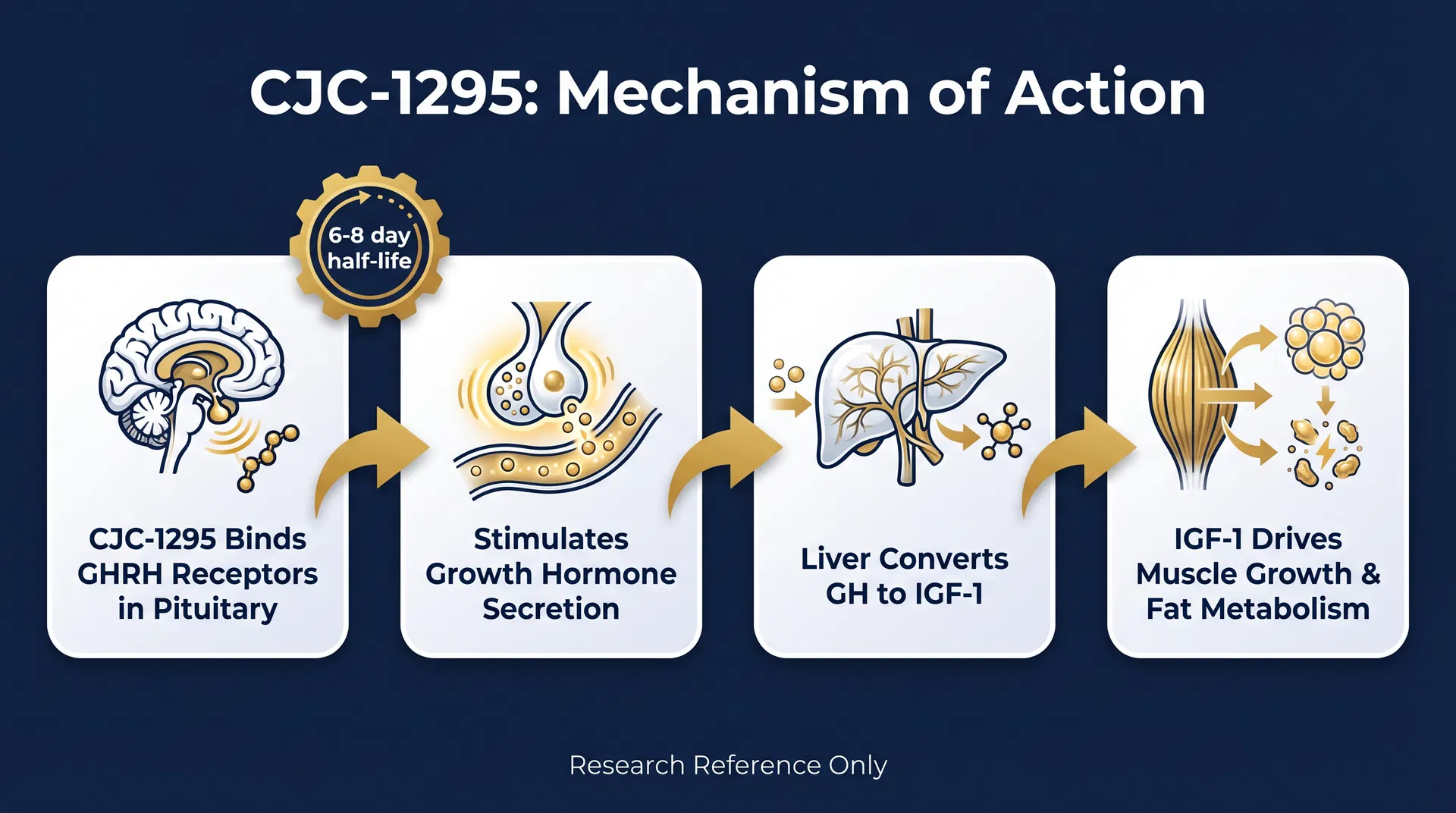
When CJC-1295 reaches the pituitary gland, it triggers the release of growth hormone (GH) in the same pulsatile pattern your body naturally uses. That GH then travels to the liver and other tissues, where it stimulates production of IGF-1 — the compound that actually carries out most of GH's effects on muscle, bone, and fat metabolism. In a published clinical study, CJC-1295 produced a 2–10 fold increase in GH levels and a 1.5–3 fold increase in IGF-1, with effects lasting up to 28 days.
The key distinction between CJC-1295 and simply injecting growth hormone directly is that CJC-1295 works through your body's own regulatory system. It stimulates your pituitary to release GH naturally, which preserves the pulsatile pattern and feedback loops that keep the system in balance. This is why it's studied as a more physiologically harmonious approach to GH axis research than direct GH administration.
CJC-1295 is one of the most clinically studied GHRH analogs, with published human pharmacokinetic data. The DAC (Drug Affinity Complex) version binds to albumin in the blood, extending its half-life from 30 minutes to nearly a week. It is a research-only compound classified as prohibited by WADA.
What is CJC-1295?
CJC-1295 (also referenced as CJC1295, cjc-1295 peptide, or Modified GRF 1-29) is a synthetic analog of growth hormone-releasing hormone (GHRH), the endogenous hypothalamic peptide that stimulates the anterior pituitary gland to secrete growth hormone (GH). Developed by ConjuChem Biotechnologies, CJC-1295 is a tetrasubstituted 30-amino-acid peptide based on the first 29 amino acids of native GHRH, with four amino acid substitutions that confer significantly enhanced metabolic stability and receptor binding affinity.
The compound is available in two primary forms: CJC-1295 without DAC (Modified GRF 1-29), which has a half-life of approximately 30 minutes and produces pulsatile GH release; and CJC-1295 with DAC (Drug Affinity Complex), which covalently binds to serum albumin to extend the half-life to 5.8–8.1 days.
- CJC-1295 is a synthetic GHRH analog — a stabilized, longer-acting version of the hypothalamic signal that tells the pituitary to release growth hormone
- The DAC (Drug Affinity Complex) modification allows CJC-1295 to bind to albumin in blood, extending its half-life from ~30 minutes to 6–8 days vs. ~30 min for CJC-1295 without DAC
- Published human PK data: produced 2–10× GH increase and 1.5–3× IGF-1 increase lasting up to 28 days (Teichman et al., JCEM 2006)
- Preserves pulsatile GH release pattern (unlike direct GH administration), maintaining the hypothalamic-pituitary feedback axis
- WADA-prohibited research compound; commonly studied in combination with Ipamorelin for synergistic GH axis stimulation
Molecular Composition
CJC-1295 is a 30-amino-acid peptide derived from the first 29 residues of human GHRH, with four strategic amino acid substitutions: Ala² → D-Ala (protects against dipeptidyl peptidase IV cleavage), Gln⁸ → Ala (reduces asparagine deamidation), Ala¹⁵ → Ala (stability enhancement), and Leu²⁷ → Met (receptor binding optimization). These substitutions collectively extend the peptide's biological half-life and enhance its affinity for the GHRH receptor (GHRHR) on pituitary somatotroph cells.
How Does It Work?
CJC-1295 extends growth hormone release by mimicking GHRH and binding to albumin, producing sustained GH pulses over days rather than minutes.
CJC-1295 acts as a functional agonist at the GHRH receptor (GHRHR), a G-protein coupled receptor expressed on the surface of pituitary somatotroph cells. Upon binding, CJC-1295 activates adenylyl cyclase via the Gαs protein, increasing intracellular cyclic AMP (cAMP) concentrations. Elevated cAMP activates protein kinase A (PKA), which phosphorylates downstream targets that ultimately trigger the synthesis and secretion of growth hormone from somatotroph secretory granules.
The secreted growth hormone then acts on the liver and peripheral tissues to stimulate the production of insulin-like growth factor-1 (IGF-1), the primary mediator of GH's anabolic and tissue-repair effects. In a landmark clinical study (Teichman et al., 2006), CJC-1295 administration produced a 2–10 fold increase in mean GH concentrations and a 1.5–3 fold increase in IGF-1 levels, with effects persisting for up to 28 days.
Key Research Pathways
GHRHR / cAMP / PKA Signaling
Binds GHRH receptor on pituitary somatotrophs, activating adenylyl cyclase → cAMP → PKA cascade that triggers GH synthesis and secretion.
GH / IGF-1 Axis Activation
Secreted GH stimulates hepatic and peripheral IGF-1 production, the primary mediator of anabolic, tissue-repair, and metabolic effects.
Pulsatile GH Release Preservation
Maintains physiological pulsatility of GH secretion, preventing receptor downregulation and preserving long-term somatotroph responsiveness.
Albumin Binding (DAC form)
The Drug Affinity Complex (DAC) modification enables reversible covalent binding to serum albumin, dramatically extending circulating half-life.
Key Findings from the Literature
- 2–10 fold increase in mean GH concentrations in healthy adult subjects (Teichman et al., 2006)
- 1.5–3 fold increase in IGF-1 levels persisting up to 28 days after multiple doses
- Preserves physiological pulsatility of GH secretion (Ionescu & Frohman, 2006)
- Estimated half-life of 5.8–8.1 days (DAC form) vs. ~30 min (without DAC)
- Normalizes growth in GHRH-knockout mouse models (Alba et al., 2006)
- Four amino acid substitutions confer resistance to DPP-IV and other proteases
Evidence by Claimed Outcome
Each outcome rated by the highest level of evidence available. Tiers follow our 5-tier methodology.
Study counts reflect peer-reviewed publications in the evidence database below. "Theoretical" outcomes have mechanistic rationale only. Learn about our evidence tiers →
Structured Evidence Table
2 cited studies — model, sample size, outcome, and effect size from published literature.
| Study | Model | Sample | Outcome | Effect Size | Level |
|---|---|---|---|---|---|
Teichman SL, et al. (2006) Prolonged stimulation of growth hormone (GH) and insulin-like growth factor I se… PubMed | Human — Phase I/II RCT | n=65 | Dose-dependent GH and IGF-1 elevation; sustained effect for up to 14 days | 2–10× increase in mean GH AUC; IGF-1 levels elevated 1.5–3× baseline | RCT |
Alba M, et al. (2006) Once-daily administration of CJC-1295, a long-acting growth hormone-releasing ho… PubMed | Mouse (GHRH knockout) | n=24 | Normalized body weight and IGF-1 levels in GH-deficient mice | Body weight normalized to wild-type controls within 4 weeks | Animal |
How Long It Lasts & How It Works in the Body
CJC-1295 (with DAC) — half-life, bioavailability, onset, and duration data
| Parameter | Value | Source |
|---|---|---|
| Half-Life (t½) | ~6–8 days Range: 5–10 days DAC modification enables once-weekly dosing | Clinical Trial Data |
| Time to Peak (Tmax) | ~2–4 hours After subcutaneous injection | Clinical Trial Data |
| Bioavailability (F) | Estimated >90% (SC) DAC modification improves stability | Clinical Trial Data |
| Onset of Action | 2–4 hours GH pulse begins within hours | — |
| Duration of Action | 5–7 days per dose Due to DAC modification | — |
The DAC (Drug Affinity Complex) modification binds CJC-1295 to albumin, dramatically extending half-life from ~30 minutes (without DAC) to 6–8 days. This enables once-weekly dosing.
References:
• Ionescu M & Frohman LA. J Clin Endocrinol Metab 2006
Important Research Context
Research References
Peer-reviewed literature supporting the research profile of CJC-1295
The following peer-reviewed studies form the primary evidence base for CJC-1295's research profile. All references are sourced from PubMed, NCBI, and peer-reviewed scientific journals. Published research is available through PubMed, NCBI, and peer-reviewed biomedical journals.
- 1.
Teichman SL, et al. Prolonged stimulation of growth hormone (GH) and insulin-like growth factor I secretion by CJC-1295, a long-acting analog of GH-releasing hormone, in healthy adults. Journal of Clinical Endocrinology & Metabolism. 2006.PMID: 16352683
CJC-1295 produced sustained GH and IGF-1 elevation for up to 6 days after a single injection in healthy adults.
- 2.
Alba M, et al. Once-daily administration of CJC-1295, a long-acting growth hormone-releasing hormone (GHRH) analog, normalizes growth in the GHRH knockout mouse. American Journal of Physiology — Endocrinology and Metabolism. 2006.PMID: 16822960
Demonstrated normalization of growth in GHRH-deficient mice with monthly dosing.
- 3.
Teichman SL, et al. Prolonged stimulation of growth hormone (GH) and insulin-like growth factor I secretion by CJC-1295, a long-acting analog of GH-releasing hormone, in healthy adults. Journal of Clinical Endocrinology & Metabolism. 2006.PMID: 16352683
Pulsatile GH secretion pattern preserved with CJC-1295, supporting physiological GH release.
CJC-1295
Growth Research
Purgo Labs list price, read 12 Sep 2026 · per-lot COA on the vendor page
Use code HEALTH for 20% off
- 1 certificate verified at the labout of stock 23 Sept10mg$54.99$43.99→ $35.19
- 2 certificates verified at the lab10mg$93.00$65.00→ $58.50
- 1 certificate verified at the lab5mg$38.00→ $34.20
Fast FedEx shipping · Discreet packaging
Technical Specifications
| Peptide Class | GHRH analog (30 amino acids) |
| Molecular Weight | 3,367.9 Da (without DAC) |
| Parent Sequence | Human GHRH residues 1–29 (tetrasubstituted) |
| Receptor Target | GHRH receptor (GHRHR) on pituitary somatotrophs |
| Half-life | ~30 min (without DAC); 5.8–8.1 days (with DAC) |
| Available Sizes | 10mg vials |
| Form | Lyophilized powder |
| Purity | ≥99% (third-party tested) |
View full legal status guide →
Known Interactions
8 documented interactions for CJC-1295
Both are GHRH analogs targeting the same receptor. Combining may cause excessive GH release. Generally use one or the other, not both.
Both increase GH secretion. Combining may cause excessive GH/IGF-1 elevation. Use with caution.
CJC-1295 (GHRH analog) + Ipamorelin (ghrelin mimetic) is the gold-standard GH-releasing combination. Dual-pathway stimulation produces amplified, pulsatile GH release.
CJC-1295 stimulates endogenous GH release; IGF-1 LR3 provides direct downstream anabolic effect. Complementary.
Different mechanisms (tissue repair vs. GH release). No known negative interaction.
Interaction data is based on published research, known pharmacological mechanisms, and clinical practitioner experience. Evidence tiers: Clinical = human data; Emerging = preclinical/case reports; Theoretical = mechanism-based inference. Always consult a qualified healthcare provider before combining compounds.
Source CJC-1295 at Purgo Labs
≥99% purity · Third-party COA · Use code HEALTH for 20% off
Other Compounds in This Guide




Related Research Guides
Supporting Research
Human evidence for CJC-1295 is essentially a single small pharmacology study showing it raises GH/IGF-1 — not clinical outcome data. Long-term safety is not established in humans. Do not imply proven benefit for body composition, recovery, or anti-aging in humans.
References
- Teichman SL, et al.[HUMAN — small PK/PD study]Pharmacology only; no outcome/safety data.. Journal of Clinical Endocrinology & Metabolism. 2006. DOI PubMedSustained IGF-1 elevation (~1.5–3× baseline) for 9–11 days after a single dose of CJC-1295 with DAC.
- Teichman SL, et al.[HUMAN — small PK/PD study]Pulsatile GH secretion preserved during continuous CJC-1295 stimulation.
Research Databases
Ready to Source CJC-1295?
Purgo Labs offers CJC-1295 with ≥99% purity, third-party certificates of analysis, and fast FedEx shipping. This is an affiliate link — we may earn a commission at no cost to you.