GHK-Cu
Collagen Synthesis & Matrix Remodeling
Glycyl-L-Histidyl-L-Lysine Copper(II) Complex
Last reviewed: August 2026
GHK-Cu is a naturally occurring tripeptide — just three amino acids — that your body produces on its own. It's been found in human blood, saliva, and urine, and its levels decline significantly with age. The 'Cu' stands for copper, which the peptide carries and delivers to cells that need it.
GHK-Cu is studied for its ability to activate collagen production and remodel the extracellular matrix — essentially the structural scaffolding that gives skin its firmness and elasticity. Think of it as a renovation signal: it tells fibroblasts (the cells that build skin structure) to produce more collagen, elastin, and other structural proteins, while simultaneously helping to break down and replace old, damaged tissue.
Collagen production drops by about 1% per year after age 20, and by the time most people are in their 40s, the visible effects are significant. GHK-Cu is one of the few compounds with a credible, well-researched mechanism for directly stimulating collagen synthesis — not just slowing its breakdown. It also has a remarkably strong safety profile, having been used in cosmetic formulations for decades.
GHK-Cu has one of the most robust research foundations of any anti-aging peptide, including published human skin studies. It's unique in having both a clear biological mechanism and decades of real-world cosmetic safety data. Purgo Labs supplies it in research-grade lyophilized form for laboratory use only.
What is GHK-Cu?
GHK-Cu — the copper(II) complex of the tripeptide glycyl-L-histidyl-L-lysine — is one of the most extensively studied naturally occurring peptides in the field of skin biology and regenerative research. First isolated from human plasma in 1973 by Loren Pickart, GHK was initially identified as a factor that promoted liver cell survival in culture.
The peptide occurs naturally in human plasma, saliva, and urine, with plasma concentrations declining significantly with age — from approximately 200 ng/mL in young adults to roughly 80 ng/mL by age 60. This age-related decline has generated considerable scientific interest in GHK-Cu as a research model for studying the molecular mechanisms of skin aging and tissue maintenance.
- GHK-Cu is a naturally occurring tripeptide (Gly-His-Lys) complexed with copper(II) that appears in human plasma, saliva, and urine at concentrations that decline sharply with age.
- Loren Pickart's foundational research (1973–2000s) demonstrated GHK-Cu stimulates collagen, elastin, and glycosaminoglycan synthesis in fibroblast cultures.
- Activates multiple wound-healing genes including MMP-2, MMP-9, TIMP-1, and TIMP-2, coordinating extracellular matrix remodeling rather than simple collagen deposition.
- Copper coordination is essential for biological activity — uncomplexed GHK peptide has significantly reduced potency in fibroblast stimulation assays.
- Plasma GHK-Cu concentration drops from ~200 ng/mL at age 20 to <80 ng/mL by age 60, suggesting a potential role in age-related tissue repair decline.
Molecular Composition
GHK-Cu is a tripeptide-metal complex consisting of three amino acids — glycine, histidine, and lysine — chelated to a copper(II) ion (Cu²⁺). The histidine residue is primarily responsible for copper coordination, with its imidazole nitrogen providing the key binding site. The resulting complex has a molecular weight of approximately 403.9 Daltons.
The copper component is not merely structural — it is functionally essential. Copper is a required cofactor for lysyl oxidase, the enzyme responsible for cross-linking collagen and elastin fibers in the extracellular matrix. It is also a cofactor for superoxide dismutase (SOD), a critical antioxidant enzyme.
How Does It Work?
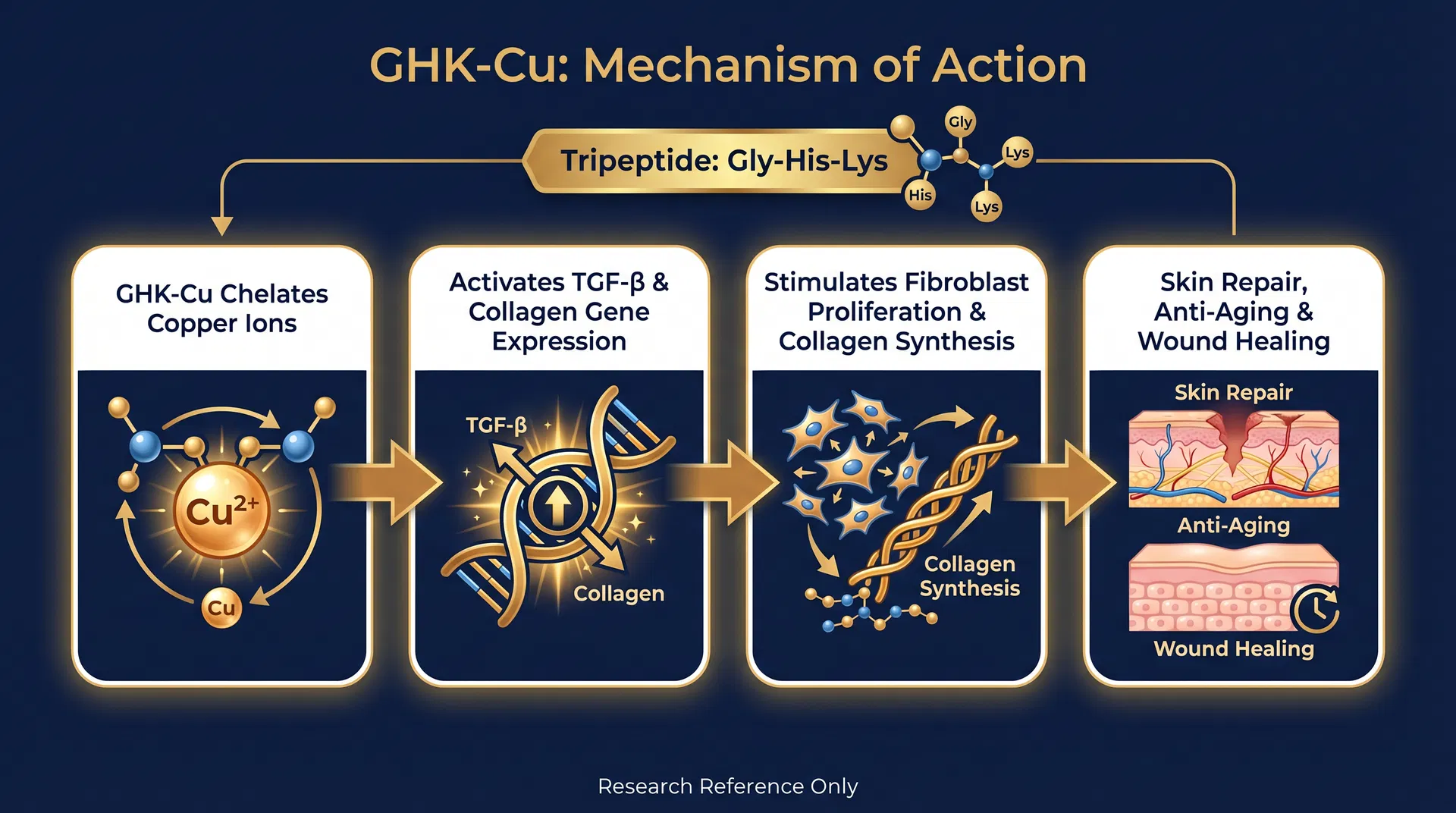
GHK-Cu stimulates collagen synthesis and skin repair by activating copper-dependent enzymes and upregulating growth factors that remodel the extracellular matrix.
GHK-Cu exerts its effects through multiple, partially overlapping mechanisms that collectively promote extracellular matrix synthesis, remodeling, and cytoprotection. The primary mechanism involves stimulation of collagen and elastin synthesis in dermal fibroblasts. In vitro studies have demonstrated that GHK-Cu increases the production of collagen types I, III, and IV, as well as elastin and glycosaminoglycans.
A second major mechanism involves the regulation of matrix metalloproteinases (MMPs) and their inhibitors (TIMPs). GHK-Cu upregulates MMP-2 (gelatinase A) while simultaneously increasing TIMP-1 expression, suggesting a role in balanced matrix remodeling rather than simple matrix deposition.
Perhaps most intriguingly, research using the Broad Institute Connectivity Map demonstrated that GHK peptide modulates the expression of over 4,000 human genes, including pathways involved in DNA repair, antioxidant defense, anti-inflammatory signaling, and stem cell activation.
Key Research Pathways
Collagen / Elastin Synthesis
Stimulates fibroblast production of collagen types I, III, and IV, elastin, and glycosaminoglycans — the structural scaffold of dermal tissue.
MMP / TIMP Matrix Remodeling
Upregulates MMP-2 and TIMP-1 in a balanced manner, enabling controlled matrix remodeling and reduction of hypertrophic scar formation.
Gene Expression Modulation
Resets pathological gene expression patterns across >4,000 genes, including DNA repair, antioxidant defense, and anti-inflammatory pathways.
Copper-Dependent Enzyme Activation
Delivers bioavailable Cu²⁺ as cofactor for lysyl oxidase (collagen cross-linking) and superoxide dismutase (antioxidant defense).
Key Findings from the Literature
- Stimulates collagen types I, III, and IV synthesis in dermal fibroblasts (Pickart et al., 2018)
- Regulates MMP-2 and TIMP-1 for balanced extracellular matrix remodeling (Siméon et al., 2000)
- Modulates expression of >4,000 human genes via epigenetic mechanisms (Pickart et al., 2017)
- Increases antioxidant enzyme activity including superoxide dismutase (SOD)
- Promotes nerve outgrowth and blood vessel formation in preclinical models
- Plasma concentrations decline ~60% between ages 20–60, correlating with skin aging markers
Evidence by Claimed Outcome
Each outcome rated by the highest level of evidence available. Tiers follow our 5-tier methodology.
Study counts reflect peer-reviewed publications in the evidence database below. "Theoretical" outcomes have mechanistic rationale only. Learn about our evidence tiers →
Structured Evidence Table
1 cited study — model, sample size, outcome, and effect size from published literature.
| Study | Model | Sample | Outcome | Effect Size | Level |
|---|---|---|---|---|---|
Pickart L & Margolina A. (2018) Regenerative and Protective Actions of the GHK-Cu Peptide in the Light of the Ne… PubMed | Review — in vitro + human | Review | GHK-Cu modulates 4,000+ genes; promotes collagen I/III synthesis; anti-inflammatory | Collagen synthesis increase: 70–100% in fibroblast cultures | In Vitro |
How Long It Lasts & How It Works in the Body
GHK-Cu (Copper Peptide) — half-life, bioavailability, onset, and duration data
| Parameter | Value | Source |
|---|---|---|
| Half-Life (t½) | ~30–60 minutes (estimated) Rapidly degraded; topical application has different kinetics | Preclinical Data |
| Time to Peak (Tmax) | ~30–60 minutes (SC) Preclinical estimates | Preclinical Data |
| Bioavailability (F) | Topical: variable; SC: estimated >70% Topical penetration depends on formulation | Preclinical Data |
| Onset of Action | Days to weeks Collagen synthesis and tissue remodeling effects are cumulative | — |
| Duration of Action | Tissue effects persist beyond plasma half-life | — |
Naturally occurring copper-binding tripeptide (Gly-His-Lys). Endogenous levels decline with age. Topical formulations are widely used for skin applications; SC injection used for systemic tissue repair protocols.
References:
• Pickart L & Margolina A. Biomolecules 2018
• Pickart L. J Biomater Sci Polym Ed 2008
Important Research Context
Research References
Peer-reviewed literature supporting the research profile of GHK-Cu
The following peer-reviewed studies form the primary evidence base for GHK-Cu's research profile. All references are sourced from PubMed, NCBI, and peer-reviewed scientific journals. Published research is available through PubMed, NCBI, and peer-reviewed biomedical journals.
- 1.
Pickart L, Margolina A. Regenerative and Protective Actions of the GHK-Cu Peptide in the Light of the New Gene Data. International Journal of Molecular Sciences. 2018.PMID: 29986520
GHK-Cu modulates over 4,000 human genes, including those controlling tissue remodeling and anti-inflammatory pathways.
- 2.
Pickart L. The human tri-peptide GHK and tissue remodeling. Journal of Biomaterials Science, Polymer Edition. 2008.PMID: 18644225
Comprehensive review of GHK-Cu's role in collagen synthesis, wound healing, and skin remodeling.
- 3.
Gorouhi F, Maibach HI. Role of topical peptides in preventing or treating aged skin. International Journal of Cosmetic Science. 2009.PMID: 19570099
Topical peptides including GHK-Cu demonstrate measurable improvements in skin firmness and wrinkle depth.
- 4.
Pickart L, Vasquez-Soltero JM, Margolina A. GHK Peptide as a Natural Modulator of Multiple Cellular Pathways in Skin Regeneration. BioMed Research International. 2015.PMID: 26236730
GHK-Cu activates TGF-β1 and promotes fibroblast proliferation and collagen production.
GHK-Cu
Skin & Anti-Aging Research
Purgo Labs list price, read 12 Sep 2026 · per-lot COA on the vendor page
50mg $29.99 → $23.99 with code HEALTH (20% off; price read 2 Oct 2026)
- 1 certificate verified at the lab50mg$29.99→ $23.99
- 2 certificates verified at the lab100mg$35.00→ $28.00
- 1 certificate verified at the lab50mg$29.99→ $23.99
Fast FedEx shipping · Discreet packaging
Technical Specifications
| Peptide Class | Tripeptide-metal complex (3 amino acids + Cu²⁺) |
| Molecular Weight | ~403.9 Da (copper complex) |
| Amino Acid Sequence | Gly-His-Lys (GHK) |
| Metal Cofactor | Copper(II) ion (Cu²⁺) |
| Natural Occurrence | Human plasma, saliva, urine |
| Available Sizes | 50mg, 100mg vials |
| Form | Lyophilized powder |
| Purity | ≥99% (third-party tested) |
View full legal status guide →
Known Interactions
6 documented interactions for GHK-Cu
Both promote wound healing and collagen synthesis via complementary mechanisms — BPC-157 via angiogenesis, GHK-Cu via collagen cross-linking.
Both support tissue remodeling and wound healing via different mechanisms — TB-500 via actin modulation, GHK-Cu via collagen synthesis.
Epithalon activates telomerase for cellular longevity; GHK-Cu supports collagen synthesis and tissue remodeling. Complementary anti-aging mechanisms.
Interaction data is based on published research, known pharmacological mechanisms, and clinical practitioner experience. Evidence tiers: Clinical = human data; Emerging = preclinical/case reports; Theoretical = mechanism-based inference. Always consult a qualified healthcare provider before combining compounds.
Source GHK-Cu at Purgo Labs
50mg $29.99 list · $23.99 with code HEALTH · lab-verifiable COA per lot
Other Compounds in This Guide


Related Research Guides
Supporting Research
GHK-Cu has more published human skin data than most research peptides, including a double-blind RCT showing improvements in skin laxity and fine lines. It is also used in FDA-cleared wound healing devices. Evidence for systemic or non-dermatological effects remains preclinical.
References
- Pickart L, Margolina A.REVIEWRegenerative and Protective Actions of the GHK-Cu Peptide in the Light of the New Gene Data. International Journal of Molecular Sciences. 2018. PubMedGHK-Cu modulates over 4,000 human genes, including those controlling tissue remodeling and anti-inflammatory pathways.
- Pickart L, Vasquez-Soltero JM, Margolina A.REVIEWGHK Peptide as a Natural Modulator of Multiple Cellular Pathways in Skin Regeneration. BioMed Res Int. 2015. PubMedGHK-Cu activates TGF-β1 and promotes fibroblast proliferation and collagen production.
Research Databases
Ready to Source GHK-Cu?
Purgo Labs offers GHK-Cu with ≥99% purity, third-party certificates of analysis, and fast FedEx shipping. This is an affiliate link — we may earn a commission at no cost to you.