


✦HEALTH · 20% off Purgo Labs✦
Back to Research Guide
Longevity ResearchTier 4 — Phase 3 Failed
Research Purposes Only
Tier 4 — Phase 3 Failed

SS-31

Cardiolipin Stabilization & Mitochondrial Cristae Restoration

SS-31 (Elamipretide) — Mitochondria-Targeted Tetrapeptide

Last reviewed: August 2026

Clinical Trials
Research Purposes Only. SS-31 is supplied by Purgo Labs strictly for qualified laboratory research use only. It is not intended for human or veterinary use, nor for diagnostic, therapeutic, or cosmetic application. Statements on this page have not been evaluated by the FDA.
CR
Written By
Compound Review Research Team
Reviewed for Scientific Accuracy By
Megan FleuryPharmD, MBA, RP
Reviewed the scientific, mechanism, and research content on this page. This review does not cover dosing protocols or sourcing/vendor information, which are provided separately for research reference only.
Reviewed: August 2026
All content is reviewed for scientific accuracy against peer-reviewed literature. View our editorial methodology.
So What Does This Actually Mean?
Plain English summary — no PhD required

SS-31 (Elamipretide) is a 4-amino-acid peptide that targets cardiolipin in the inner mitochondrial membrane. Phase II trials showed encouraging signals, but the pivotal Phase 3 MMPOWER-HF trial (n=360, 2023) did not meet its primary endpoint. Efficacy is not demonstrated in humans. Anti-aging and longevity effects are preclinical only.

What It Does

SS-31 concentrates 1,000-fold in the inner mitochondrial membrane, stabilizing cardiolipin and the electron transport chain complexes that produce ATP. This reduces ROS production, improves energy output, and protects against mitochondrial dysfunction.

Why It Matters

Mitochondrial dysfunction is a hallmark of aging and a driver of heart failure and neurodegeneration. SS-31 concentrates at the exact site of ROS generation — a precision that conventional antioxidants lack.

The Bottom Line

SS-31 is a mitochondria-targeted tetrapeptide with a well-characterized mechanism and the most advanced clinical program of any mitochondria-targeted peptide. However, the Phase 3 MMPOWER-HF trial failed its primary endpoint. Human efficacy is not demonstrated. Anti-aging effects are preclinical only.

Overview

What is SS-31?

SS-31 (also known as Elamipretide or MTP-131) is a tetrapeptide that selectively concentrates in the inner mitochondrial membrane, where it binds cardiolipin — a phospholipid essential for electron transport chain function. The proposed mechanism involves stabilizing cardiolipin and restoring cristae architecture. Phase II trials in heart failure showed encouraging signals, but the pivotal Phase 3 MMPOWER-HF trial (n=360, 2023) did not meet its primary endpoint. Efficacy is not demonstrated in humans. Anti-aging and longevity effects are preclinical only.

Key Takeaways
  • SS-31 (Szeto-Schiller peptide 31, also known as Elamipretide) is a tetrapeptide (D-Arg-Dmt-Lys-Phe-NH2) developed by Hazel Szeto at Weill Cornell Medicine, designed to selectively target the inner mitochondrial membrane.
  • Mechanism: the alternating aromatic-cationic structure enables SS-31 to selectively concentrate in the inner mitochondrial membrane (IMM) where it binds cardiolipin — a phospholipid essential for electron transport chain (ETC) organization and cristae structure.
  • Cardiolipin binding stabilizes cytochrome c in the ETC, reduces electron leak (and thus reactive oxygen species production), and preserves mitochondrial cristae architecture during ischemia-reperfusion injury.
  • Clinical translation: Elamipretide has been evaluated in Phase 2 and Phase 3 trials. The pivotal Phase 3 MMPOWER-HF trial (n=360, 2023) did not meet its primary endpoint. The Barth syndrome Phase 3 program (MMPOWER-3) also did not meet its primary endpoint. Efficacy is not demonstrated; SS-31 is not FDA-approved.
  • Unlike MOTS-c (which acts via AMPK signaling), SS-31 acts directly at the mitochondrial membrane level — making it a complementary tool for studying mitochondrial biology from a structural vs. signaling perspective.
Composition

Molecular Composition

Amino Acid Sequence
D-Arg-2',6'-Dmt-Lys-Phe-NH2

SS-31 is a 4-amino-acid tetrapeptide with an alternating aromatic-cationic motif (D-Arg-2',6'-Dmt-Lys-Phe-NH2). The dimethyltyrosine (Dmt) residue provides antioxidant activity, while the cationic residues (D-Arg, Lys) drive electrostatic concentration in the inner mitochondrial membrane, achieving 1,000-fold enrichment relative to cytoplasm.

Mechanism of Action

How Does It Work?

!

SS-31 restores mitochondrial function by stabilizing cardiolipin in the inner mitochondrial membrane, improving ATP production efficiency and reducing damaging free radical leakage.

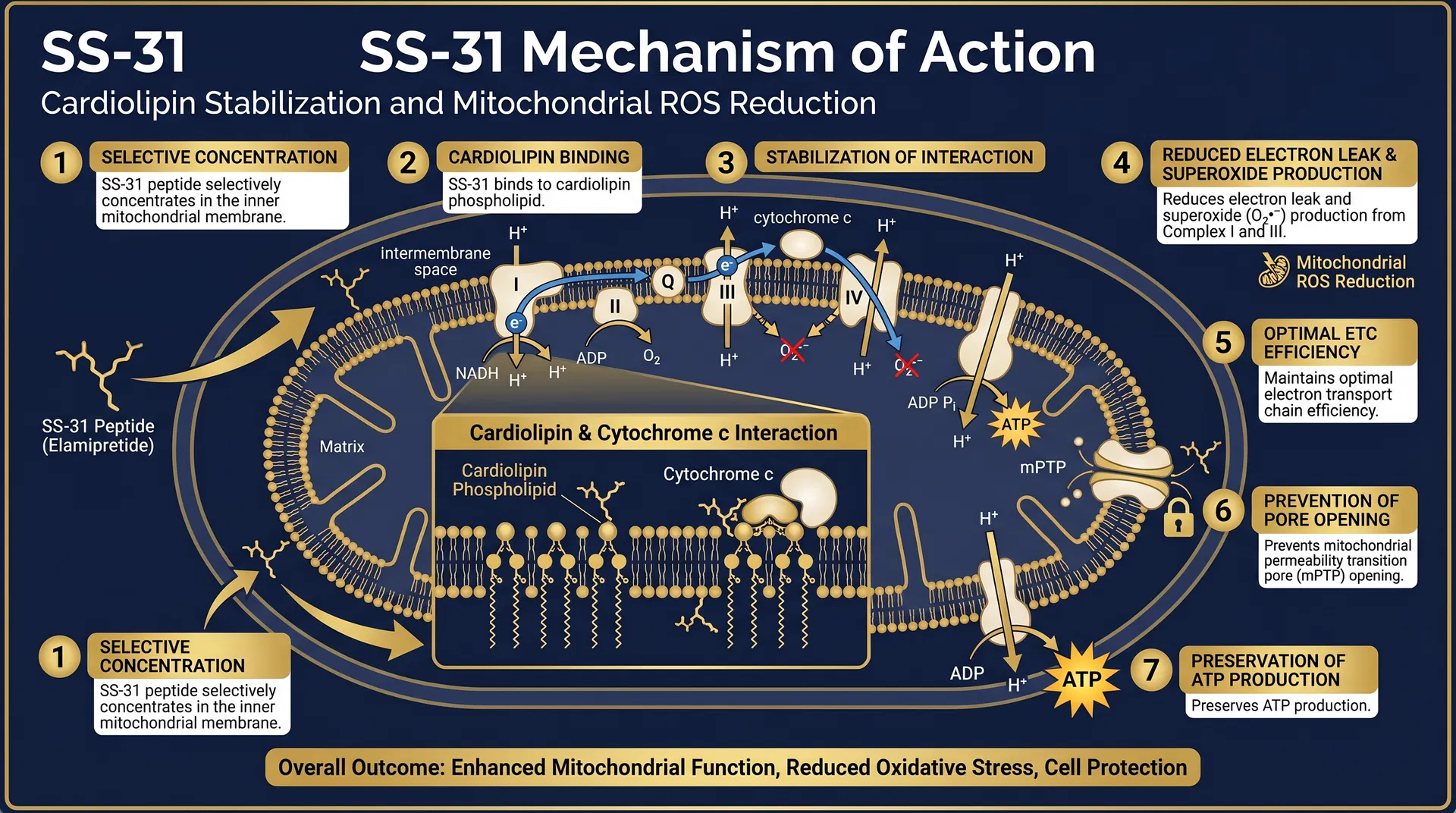
SS-31 concentrates in the inner mitochondrial membrane via electrostatic interactions, where it binds cardiolipin — a phospholipid that anchors electron transport chain complexes. By stabilizing cardiolipin, SS-31 maintains optimal cristae architecture and ETC complex conformation, improving ATP synthesis efficiency and reducing electron leak (and consequent ROS generation).

SS-31 mechanism of action diagram — step-by-step signaling pathway infographic
SS-31 Mechanism of Action — Simplified signaling pathway diagram. For research reference only.
"SS-31 targets the inner mitochondrial membrane and restores mitochondrial function by stabilizing cardiolipin, reducing ROS, and improving ATP production." — Szeto, Antioxidants & Redox Signaling, 2014
Signaling Pathways

Key Research Pathways

Cardiolipin Stabilization / Cristae Architecture

Binds cardiolipin in the inner mitochondrial membrane, stabilizing cristae structure and maintaining optimal conformation of electron transport chain complexes for efficient ATP synthesis.

ROS Scavenging / Mitochondrial Antioxidant Defense

Reduces mitochondrial superoxide and hydrogen peroxide production by preventing electron leak from the electron transport chain.

Ischemia-Reperfusion Protection

Protects against ischemia-reperfusion injury by maintaining mitochondrial membrane potential and preventing mPTP opening during reperfusion.

Research Highlights

Key Findings from the Literature

  • Phase 2 trials showed encouraging signals; pivotal Phase 3 MMPOWER-HF trial (n=360, 2023) did not meet its primary endpoint
  • Phase 3 Barth syndrome program (MMPOWER-3): primary endpoint not met; some secondary endpoints improved
  • Reversed age-related decline in skeletal muscle function in old mice (Science, 2020)
  • 1,000-fold concentration in inner mitochondrial membrane vs. cytoplasm
  • Reduces mitochondrial ROS by stabilizing cardiolipin and preventing electron leak
Outcome Matrix

Evidence by Claimed Outcome

Each outcome rated by the highest level of evidence available. Tiers follow our 5-tier methodology.

StrongModeratePreliminaryPreclinicalTheoretical
Mitochondrial membrane protection
Moderate
4
Phase II trial in heart failure (PROGRESS-HF); cardiolipin targeting confirmed
Cardiac function improvement
Moderate
3
Phase II data; PROGRESS-HF showed improved 6MWT
Renal protection
Preliminary
2
Phase I/II data in CKD; mechanistically plausible
Exercise tolerance
Preliminary
1
Secondary endpoint in PROGRESS-HF; positive trend

Study counts reflect peer-reviewed publications in the evidence database below. "Theoretical" outcomes have mechanistic rationale only. Learn about our evidence tiers →

Researcher Notes

Important Research Context

SS-31 (Elamipretide) has the most advanced clinical data of any mitochondria-targeted peptide, but the pivotal Phase 3 MMPOWER-HF trial (n=360, 2023) did not meet its primary endpoint in heart failure. The Barth syndrome Phase 3 program (MMPOWER-3) also did not meet its primary endpoint. Anti-aging and longevity effects are preclinical only. A 2020 study in Science demonstrated SS-31 reversed age-related decline in skeletal muscle function in old mice — this is animal data, not human evidence.

Research References

Peer-reviewed literature supporting the research profile of SS-31

The following peer-reviewed studies form the primary evidence base for SS-31's research profile. All references are sourced from PubMed, NCBI, and peer-reviewed scientific journals. Published research is available through PubMed, NCBI, and peer-reviewed biomedical journals.

  1. 1.

    Szeto HH. First-in-class cardiolipin-protective compound as a therapeutic agent to restore mitochondrial bioenergetics. British Journal of Pharmacology. 2014.PMID: 24117165

    SS-31 (Elamipretide) protects cardiolipin and restores mitochondrial cristae structure and ATP production.

  2. 2.

    Chatfield KC, et al. Elamipretide improves mitochondrial function in the failing human heart. JACC: Basic to Translational Science. 2019.PMID: 31061916

    SS-31 improved mitochondrial respiration in human failing heart tissue ex vivo.

  3. 3.

    Daubert MA, et al. Novel Mitochondria-Targeting Peptide in Heart Failure Treatment: A Randomized, Placebo-Controlled Trial of Elamipretide. Circulation: Heart Failure. 2017.PMID: 29217757

    Phase II trial: SS-31 (elamipretide) improved cardiac function and exercise capacity in heart failure patients.

SS-31

Longevity Research

From $54.99

Purgo Labs list price, read 12 Sep 2026 · per-lot COA on the vendor page

1 vial (sold as PL-31)
List price · read 12 Sep 2026
$54.99
Compare vendors that sell SS-31

Purgo Labs does not list SS-31 (checked 26 Sep 2026)

Fast FedEx shipping · Discreet packaging

Sourced from Purgo Labs
✅≥99% Purity
📋COA Verified
🏭cGMP Made

Technical Specifications

Peptide Class
Szeto-Schiller tetrapeptide (4 amino acids)
Molecular Weight
639.8 Da
Regulatory Status
Phase 3 MMPOWER-HF failed primary endpoint (2023); not FDA-approved
Available Sizes
5mg, 10mg vials
Form
Lyophilized powder
Purity
≥99% (third-party tested)
Legal Status
Research Chemical

View full legal status guide →

Where to buy SS-31

Purgo Labs does not list this compound — every scored vendor that does, with dated prices

Compare vendors
Safety

SS-31 side effects

Human trial data

Extensive human trial data for the pharmaceutical form (elamipretide); research-grade SS-31 is not that product

SS-31 is the research name for elamipretide, a mitochondria-targeting tetrapeptide that Stealth BioTherapeutics has taken through multiple randomised trials in heart failure, primary mitochondrial myopathy and Barth syndrome. Its adverse-effect profile is therefore unusually well characterised for a compound sold by research vendors: injection-site reactions dominate. The efficacy record is mixed, which matters when weighing any risk.

Research-use information only. Research-grade SS-31 is not an approved medicine; where trial or label figures appear below they belong to the pharmaceutical product studied, not to any research vial. This section does not give dosing or medical advice.

What is reported

Every rate carries its source. Where no source exists, no rate is printed.

EffectRate (sourced)DetailSource
Injection-site reactions (erythema, pain, pruritus)not quantifiedThe most frequent adverse event across subcutaneous elamipretide trials; generally mild and reported at high frequency in daily-injection studies.Daubert et al. 2017 (PROGRESS-HF); Stealth BioTherapeutics trial reports
Serious adverse eventsnot quantifiedNo consistent drug-related serious adverse-event signal has been reported across the published trials.Daubert et al. 2017; Szeto 2014 (review)

What is not known

  • •Whether a research vial contains elamipretide at the labelled dose — the trial data belong to the pharmaceutical product.
  • •Long-term effects beyond trial durations.

Mechanism-based cautions

  • •Elamipretide binds cardiolipin in the inner mitochondrial membrane; effects on mitochondrial function are the intended action and are systemic.
  • •The Phase 3 trial in primary mitochondrial myopathy (MMPOWER-3) missed its primary endpoints, and the heart-failure programme did not progress — efficacy for those uses is not established.

Regulatory status: Elamipretide received FDA accelerated approval for Barth syndrome in 2025 (marketed as Forzinity); it is not approved for any other indication. Research-grade SS-31 is not the approved product.

Side-effect references

  1. Daubert MA, et al. Novel Mitochondria-Targeting Peptide in Heart Failure Treatment: A Randomized, Placebo-Controlled Trial of Elamipretide. Circulation: Heart Failure, 2017. PMID 29217757.
  2. Szeto HH. First-in-class cardiolipin-protective compound as a therapeutic agent to restore mitochondrial bioenergetics. British Journal of Pharmacology, 2014. PMID 24117165.
  3. Chatfield KC, et al. Elamipretide improves mitochondrial function in the failing human heart. JACC: Basic to Translational Science, 2019. PMID 31061916.

What is actually in a research vial

Everything above describes SS-31 the molecule. The risk specific to a research vial is different: it may not contain SS-31 at the labelled amount, and it may contain what the synthesis left behind. Identity (mass spectrometry), purity (HPLC), measured net content and an endotoxin result are the four lines on a certificate that bear on adverse effects, and only a certificate you can check at the laboratory tells you any of them. This is what we have verified for SS-31 so far.

Who sells SS-31, and what they document

20 of the 105 vendors on our scoreboard list SS-31 with a price we read on the product page (23 Sep 2026–1 Nov 2026). Of those, 20 name their testing laboratory, 17 publish certificates that resolve on the lab's own site, and 19 publish measured milligrams against the label. The full ranking, with every dated price, is on Best SS-31 Vendors.

VendorRubricLab namedPrice read
MyPurePeptidepartner10/10Janoshik Analytical$80.00 · 50mg · 1 Nov 2026
Oneday Compoundspartner10/10ILS Laboratories (San Diego, CA)$20.99 · 10mg · 29 Oct 2026
Peptide Giantspartner10/10Janoshik Analytical · Vanguard Laboratory$49.99 · 10mg · 1 Nov 2026
Premier Bio Labs10/10ILS Laboratories + Freedom Diagnostics$55.99 · 10mg · 1 Nov 2026
ezPepspartner9/10ILS Laboratories (also Kovera Labs, Freedom Diagnostics, Horizon Analytical)$129.99 · 50mg · 31 Oct 2026

Top 5 by rubric score; 15 more on the ranking page.

SS-31 certificates we have opened

None yet for SS-31 specifically. The COA library holds the certificates we have read for each vendor on other compounds, which is the next best signal of how that vendor documents a lot.

Side-effect questions

What are the most common side effects of SS-31?

In the published elamipretide trials, injection-site reactions — redness, pain, itching — were by far the most common, and were usually mild. No consistent serious adverse-event signal has been reported. Those data come from the pharmaceutical product given under trial conditions, not from research vials.

Is SS-31 approved?

Elamipretide has a narrow 2025 FDA accelerated approval for Barth syndrome, a rare mitochondrial disease. It is not approved for heart failure, mitochondrial myopathy, ageing or performance, and research-grade SS-31 is not the approved product.

Side-effect section last reviewed 2026-09-13. Moved from the standalone side-effects page on 10 October 2026; text unchanged.

Everything we publish on SS-31

More on SS-31: comparisons, interactions, where to buy

Supporting Research

Mixed EvidenceMixed — Phase 2 positive; Phase 3 cardiac trial (MMPOWER-HF) negative
Evidence note: The pivotal Phase 3 MMPOWER-HF trial (2023, n=360) did not meet its primary endpoint. Anti-aging and longevity effects are preclinical only. SS-31 is not FDA-approved.

SS-31 (elamipretide) had encouraging Phase 2 cardiac data, but the pivotal Phase 3 trial (MMPOWER-HF, n=360) failed its primary endpoint in 2023 — no significant improvement in 6-minute walk distance vs placebo. The Barth syndrome program continues. Anti-aging, exercise, and longevity claims are preclinical only. Present the Phase 3 failure honestly.

References

  • Daubert MA, et al.HUMAN RCT, Phase 2
    Novel Mitochondria-Targeting Peptide in Heart Failure Treatment: A Randomized, Placebo-Controlled Trial of Elamipretide. Circulation: Heart Failure. 2017. PubMed
    SS-31 (elamipretide) improved cardiac function and exercise capacity in heart failure patients.
  • Chatfield KC, et al.HUMAN EX VIVO
    Elamipretide improves mitochondrial function in the failing human heart. JACC Basic Transl Sci. 2019. PubMed
    SS-31 improved mitochondrial respiration in human failing heart tissue ex vivo.
  • Szeto HH, Schiller PW.REVIEW
    Stealth peptides target cellular powerhouses and enable a new era of medicine. Pharmaceutical Research. 2011. PubMed
    SS-31 selectively concentrates in the inner mitochondrial membrane via cardiolipin binding, reducing ROS and improving ATP production.

Research Databases

PubMedClinicalTrials.gov

Get 24 partner codes now, and every SS-31 price move, Mondays and Fridays

The welcome email carries every verified partner code we hold. Then two short emails a week, Monday and Friday: partner sales checked against the market, every SS-31 price move across our scored vendors, restocks, score changes, and the certificates we opened.

Codes now, the report Mondays and Fridays. Unsubscribe in one click. We never sell or share the list. See this week's issue.

Ready to Source SS-31?

Purgo Labs does not currently list SS-31. The ranking below covers every scored vendor that does, with dated product-page prices.

Compare vendors that sell SS-31