

Is retatrutide safe?
Nobody can say yet. A phase 2 trial in 338 people reported a tolerability profile similar in kind to other incretin drugs with a heart-rate signal; phase 3 is what establishes safety and it is not finished.
GLP-3 R / GLP-3 RT: Phase 3 Results, Approval Status & Verified Vendor Prices
Retatrutide (LY3437943) — GIP/GLP-1/Glucagon Triple Agonist
Last reviewed: 9 October 2026
GLP-3 R (Retatrutide) is one of the newest and most discussed compounds in metabolic research. It's a triple-receptor agonist — meaning it activates three different hormone receptors simultaneously: GLP-1R, GIP-R, and glucagon receptor. This triple action is what makes it particularly interesting compared to existing GLP-1 drugs like Ozempic, which only target one receptor.
By hitting all three receptors at once, Retatrutide combines the appetite-suppressing, insulin-stimulating effects of GLP-1 with the additional metabolic benefits of GIP (which enhances insulin secretion and may improve GLP-1 receptor sensitivity) and glucagon (which increases energy expenditure and fat burning). In Phase 2 clinical trials published in the New England Journal of Medicine in 2023, Retatrutide produced weight loss of up to 24.2% of body weight over 48 weeks — the highest ever reported for a pharmacological agent in a clinical trial.
The 24% weight loss figure from the Phase 2 trial is genuinely unprecedented in pharmacology. For context, semaglutide (Wegovy) produces about 15% weight loss, and tirzepatide about 20%. Retatrutide's triple-receptor mechanism may represent the next generation of metabolic therapeutics. It's currently in Phase 3 trials, meaning it could reach clinical approval within the next few years.
Retatrutide is arguably the most scientifically exciting compound in this entire catalog right now. Its Phase 2 NEJM data showing 24% weight loss is unprecedented, and its triple-receptor mechanism is at the cutting edge of metabolic research. It is an investigational compound with no current regulatory approval, supplied for laboratory research use only.
Retatrutide (LY3437943, GLP-3 R) is a novel triple agonist developed by Eli Lilly that simultaneously activates three incretin and metabolic hormone receptors: the glucose-dependent insulinotropic polypeptide receptor (GIPR), the glucagon-like peptide-1 receptor (GLP-1R), and the glucagon receptor (GCGR). This triple agonism represents the next generation of metabolic peptide therapeutics, building on the success of GLP-1 agonists (semaglutide) and dual GIP/GLP-1 agonists (tirzepatide).
Phase II clinical trial data published in the New England Journal of Medicine (2023) demonstrated that retatrutide produced up to 24.2% mean body weight reduction at 48 weeks — the largest weight loss observed for any pharmacological agent in a clinical trial to date, surpassing even tirzepatide's results.
Retatrutide is a 37-amino-acid peptide with a fatty acid modification that enables once-weekly subcutaneous dosing through albumin binding. The sequence is based on a glucagon backbone with modifications that enable simultaneous engagement of GIPR, GLP-1R, and GCGR. The molecular weight is 4,731.33 Daltons.
The triple receptor agonism is achieved through careful sequence engineering: the N-terminal region is optimized for GLP-1R and GCGR engagement, while specific residues in the mid-sequence region enable GIPR activation. The fatty acid modification (C18 fatty diacid) enables albumin binding for extended half-life.
Retatrutide drives the most potent weight loss observed in clinical trials by activating three receptors — GLP-1, GIP, and glucagon — simultaneously.
Retatrutide's mechanism of action involves simultaneous activation of three receptors with complementary metabolic effects. GLP-1R activation provides glucose-dependent insulin secretion, glucagon suppression, gastric emptying delay, and central appetite suppression. GIPR activation enhances insulin secretion and may contribute to the superior weight loss observed with dual/triple agonists compared to GLP-1R agonists alone.
GCGR activation is the distinguishing feature of retatrutide: glucagon receptor stimulation increases hepatic glucose production (which is counterbalanced by the GLP-1R-mediated insulin secretion), but more importantly, it increases energy expenditure through thermogenic effects in brown adipose tissue and hepatic fatty acid oxidation. This energy expenditure-increasing component may explain the superior weight loss efficacy of retatrutide compared to GLP-1/GIP dual agonists.
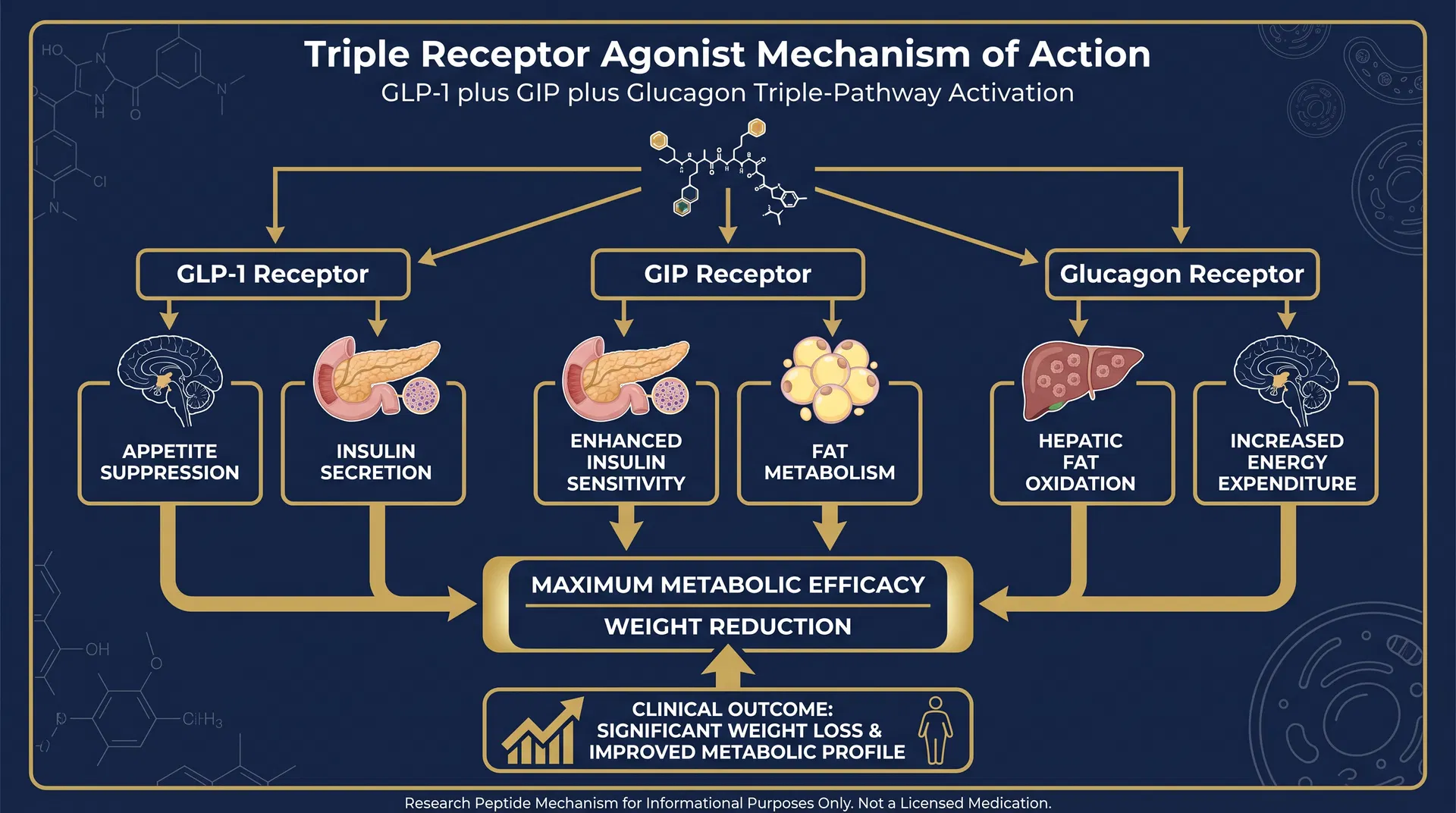
Glucose-dependent insulin secretion, glucagon suppression, gastric emptying delay, and central appetite suppression via hypothalamic GLP-1R.
Enhances insulin secretion and may contribute to superior weight loss vs. GLP-1R agonists alone through complementary beta cell effects.
Glucagon receptor activation increases hepatic fatty acid oxidation and brown adipose thermogenesis, raising total energy expenditure.
C18 fatty diacid modification enables reversible albumin binding, extending half-life to support once-weekly dosing.
Each outcome rated by the highest level of evidence available. Tiers follow our 5-tier methodology.
Study counts reflect peer-reviewed publications in the evidence database below. "Theoretical" outcomes have mechanistic rationale only. Learn about our evidence tiers →
1 cited study — model, sample size, outcome, and effect size from published literature.
| Study | Model | Sample | Outcome | Effect Size | Level |
|---|---|---|---|---|---|
Jastreboff AM, et al. (2023) Triple–Hormone-Receptor Agonist Retatrutide for Obesity — A Phase 2 Trial PubMed | Human — Phase II RCT | n=338 | 24.2% mean body weight reduction at 48 weeks (highest dose cohort) | 24.2% weight loss vs. 2.1% placebo; statistically significant (p<0.001) | Phase II |
Retatrutide — half-life, bioavailability, onset, and duration data
| Parameter | Value | Source |
|---|---|---|
| Half-Life (t½) | ~6 days (144 hours) Range: 120–168 hours Phase 2 data; enables once-weekly dosing | Clinical Trial Data |
| Time to Peak (Tmax) | ~24–48 hours Phase 2 pharmacokinetic data | Clinical Trial Data |
| Bioavailability (F) | ~85% (estimated) Based on Phase 2 data; not yet in prescribing information | Clinical Trial Data |
| Protein Binding | >99% Fatty acid-mediated albumin binding | Clinical Trial Data |
| Onset of Action | 1–2 weeks Phase 2 NEJM data | — |
| Duration of Action | 7 days per dose | — |
Triple agonist (GLP-1/GIP/glucagon). Phase 2 data only as of 2025. PK profile similar to tirzepatide. Phase 3 TRIUMPH trials ongoing.
References:
• Jastreboff AM et al. NEJM 2023; 389:514-526 (TRIUMPH Phase 2)
Peer-reviewed literature supporting the research profile of Retatrutide
The following peer-reviewed studies form the primary evidence base for Retatrutide's research profile. All references are sourced from PubMed, NCBI, and peer-reviewed scientific journals. Published research is available through PubMed, NCBI, and peer-reviewed biomedical journals.
Jastreboff AM, et al. Triple-Hormone-Receptor Agonist Retatrutide for Obesity — A Phase 2 Trial. New England Journal of Medicine. 2023.PMID: 37366315
Retatrutide achieved up to 24.2% body weight reduction at 48 weeks — the highest reported for any pharmacological agent in Phase II.
Coskun T, et al. LY3437943, a novel triple GIP, GLP-1, and glucagon receptor agonist for glycemic control and weight loss. Cell Metabolism. 2022.PMID: 35985340
Preclinical characterization of retatrutide's triple receptor agonism and metabolic effects.
Metabolic Research
Purgo Labs list price, read 12 Sep 2026 · per-lot COA on the vendor page
10mg $59.99 → $47.99 with code HEALTH (20% off; price read 1 Nov 2026)
Fast FedEx shipping · Discreet packaging
View full legal status guide →
5 documented interactions for Retatrutide
Both target GLP-1 receptors. Combining is contraindicated due to additive receptor agonism and adverse event risk.
Both affect glucose metabolism. Monitor blood glucose if combining.
BPC-157 may support GI health during triple agonist therapy. No known negative interaction.
Interaction data is based on published research, known pharmacological mechanisms, and clinical practitioner experience. Evidence tiers: Clinical = human data; Emerging = preclinical/case reports; Theoretical = mechanism-based inference. Always consult a qualified healthcare provider before combining compounds.
Source Retatrutide at Purgo Labs
10mg $59.99 list · $47.99 with code HEALTH · lab-verifiable COA per lot
Since the 2025–26 enforcement wave almost no vendor lists retatrutide by name. These are the 39 house codes we have read on vendor pages. 24 of them come with a stated identity (a CAS number, a lab lot prefix on the vendor's certificate page, or the vendor's own FAQ); the rest are codes only, and we keep those out of the price table.
Full decoder: every GLP-1, tirzepatide and retatrutide vendor code, with the evidence behind each · green = identity stated, amber = code only
Phase 2 human trial data exist; not approved anywhere — figures are from the phase 2 obesity trial
Retatrutide is unapproved and still in phase 3, so its safety profile is provisional. The phase 2 obesity trial reported dose-dependent gastrointestinal effects during escalation, discontinuations that rose with dose, and an increase in heart rate. Long-term safety is unknown.
Research-use information only. Research-grade Retatrutide is not an approved medicine; where trial or label figures appear below they belong to the pharmaceutical product studied, not to any research vial. This section does not give dosing or medical advice.
Every rate carries its source. Where no source exists, no rate is printed.
| Effect | Rate (sourced) | Detail | Source |
|---|---|---|---|
| Gastrointestinal events (nausea, diarrhoea, vomiting, constipation) | not quantified | Dose-related, mostly mild-to-moderate, concentrated during escalation. | Jastreboff et al. 2023 (phase 2) |
| Discontinuation for adverse events | 6–16% across dose groups vs 0% placebo | Higher at higher doses. | Jastreboff et al. 2023 |
| Heart-rate increase | not quantified | Dose-dependent rise observed, greatest early in treatment. | Jastreboff et al. 2023 |
| Dysaesthesia / skin sensitivity | not quantified | Reported in the phase 2 programme at higher doses. | Jastreboff et al. 2023 |
Regulatory status: Not approved anywhere; Eli Lilly phase 3 (TRIUMPH) ongoing as of 2026.
Everything above describes Retatrutide the molecule. The risk specific to a research vial is different: it may not contain Retatrutide at the labelled amount, and it may contain what the synthesis left behind. Identity (mass spectrometry), purity (HPLC), measured net content and an endotoxin result are the four lines on a certificate that bear on adverse effects, and only a certificate you can check at the laboratory tells you any of them. This is what we have verified for Retatrutide so far.
28 of the 105 vendors on our scoreboard list Retatrutide with a price we read on the product page (5 Sep 2026–1 Nov 2026). Of those, 27 name their testing laboratory, 24 publish certificates that resolve on the lab's own site, and 27 publish measured milligrams against the label. The full ranking, with every dated price, is on Best Retatrutide Vendors.
| Vendor | Rubric | Lab named | Price read |
|---|---|---|---|
| Idun Peptides | 10/10 | Kovera Labs (named in certificate captions only) | $44.99 · 10mg · 5 Sep 2026 |
| MyPurePeptidepartner | 10/10 | Janoshik Analytical | $80.00 · 10mg · 1 Nov 2026 |
| Oneday Compoundspartner | 10/10 | ILS Laboratories (San Diego, CA) | $32.99 · 5mg · 29 Oct 2026 |
| Panda Peptides | 10/10 | Janoshik Analytical · ILS Labs (per batch) | $53.99 · 10mg · 25 Oct 2026 |
| Peptide Giantspartner | 10/10 | Janoshik Analytical · Vanguard Laboratory | $39.99 · 5mg · 1 Nov 2026 |
Top 5 by rubric score; 23 more on the ranking page.
4 certificates for Retatrutide in the COA library: 4 checkable on the laboratory's own site, 4 stating measured mass against the label, 2 carrying a flag.
Nobody can say yet. A phase 2 trial in 338 people reported a tolerability profile similar in kind to other incretin drugs with a heart-rate signal; phase 3 is what establishes safety and it is not finished.
Side-effect section last reviewed 2026-09-12. Moved from the standalone side-effects page on 10 October 2026; text unchanged.
Retatrutide is not yet FDA-approved and is currently in Phase 3 clinical trials as of 2025. It is available as a research chemical for laboratory research purposes. It is not a controlled substance.
| Jurisdiction | Status as stated |
|---|---|
| United States | Not FDA-approved. Currently in Phase 3 clinical trials. Available as a research chemical for laboratory research. Not a controlled substance. |
| Canada | Not approved by Health Canada. Available for research purposes. |
| United Kingdom | Not licensed by the MHRA. Available for research purposes. |
| Australia | Not approved by the TGA. Available for research purposes. |
| European Union | Not approved by the EMA. Available for research purposes. |
Statements above are as our legal-status page for Retatrutide stated them in 2025; they were moved here on 10 October 2026 and were not re-verified in the move. Regulations change. This is general information, not legal advice; check the current position with your own jurisdiction's regulator before relying on it.
No. As of 2025, retatrutide is in Phase 3 clinical trials and has not yet received FDA approval. It is available as a research chemical for laboratory research purposes only.
No. Retatrutide is not listed as a controlled substance under the DEA Controlled Substances Act.
Based on Phase 3 trial timelines, retatrutide could potentially receive FDA approval in 2026 or 2027, though this timeline is not guaranteed.
Yes. Retatrutide can be legally purchased as a research chemical in the United States for legitimate laboratory research purposes.
Tirzepatide is FDA-approved (as Mounjaro and Zepbound), while retatrutide is still in clinical trials. Both are available as research chemicals, but tirzepatide also has an approved prescription form.
Retatrutide has Phase 2 human trial data showing exceptional weight loss (24.2% at 48 weeks). Phase 3 is ongoing. It is investigational — not FDA-approved. Claims about weight loss efficacy can be stated with confidence when tied to the Phase 2 NEJM trial, but must be accompanied by the Phase 3 / not-approved caveat.
Purgo Labs offers Retatrutide with ≥99% purity, third-party certificates of analysis, and fast FedEx shipping. This is an affiliate link — we may earn a commission at no cost to you.