AOD-9604
Targeted Lipolysis Without IGF-1 Stimulation
AOD-9604 — Modified GH Fragment (hGH 176-191)
Last reviewed: August 2026
AOD-9604 is a fragment of human growth hormone engineered to retain only the fat-burning properties of hGH while eliminating the growth-promoting and blood-sugar-disrupting effects. It received FDA GRAS status in 2014. The Phase 2b human obesity trial did not meet its primary weight-loss endpoint, and results were never published in a peer-reviewed journal. Human fat-loss efficacy is not established.
AOD-9604 activates fat cells' beta3-adrenergic receptors, triggering lipolysis (fat breakdown) and blocking lipogenesis (new fat creation). It does this without raising IGF-1 or insulin, which distinguishes it from full-length growth hormone.
Most fat-loss peptides work indirectly through appetite suppression or growth hormone release. AOD-9604 acts directly on fat cells in preclinical models, making it a mechanistically distinct tool for metabolic research. Its FDA GRAS status covers food safety, not therapeutic efficacy. The Phase 2b obesity trial failed its primary endpoint and was not published.
AOD-9604 is a GH-derived fat metabolism peptide with FDA GRAS status (food safety only) and a clean safety profile. Human fat-loss efficacy is not established — the Phase 2b obesity trial did not meet its primary endpoint and results were never published. It remains a tool for preclinical metabolic research.
What is AOD-9604?
AOD-9604 is a synthetic peptide fragment derived from the C-terminus of human growth hormone (hGH), specifically amino acids 176–191. Unlike full-length hGH, AOD-9604 retains the lipolytic (fat-burning) activity of the parent molecule without stimulating IGF-1 production or promoting cell proliferation. It received FDA GRAS designation in 2014 and has completed Phase II and Phase III clinical trials for obesity.
- AOD-9604 is a synthetic 16-amino acid peptide corresponding to the C-terminal lipolytic domain of human growth hormone (hGH 177-191), with a tyrosine added at the N-terminus for stability.
- Activates β3-adrenergic receptors in adipose tissue to stimulate lipolysis (fat breakdown) and inhibits lipogenesis — the same mechanism as the lipolytic region of full GH, without the growth-promoting or insulin-desensitizing effects of full GH.
- The Phase 2b obesity trial (METAOD-001, >500 subjects, Metabolic Pharmaceuticals) did not meet its primary weight-loss endpoint, and results were never published in a peer-reviewed journal. Human fat-loss efficacy is not established. The trials did establish a meaningful human safety database.
- The key advantage over full GH for metabolic research: AOD-9604 lacks the IGF-1-stimulating, glucose-elevating, and anabolic effects of full GH, providing a more targeted tool for studying fat metabolism specifically.
- Research applications include studying β3-adrenergic receptor biology in adipose tissue, the lipolytic domain of GH independent of its anabolic effects, and fat metabolism mechanisms.
Molecular Composition
AOD-9604 consists of 16 amino acids corresponding to the C-terminal fragment of hGH (positions 176–191), with a disulfide bridge between Cys182 and Cys189. This fragment contains the region responsible for hGH's lipolytic activity while lacking the N-terminal domain required for IGF-1 stimulation and cell proliferation.
How Does It Work?
AOD-9604 reduces body fat by activating beta3-adrenergic receptors in adipose tissue to stimulate lipolysis, without the growth-promoting effects of full-length hGH.
AOD-9604 activates beta3-adrenergic receptors in adipose tissue, stimulating cAMP-mediated lipolysis and increasing fatty acid oxidation. Simultaneously, it suppresses acetyl-CoA carboxylase activity, reducing de novo lipogenesis and triglyceride synthesis. Unlike full-length hGH, it does not activate the JAK2/STAT5 pathway responsible for IGF-1 production.
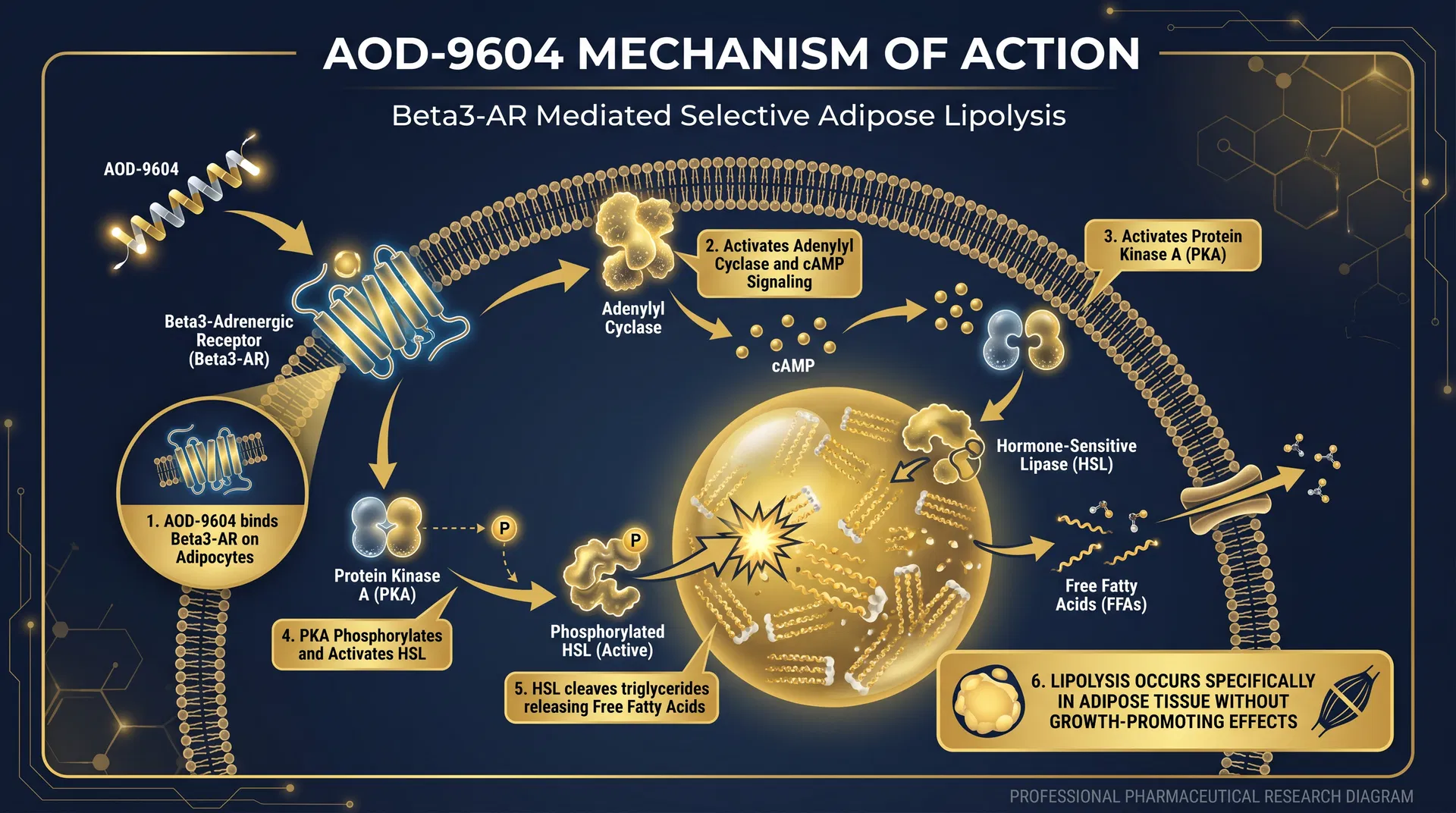
Key Research Pathways
Beta3-Adrenergic Receptor Activation
Activates beta3-adrenergic receptors in adipose tissue, stimulating cAMP-mediated lipolysis and increasing fatty acid oxidation independent of IGF-1 signaling.
Lipogenesis Inhibition
Suppresses acetyl-CoA carboxylase activity, reducing de novo lipogenesis and triglyceride synthesis in adipocytes.
GH Receptor Partial Agonism
Binds GH receptor with lower affinity than full-length hGH, activating metabolic pathways without triggering the full mitogenic or diabetogenic effects of hGH.
Key Findings from the Literature
- FDA GRAS (Generally Recognized as Safe) designation granted in 2014
- Phase 2b obesity trial (METAOD-001, >500 subjects) did not meet its primary weight-loss endpoint; results were never published in a peer-reviewed journal
- No adverse effects on blood glucose, insulin sensitivity, or IGF-1 levels in clinical trials (clean safety profile)
- Stimulates lipolysis and inhibits lipogenesis through beta3-adrenergic receptor activation (preclinical data)
- FDA GRAS designation (2014) covers food safety only — not therapeutic efficacy
Evidence by Claimed Outcome
Each outcome rated by the highest level of evidence available. Tiers follow our 5-tier methodology.
Study counts reflect peer-reviewed publications in the evidence database below. "Theoretical" outcomes have mechanistic rationale only. Learn about our evidence tiers →
How Long It Lasts & How It Works in the Body
AOD-9604 — half-life, bioavailability, onset, and duration data
| Parameter | Value | Source |
|---|---|---|
| Half-Life (t½) | ~30 minutes (SC) Short half-life; SC preferred for lipolytic effects | Clinical Trial Data |
| Time to Peak (Tmax) | ~15–30 minutes (SC) After subcutaneous injection | Clinical Trial Data |
| Bioavailability (F) | SC: estimated 70–80%; Oral: very low Oral bioavailability is minimal | Clinical Trial Data |
| Onset of Action | 30–60 minutes Lipolytic effects begin within 30–60 min of SC injection | — |
| Duration of Action | 2–4 hours per dose Multiple daily doses used in protocols | — |
C-terminal fragment of human growth hormone (hGH176-191). Retains lipolytic activity of hGH without the anabolic or diabetogenic effects. Phase 2 clinical trials for obesity completed.
References:
• Heffernan M et al. J Endocrinol 2001
• Ng FM et al. J Mol Endocrinol 1990
Important Research Context
Research References
Peer-reviewed literature supporting the research profile of AOD-9604
The following peer-reviewed studies form the primary evidence base for AOD-9604's research profile. All references are sourced from PubMed, NCBI, and peer-reviewed scientific journals. Published research is available through PubMed, NCBI, and peer-reviewed biomedical journals.
- 1.
Heffernan MA, et al. The effects of human GH and its lipolytic fragment (AOD9604) on lipid metabolism following chronic treatment in obese mice and beta(3)-AR knock-out mice. Endocrinology. 2001.PMID: 11713213
AOD-9604 stimulated fat oxidation and reduced adiposity without affecting IGF-1 or insulin levels.
- 2.
Ng FM, et al. Metabolic studies of a synthetic lipolytic domain (AOD9604) of human growth hormone. Hormone Research. 2000.PMID: 11146367
Established AOD-9604 as the active lipolytic fragment of hGH with selective fat-burning activity.
AOD-9604
Metabolic Research
Purgo Labs list price, read 12 Sep 2026 · per-lot COA on the vendor page
5mg $39.99 → $31.99 with code HEALTH (20% off; price read 23 Sept 2026)
- 1 certificate verified at the lab5mg$49.99$39.99→ $31.99
- 1 certificate verified at the lab5mg$49.99→ $42.49
- 1 certificate verified at the lab5mg$58.00→ $52.20
Fast FedEx shipping · Discreet packaging
Technical Specifications
| Peptide Class | GH fragment (hGH 176-191) |
| Molecular Weight | 1,817.1 Da |
| Regulatory Status | FDA GRAS designation (2014, food safety only); Phase 2b trial did not meet primary endpoint |
| Available Sizes | 2mg, 5mg vials |
| Form | Lyophilized powder |
| Purity | ≥99% (third-party tested) |
View full legal status guide →
Known Interactions
6 documented interactions for AOD-9604
Both affect fat metabolism. AOD-9604 via lipolysis; semaglutide via appetite suppression and metabolic effects. Theoretical additive effect — monitor for excessive fat loss.
Both affect fat metabolism. Monitor for excessive fat loss when combining.
AOD-9604 targets fat metabolism; BPC-157 targets tissue repair. No known interaction.
AOD-9604 targets fat metabolism; IGF-1 LR3 targets muscle growth. No known negative interaction.
Interaction data is based on published research, known pharmacological mechanisms, and clinical practitioner experience. Evidence tiers: Clinical = human data; Emerging = preclinical/case reports; Theoretical = mechanism-based inference. Always consult a qualified healthcare provider before combining compounds.
Source AOD-9604 at Purgo Labs
5mg $39.99 list · $31.99 with code HEALTH · lab-verifiable COA per lot
Other Compounds in This Guide



Supporting Research
Despite widespread fat-loss marketing, the large human obesity trial (Phase 2b, >500 subjects, Metabolic Pharmaceuticals, ~2007) failed its primary endpoint and was never published in a peer-reviewed journal. No credible published human evidence supports fat-loss efficacy. The FDA GRAS designation covers food safety, not therapeutic efficacy. The compound has a clean safety profile but an unproven efficacy profile.
References
Research Databases
Ready to Source AOD-9604?
Purgo Labs offers AOD-9604 with ≥99% purity, third-party certificates of analysis, and fast FedEx shipping. This is an affiliate link — we may earn a commission at no cost to you.