


Is Glow safe to inject?
No human study has asked that question about the blend or about injectable GHK-Cu. The topical safety record of GHK-Cu is real but does not transfer to injection.
Triple-Action Regenerative & Anti-Aging Stack
Glow Complex — GHK-Cu + BPC-157 + TB-500 Tri-Peptide Blend
Last reviewed: August 2026
The Glow Complex combines three peptides — GHK-Cu, BPC-157, and TB-500 — into a single research formulation. Each compound targets a different aspect of skin and tissue repair, and the blend is designed around the idea that comprehensive regeneration requires addressing multiple biological processes at once.
GHK-Cu handles the structural rebuild — stimulating collagen and elastin production and resetting gene expression toward a younger, healthier pattern. BPC-157 handles the vascular side — promoting new blood vessel growth to ensure the repair zone has adequate supply. TB-500 handles cell logistics — enabling repair cells to migrate efficiently to where they're needed. Together, the three compounds theoretically cover the full repair cascade: rebuild, supply, and mobilize.
Skin aging and damage are multi-factorial — they involve collagen loss, reduced blood supply, slower cell turnover, and impaired repair signaling all at once. A single-compound approach addresses only one of these. The Glow Complex is built on the premise that a multi-target approach may be more effective for comprehensive skin research than any single peptide alone.
The Glow Complex is a sophisticated tri-peptide research formulation with a sound mechanistic rationale. Direct studies on this specific three-way combination are limited; the synergy hypothesis is based on the well-characterized individual mechanisms of each component. All three components are research-only compounds.
The Glow Complex is Purgo Labs' flagship tri-peptide formulation, combining three of the most extensively researched compounds in skin biology and regenerative medicine: GHK-Cu (glycyl-L-histidyl-L-lysine copper complex), BPC-157 (Body Protection Compound 157), and TB-500 (thymosin beta-4 fragment). Each component brings a distinct and complementary mechanism to the blend, creating what researchers hypothesize to be a synergistic multi-pathway approach to tissue regeneration and anti-aging.
The rationale for this specific combination is grounded in the non-overlapping nature of the three peptides' primary mechanisms: GHK-Cu operates primarily at the level of gene expression and extracellular matrix synthesis; BPC-157 focuses on angiogenic and growth factor signaling; and TB-500 addresses cytoskeletal dynamics and cell migration. Together, they theoretically address the three fundamental requirements for tissue repair: structural matrix, vascular supply, and cellular recruitment.
The Glow Complex contains three co-lyophilized components: GHK-Cu (Gly-His-Lys copper(II) complex, MW ~403.9 Da), BPC-157 (15-amino-acid pentadecapeptide, MW 1,419.56 Da), and TB-500 (Ac-LKKTETQ heptapeptide, MW 889.0 Da). All three components are verified at ≥99% purity by independent third-party certificate of analysis.
The inclusion of GHK-Cu alongside the two recovery peptides is particularly notable: GHK-Cu's capacity to modulate over 4,000 genes — including those involved in collagen synthesis, antioxidant defense, and anti-inflammatory signaling — provides a broad epigenetic foundation upon which the more targeted angiogenic (BPC-157) and migratory (TB-500) effects can act.
The Glow Complex combines GHK-Cu, MT-1, and MT-2 to simultaneously stimulate collagen synthesis, increase melanin production, and activate skin repair pathways.
The Glow Complex operates through three parallel and potentially synergistic mechanisms. GHK-Cu activates the TGF-β pathway to stimulate collagen and elastin synthesis, modulates MMP/TIMP balance for controlled matrix remodeling, and delivers bioavailable copper as a cofactor for lysyl oxidase and superoxide dismutase. Its broad gene expression modulation via the Broad Institute Connectivity Map-identified pathways provides an epigenetic foundation for comprehensive tissue remodeling.
BPC-157 contributes VEGFR2-mediated angiogenesis and Egr-1-driven growth factor expression (PDGF, FGF), ensuring adequate vascular supply to support the metabolically demanding process of tissue repair. TB-500 provides the cellular migratory component: by binding G-actin via its WH2 domain, it enables fibroblasts, keratinocytes, and endothelial cells to migrate into the repair zone, while its Akt/PI3K activation provides cytoprotective support.
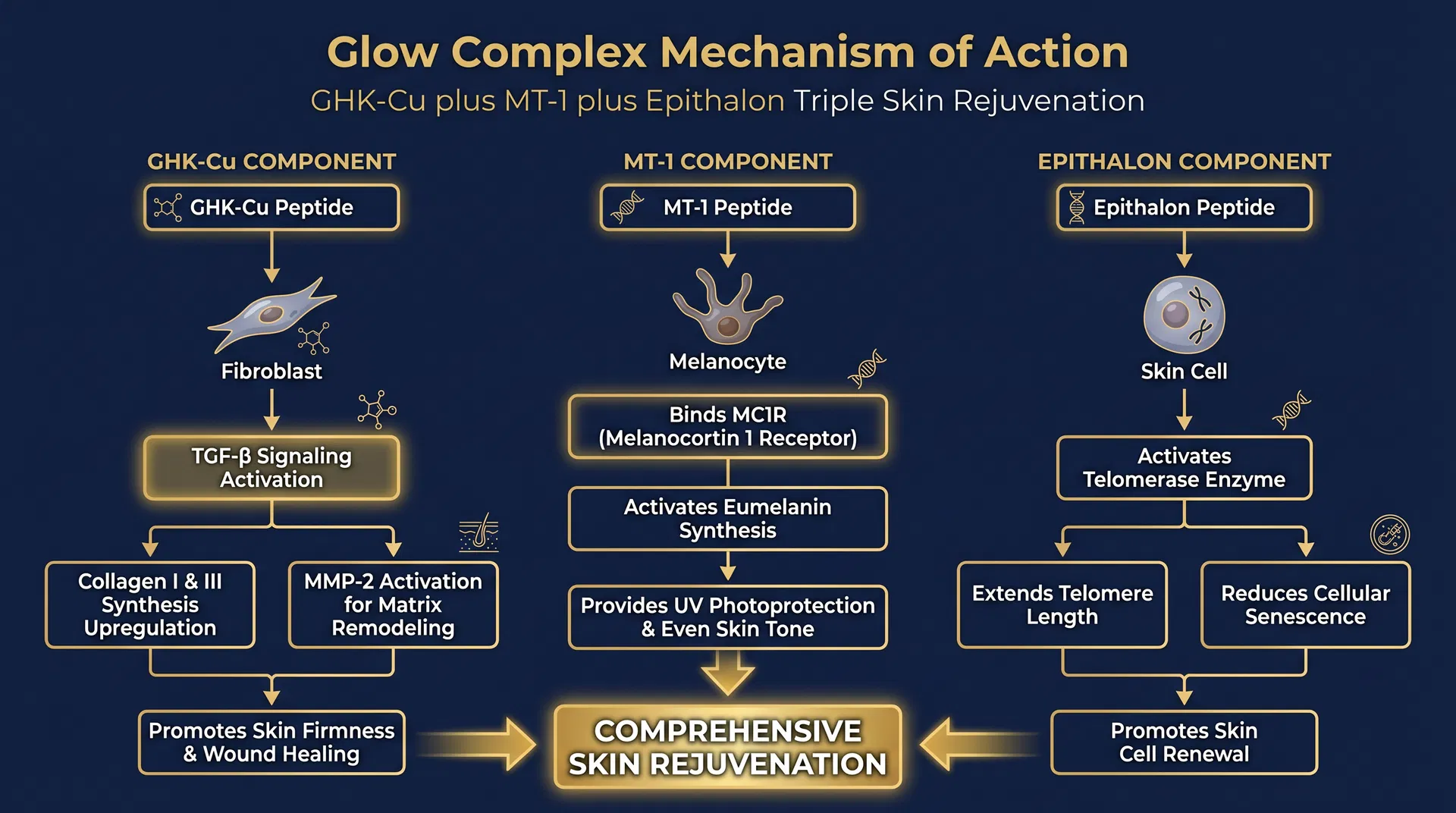
GHK-Cu activates TGF-β pathway and stimulates fibroblast production of collagen types I, III, IV, elastin, and glycosaminoglycans.
BPC-157 upregulates VEGFR2 to drive new blood vessel formation, ensuring vascular supply to the repair zone.
TB-500 binds G-actin via WH2 domain, enabling directed migration of repair cells into the wound bed.
GHK-Cu resets pathological gene expression across >4,000 genes, including DNA repair, antioxidant defense, and anti-inflammatory pathways.
Each outcome rated by the highest level of evidence available. Tiers follow our 5-tier methodology.
Study counts reflect peer-reviewed publications in the evidence database below. "Theoretical" outcomes have mechanistic rationale only. Learn about our evidence tiers →
Peer-reviewed literature supporting the research profile of Glow Complex
The following peer-reviewed studies form the primary evidence base for Glow Complex's research profile. All references are sourced from PubMed, NCBI, and peer-reviewed scientific journals. Published research is available through PubMed, NCBI, and peer-reviewed biomedical journals.
Pickart L, Margolina A. Regenerative and Protective Actions of the GHK-Cu Peptide in the Light of the New Gene Data. International Journal of Molecular Sciences. 2018.PMID: 29986520
GHK-Cu component: modulates 4,000+ genes including collagen synthesis and anti-inflammatory pathways.
Hadley ME, Dorr RT. Melanocortin peptide therapeutics: historical milestones, clinical studies and commercialization. Peptides. 2006.PMID: 16412534
MT-I component: established melanocortin receptor activity and skin pigmentation research.
Gorouhi F, Maibach HI. Role of topical peptides in preventing or treating aged skin. International Journal of Cosmetic Science. 2009.PMID: 19570099
Topical peptide combinations show synergistic improvements in skin texture and firmness.
Blends Research
Purgo Labs list price, read 12 Sep 2026 · per-lot COA on the vendor page
Use code HEALTH for 20% off
Fast FedEx shipping · Discreet packaging
View full legal status guide →
Source Glow Complex at Purgo Labs
≥99% purity · Third-party COA · Use code HEALTH for 20% off
Blend — no study of the combination; inferred from three components (topical GHK-Cu has human data; the other two do not)
Glow combines a copper peptide with two repair peptides. Topical GHK-Cu has decades of human cosmetic-study data and is well tolerated; injectable GHK-Cu, BPC-157 and TB-500 have no human safety trials. The GHK-Cu component dominates the mass, so copper load and injection-site irritation are the most plausible concerns.
Research-use information only. Research-grade Glow Complex is not an approved medicine; where trial or label figures appear below they belong to the pharmaceutical product studied, not to any research vial. This section does not give dosing or medical advice.
Every rate carries its source. Where no source exists, no rate is printed.
| Effect | Rate (sourced) | Detail | Source |
|---|---|---|---|
| Injection-site irritation | not quantified | Most plausible effect given the copper-peptide mass; unquantified. | General |
| Topical GHK-Cu (component) | not quantified | Well tolerated in human skin studies. | Pickart & Margolina 2018 (review) |
No study has evaluated this combination. The evidence lives with the components:
Regulatory status: No component is approved for injection anywhere.
No human study has asked that question about the blend or about injectable GHK-Cu. The topical safety record of GHK-Cu is real but does not transfer to injection.
Side-effect section last reviewed 2026-09-12. Moved from the standalone side-effects page on 10 October 2026; text unchanged.
Glow Complex is a proprietary blend of GHK-Cu, BPC-157, and TB-500. No human or animal clinical trials have been conducted on this specific blend formulation. Individual constituent evidence is preclinical or cosmetic-topical only.
Purgo Labs offers Glow Complex with ≥99% purity, third-party certificates of analysis, and fast FedEx shipping. This is an affiliate link — we may earn a commission at no cost to you.