


What are the side effects of the Wolverine blend?
Nobody knows in the way that word implies. There are no human trials of BPC-157, of TB-500, or of the two together. Injection-site reactions are the one predictable effect.
Synergistic Dual-Peptide Regenerative Stack
Wolverine Blend — BPC-157 + TB-500 Combination
Last reviewed: August 2026
The Wolverine Blend combines two of the most studied recovery peptides — BPC-157 and TB-500 — into a single vial. The name is a nod to the comic book character famous for near-instant healing, and the idea behind the blend is that the two compounds target tissue repair from different angles simultaneously.
BPC-157 works locally — it signals the body to grow new blood vessels at the site of damage, which is the critical first step in any healing process. TB-500 works more systemically — it helps repair cells throughout the body navigate toward the injury. Together, researchers hypothesize that you get both the 'build the roads' signal (BPC-157) and the 'send the workers' signal (TB-500) at the same time.
Most recovery peptides address one part of the healing cascade. The appeal of a dual-compound blend is that it theoretically covers more ground in a single protocol. This is why the BPC-157/TB-500 combination is one of the most discussed stacks in preclinical recovery research — the mechanisms genuinely complement each other rather than overlap.
The Wolverine Blend is a convenient co-formulation of two individually well-studied compounds. The synergy hypothesis is mechanistically sound, though direct studies on the combination specifically are limited. Both components are research-only compounds; no human clinical data exists for this specific blend.
The Wolverine Blend is a pre-combined formulation of two of the most extensively researched recovery peptides available: BPC-157 and TB-500. Named for the comic archetype of rapid, near-instantaneous tissue regeneration, this blend is designed to leverage the complementary and potentially synergistic mechanisms of both compounds in a single reconstitutable vial.
BPC-157 contributes its well-characterized angiogenic and cytoprotective activity — particularly its upregulation of VEGFR2 and modulation of the nitric oxide system — while TB-500 provides systemic actin-regulatory and cell-migratory support through its WH2 domain binding activity. Together, the two peptides address tissue repair from both a local vascular and a systemic cellular migration standpoint.
The Wolverine Blend contains a fixed-ratio combination of BPC-157 (Body Protection Compound 157, a 15-amino-acid pentadecapeptide, MW 1,419.56 Da) and TB-500 (the Ac-LKKTETQ heptapeptide fragment of thymosin beta-4, MW 889.0 Da). Both components are supplied as co-lyophilized powder in a single vial, maintaining ≥99% purity for each constituent as verified by independent third-party certificate of analysis.
The rationale for co-formulation is rooted in the complementary nature of the two peptides' mechanisms: BPC-157 primarily acts at the local tissue level through angiogenic and growth factor signaling, while TB-500 exerts systemic effects on cell migration and cytoskeletal dynamics, potentially enabling a more comprehensive regenerative response than either compound alone.
The Wolverine Blend combines BPC-157 and TB-500 to simultaneously accelerate angiogenesis and cell migration, producing faster recovery than either peptide alone.
The Wolverine Blend operates through the combined mechanisms of its two constituent peptides. BPC-157 activates the VEGFR2 pathway to stimulate angiogenesis and upregulates Egr-1 to drive expression of PDGF, FGF, and other repair-associated growth factors. Simultaneously, it modulates the nitric oxide system to provide cytoprotective and vascular tone-regulating effects.
TB-500 complements this by binding monomeric G-actin via its WH2 domain, enabling the directed migration of fibroblasts, endothelial cells, and keratinocytes into the wound bed. It also activates the Akt/PI3K survival pathway and downregulates pro-inflammatory cytokines IL-1β and TNF-α, reducing the inflammatory burden that can impede healing.
The theoretical synergy between these mechanisms — local angiogenesis plus systemic cell migration — has made the BPC-157/TB-500 combination one of the most discussed dual-peptide stacks in preclinical recovery research.
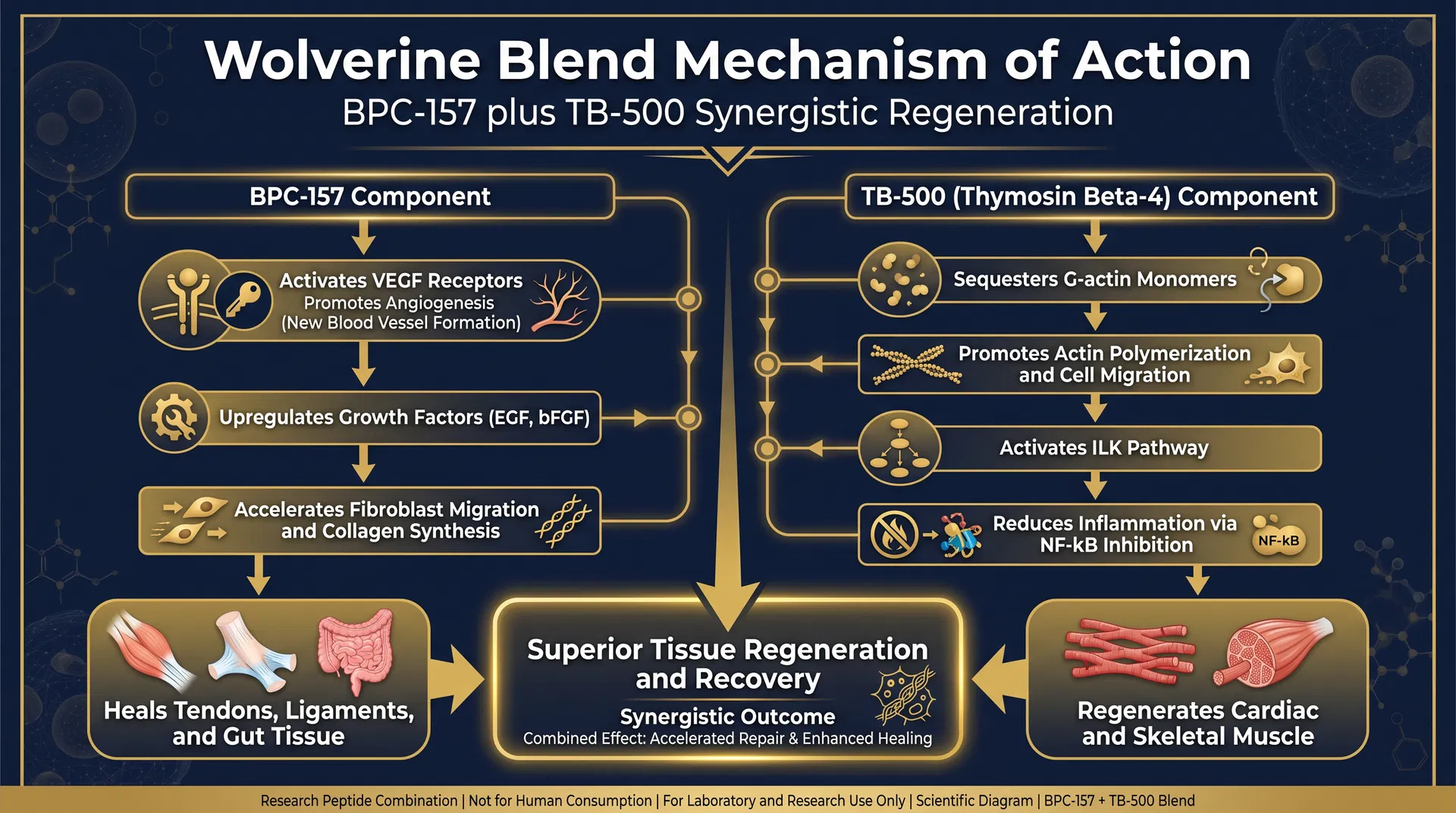
BPC-157 component upregulates VEGFR2, driving new blood vessel formation and improving perfusion at sites of tissue injury.
TB-500 component binds G-actin via WH2 domain, enabling directed migration of repair cells into the wound bed.
TB-500 activates the Akt survival pathway, protecting cells from ischemic and inflammatory damage during the repair process.
BPC-157 modulates nitric oxide while TB-500 suppresses IL-1β and TNF-α, collectively reducing inflammatory impedance to healing.
Each outcome rated by the highest level of evidence available. Tiers follow our 5-tier methodology.
Study counts reflect peer-reviewed publications in the evidence database below. "Theoretical" outcomes have mechanistic rationale only. Learn about our evidence tiers →
Peer-reviewed literature supporting the research profile of Wolverine Blend
The following peer-reviewed studies form the primary evidence base for Wolverine Blend's research profile. All references are sourced from PubMed, NCBI, and peer-reviewed scientific journals. Published research is available through PubMed, NCBI, and peer-reviewed biomedical journals.
Sikiric P, et al. Stable gastric pentadecapeptide BPC 157: novel therapy in gastrointestinal tract. Current Pharmaceutical Design. 2011.PMID: 21548867
BPC-157 component: cytoprotective and tissue repair activity across multiple tissue types.
Goldstein AL, Hannappel E, Kleinman HK. Thymosin beta4: actin-sequestering protein moonlights to repair injured tissues. Trends in Molecular Medicine. 2005.PMID: 16099219
TB-500 component: established role in actin regulation and tissue repair signaling.
Blends Research
Purgo Labs list price, read 12 Sep 2026 · per-lot COA on the vendor page
Use code HEALTH for 20% off
Fast FedEx shipping · Discreet packaging
View full legal status guide →
Source Wolverine Blend at Purgo Labs
≥99% purity · Third-party COA · Use code HEALTH for 20% off
Blend — no study of the combination; everything is inferred from the two components, neither of which has a human safety trial
The Wolverine blend combines two peptides that have never been through a controlled human safety trial, in a fixed ratio nobody has studied. The previous version of this page printed frequency percentages for this blend; they were invented, and they are gone. What can be said honestly is component by component.
Research-use information only. Research-grade Wolverine Blend is not an approved medicine; where trial or label figures appear below they belong to the pharmaceutical product studied, not to any research vial. This section does not give dosing or medical advice.
Every rate carries its source. Where no source exists, no rate is printed.
| Effect | Rate (sourced) | Detail | Source |
|---|---|---|---|
| Injection-site reactions | not quantified | Expected from any injected peptide; unquantified. | General |
No study has evaluated this combination. The evidence lives with the components:
Regulatory status: Neither component is approved anywhere.
Everything above describes Wolverine Blend the molecule. The risk specific to a research vial is different: it may not contain Wolverine Blend at the labelled amount, and it may contain what the synthesis left behind. Identity (mass spectrometry), purity (HPLC), measured net content and an endotoxin result are the four lines on a certificate that bear on adverse effects, and only a certificate you can check at the laboratory tells you any of them. This is what we have verified for Wolverine Blend so far.
1 certificate for Wolverine Blend in the COA library: 1 checkable on the laboratory's own site, 1 stating measured mass against the label, 1 carrying a flag.
Nobody knows in the way that word implies. There are no human trials of BPC-157, of TB-500, or of the two together. Injection-site reactions are the one predictable effect.
Side-effect section last reviewed 2026-09-12. Moved from the standalone side-effects page on 10 October 2026; text unchanged.
Wolverine Stack is a proprietary blend of BPC-157 and TB-500. No human or animal clinical trials have been conducted on this specific blend formulation. Evidence for individual constituents is preclinical only.
Purgo Labs offers Wolverine Blend with ≥99% purity, third-party certificates of analysis, and fast FedEx shipping. This is an affiliate link — we may earn a commission at no cost to you.