BPC-157 vs Thymosin Alpha-1
Complete head-to-head comparison of BPC-157 (tissue repair, gut healing) and Thymosin Alpha-1 (immune modulation, antiviral defense) — mechanisms, evidence, dosing protocols, stacking guide, and decision tree.
| Category | BPC-157 | Thymosin Alpha-1 |
|---|---|---|
| Primary Mechanism | EGR-1 upregulation, angiogenesis, NO-cGMP pathway, collagen synthesis | TLR signaling, dendritic cell maturation, T-cell differentiation, cytokine modulation |
| Primary Application | Tissue repair, injury healing, gut health, musculoskeletal recovery | Immune system modulation, antiviral defense, chronic infection support |
| Route | SubQ injection (preferred) or oral | SubQ injection |
| Evidence Level | Extensive preclinical (rodent); limited human data | Tier 2 — human cohort data; FDA-approved in some countries (Zadaxin) |
| Best For | Tendon/ligament repair, gut healing, post-surgical recovery | Immune modulation, antiviral support, chronic infection, post-illness recovery |
BPC-157 and Thymosin Alpha-1 are among the most widely researched peptides in the research community, but they operate through fundamentally different biological pathways. BPC-157 is a synthetic pentadecapeptide derived from a protective protein in gastric juice — its primary function is tissue repair, angiogenesis, and gut healing. Thymosin Alpha-1 is a naturally occurring thymic peptide — its primary function is immune modulation, T-cell maturation, and antiviral defense.
This mechanistic divergence is the key insight for researchers: these compounds are not competing alternatives but complementary tools. The question is rarely "which one?" but rather "which one for this specific goal?" — and in many protocols, the answer is both. This guide provides the mechanistic detail, evidence comparison, and decision framework needed to make that determination.
Research Disclaimer: All content on this page is for educational and research purposes only. These compounds are not FDA-approved for the indications discussed. Always consult a qualified healthcare professional before considering any peptide protocol.
Mechanism Deep Dive
Body Protection Compound-157 · Gastric Pentadecapeptide
BPC-157 is a synthetic 15-amino acid peptide (GEPPPGKPADDAGLV) derived from a protective protein found in human gastric juice. Its primary mechanisms of action center on tissue repair and angiogenesis: it upregulates EGR-1 (early growth response protein-1), a transcription factor that drives collagen synthesis, tendon cell proliferation, and vascular endothelial growth. It also activates the NO-cGMP pathway, promoting vasodilation and tissue perfusion, and directly upregulates VEGF for new blood vessel formation.
Beyond tissue repair, BPC-157 modulates the dopamine and serotonin neurotransmitter systems, which underlies its studied effects on mood, TBI recovery, and neurological protection. It also has direct gastric mucosal protective effects, making it the most studied peptide for IBD, leaky gut syndrome, and GI injury repair.
Tα1 · 28-Amino Acid Thymic Peptide
Thymosin Alpha-1 (Tα1) is a 28-amino acid peptide naturally produced by the thymus gland. It is the primary biological mediator of thymic immune education — the process by which T-cells mature and differentiate into functional immune cells. Tα1 promotes Th1 T-cell differentiation (cell-mediated immunity), activates dendritic cells to present antigens more effectively, enhances natural killer (NK) cell cytotoxicity, and upregulates MHC class I and II expression on tumor cells, making them more visible to the immune system.
Tα1 also activates Toll-like receptor 9 (TLR9) signaling, which is central to antiviral innate immunity. This mechanism underlies its clinical use in hepatitis B and C treatment in several countries, and its studied role as a cancer immunotherapy adjuvant. It modulates cytokine production — increasing IL-2 and IFN-gamma while reducing pro-inflammatory cytokines in autoimmune contexts.
Head-to-Head Comparison
| Category | BPC-157 | Thymosin Alpha-1 |
|---|---|---|
| Primary Mechanism | EGR-1 upregulation, angiogenesis, NO synthesis, collagen stimulation | T-cell maturation, dendritic cell activation, TLR9 signaling, MHC upregulation |
| Primary Application | Tissue repair, injury healing, gut health, musculoskeletal recovery | Immune modulation, antiviral defense, cancer immunotherapy, autoimmune support |
| Tissue Repair | Excellent — primary indication; tendon, ligament, muscle, gut | Minimal — indirect via anti-inflammatory immune modulation |
| Immune Function | Moderate anti-inflammatory; not primary immune modulator | Excellent — primary indication; T-cell, NK cell, dendritic cell activation |
| Gut Health | Excellent — gastric mucosal protection, IBD, leaky gut | Minimal direct gut effects |
| Antiviral Activity | Limited preclinical data | Strong — used clinically for hepatitis B/C; TLR9 activation |
| Anti-Tumor | Limited data | Significant — MHC I/II upregulation, NK cell activation, clinical adjuvant use |
| Neurological Effects | Dopamine/serotonin modulation; studied for depression, TBI | Minimal direct neurological effects |
| Administration | SubQ injection or oral (reduced efficacy oral) | SubQ injection only |
| Cycle Length | 4–12 weeks | 4–8 weeks |
| Evidence Level | Extensive preclinical (rodent); limited human data | Phase 2/3 human trials; clinical approval in some countries |
| Safety Profile | Favorable in preclinical; no serious adverse events reported | Favorable; well-tolerated in clinical trials |
| Stackable With | TB-500, GHK-Cu, Thymosin Alpha-1, CJC-1295/Ipamorelin | BPC-157, GHK-Cu, NAD+, Epithalon |
Research Verdict
Complementary, Not Competing
BPC-157 and Thymosin Alpha-1 are not alternatives to each other — they target entirely different biological systems. BPC-157 is the clear choice for tissue repair, injury recovery, and gut healing. Thymosin Alpha-1 is the clear choice for immune optimization, antiviral support, and cancer immunotherapy adjuvant use. For researchers with both recovery and immune goals, stacking both is mechanistically rational with no known interaction concerns.
Stacking Protocols
Protocol 1: Injury Recovery + Immune Support
BPC-157 drives tissue repair, angiogenesis, and collagen synthesis at the injury site while Thymosin Alpha-1 modulates the systemic immune response to reduce chronic inflammation and support immune-mediated healing. This combination is used in research protocols for post-surgical recovery, chronic injury, and immune-compromised subjects. The two compounds have no mechanism-based conflicts.
Protocol 2: Gut Healing + Immune Modulation
For research subjects with both gut pathology (IBD, leaky gut, gastric ulcers) and immune dysfunction. BPC-157 provides direct gastric mucosal protection and gut healing via EGR-1 upregulation. Thymosin Alpha-1 modulates the gut-associated immune response, reducing autoimmune-mediated gut inflammation. This combination is relevant for conditions where gut pathology and immune dysregulation co-occur.
Protocol 3: Longevity / Anti-Aging Stack
For longevity-focused research protocols targeting tissue maintenance, immune senescence reversal, and systemic repair. Thymosin Alpha-1 addresses thymic involution (the age-related decline in thymic function that reduces T-cell production), which is a primary driver of immune aging. BPC-157 maintains tissue repair capacity. GHK-Cu can be added for collagen and skin aging research. This stack targets three distinct aging pathways simultaneously.
Compound Selection by Research Goal
| Research Goal | Recommended | Rationale |
|---|---|---|
| Tendon / ligament injury repair | BPC-157 | Direct EGR-1 upregulation, angiogenesis, collagen synthesis |
| Gut healing (IBD, leaky gut, ulcers) | BPC-157 | Gastric mucosal protection; primary indication |
| Immune optimization / T-cell support | Thymosin Alpha-1 | Primary thymic peptide for T-cell maturation and activation |
| Antiviral support (hepatitis, chronic viral) | Thymosin Alpha-1 | Clinical approval for hepatitis B/C; TLR9 activation |
| Cancer immunotherapy adjuvant | Thymosin Alpha-1 | MHC I/II upregulation; NK cell activation; clinical data |
| Musculoskeletal recovery (post-surgery) | BPC-157 | Angiogenesis + collagen synthesis; most studied for this |
| Chronic inflammation reduction | Stack both | BPC-157 (local tissue) + Thymosin Alpha-1 (systemic immune) |
| Neurological support (TBI, depression) | BPC-157 | Dopamine/serotonin modulation; studied in TBI models |
| General longevity / immune aging | Thymosin Alpha-1 | Thymic involution reversal; immune senescence research |
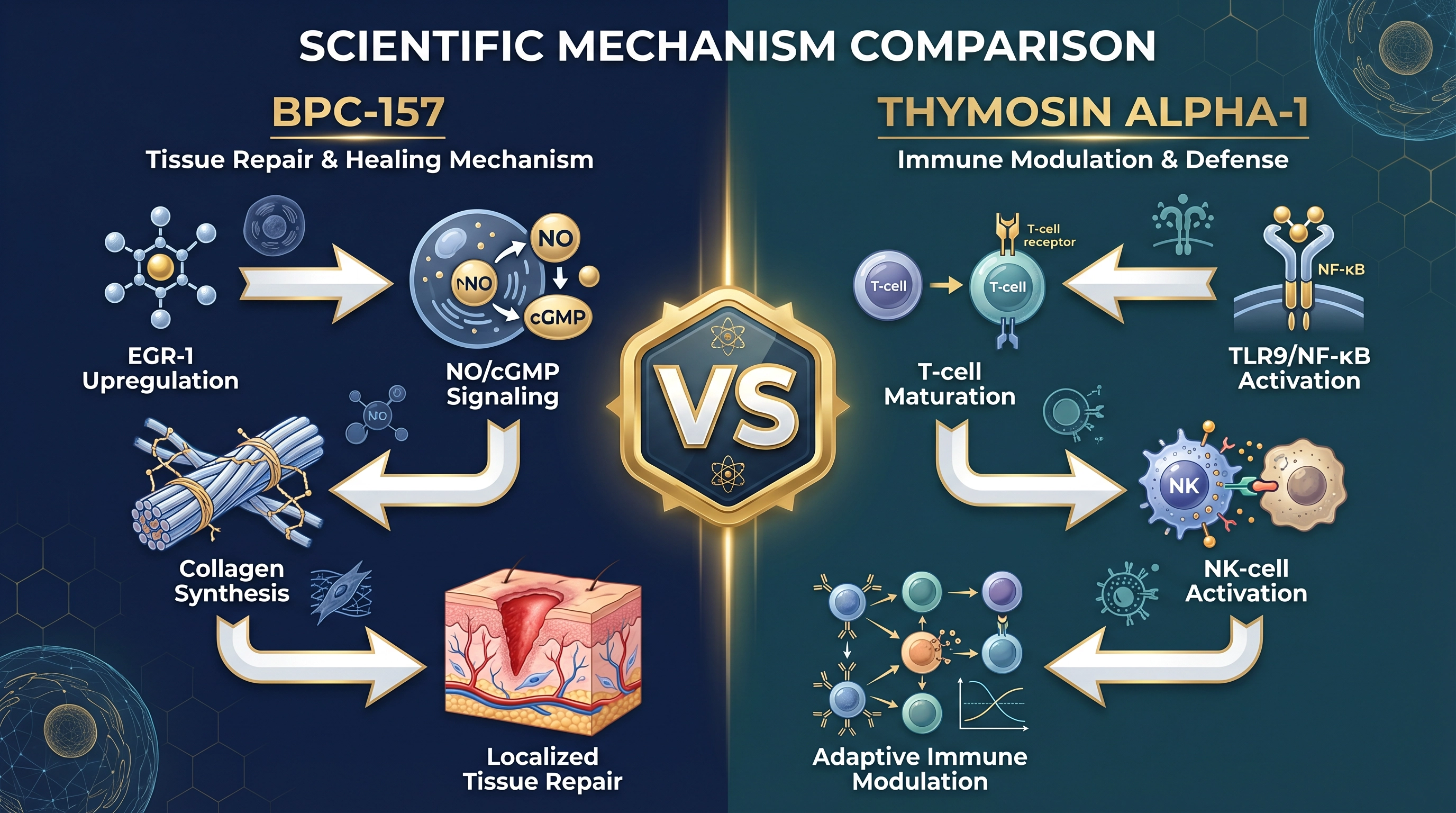
Pathway Comparison Diagram
BPC-157 targets localized tissue repair via EGR-1/NO-cGMP; Thymosin Alpha-1 activates TLR9/NF-κB to mature T-cells and NK-cells for adaptive immune modulation.
What the cited studies used
One row per compound: the amount and schedule administered in a specific indexed study, who received it, and the paper. These are reports of what was done in that study, not recommendations, and several are animal or single-dose studies. Where no indexed human regimen exists we say so rather than print a number. Community "stacks" and cycle schedules are not reproduced on this site.
Research use only. Compound Review scores vendors on documentation — laboratory certificates, lot records, pricing and company identity. Nothing on this page is guidance on human or veterinary use, dosing or health outcomes.
| Compound | Regimen in the study | Population | Source |
|---|---|---|---|
| BPC-157 | No PubMed-indexed human dose trial in our reference set The amounts circulating online (mcg/day, 'oral vs injection') come from forum practice, not from a human trial. We print none. | Rodent studies only (the compound profile cites them) | none |
| Thymosin alpha-1 | No verified PMID in our reference set Thymalfasin is a licensed product in several countries with a labelled regimen; we cite only what we have verified on PubMed, and have not yet verified a trial for this table. | — | none |
Frequently Asked Questions
What is the difference between BPC-157 and Thymosin Alpha-1?
BPC-157 is a gastric pentadecapeptide focused on tissue repair, angiogenesis, gut healing, and musculoskeletal recovery. Thymosin Alpha-1 is a thymic peptide focused on immune modulation, T-cell maturation, antiviral defense, and anti-tumor immunity. They have largely non-overlapping mechanisms and are often stacked for complementary effects in recovery and immune optimization protocols.
Which is better for injury recovery — BPC-157 or Thymosin Alpha-1?
BPC-157 is significantly more studied for injury recovery. It promotes tendon, ligament, muscle, and gut healing through EGR-1 upregulation, angiogenesis, and collagen synthesis stimulation. Thymosin Alpha-1 is primarily an immune peptide and is not typically used for musculoskeletal injury recovery — its contribution to recovery is indirect via anti-inflammatory immune modulation.
Can BPC-157 and Thymosin Alpha-1 be stacked?
Yes — they are highly complementary. BPC-157 handles tissue repair, angiogenesis, and gut health while Thymosin Alpha-1 modulates immune function, reduces chronic inflammation, and enhances antiviral defense. The combination is used in research protocols targeting both recovery and immune optimization simultaneously. There is no known mechanism-based conflict between the two compounds.
What is Thymosin Alpha-1 used for in research?
Thymosin Alpha-1 is used in research for immune modulation, chronic viral infections (hepatitis B and C), cancer immunotherapy support, and autoimmune conditions. It has been used clinically in some countries for hepatitis B and C treatment, and as an adjuvant in cancer immunotherapy. It enhances T-cell maturation, dendritic cell activation, and natural killer cell function.
Which has more research — BPC-157 or Thymosin Alpha-1?
Both have substantial research bases but in different areas. BPC-157 has extensive preclinical data across multiple injury and gut healing models (primarily rodent studies). Thymosin Alpha-1 has more human clinical trial data, particularly for viral infections, immunodeficiency, and cancer immunotherapy. BPC-157 has more animal study data; Thymosin Alpha-1 has more human clinical data.
What is the mechanism of BPC-157?
BPC-157 (Body Protection Compound-157) is a synthetic pentadecapeptide derived from a protective protein in gastric juice. Its primary mechanisms include: upregulation of EGR-1 (early growth response protein-1) which drives collagen synthesis and angiogenesis; activation of the NO-cGMP pathway for vasodilation and tissue perfusion; upregulation of VEGF for new blood vessel formation; and modulation of the dopamine and serotonin systems. It also has direct gastric mucosal protective effects.
What is the mechanism of Thymosin Alpha-1?
Thymosin Alpha-1 is a 28-amino acid peptide naturally produced by the thymus gland. It acts primarily on the innate and adaptive immune system: it promotes T-cell maturation and differentiation (particularly Th1 cells), activates dendritic cells and natural killer cells, upregulates MHC class I and II expression on tumor cells (making them more visible to the immune system), and modulates cytokine production (increasing IL-2, IFN-gamma while reducing pro-inflammatory cytokines). It also activates Toll-like receptor 9 (TLR9) signaling.
How do I choose between BPC-157 and Thymosin Alpha-1?
Choose BPC-157 if your research goal is tissue repair, injury healing, gut health, or musculoskeletal recovery. Choose Thymosin Alpha-1 if your research goal is immune optimization, antiviral support, cancer immunotherapy adjuvant use, or autoimmune modulation. If both goals are present, the compounds can be stacked as they work through entirely different pathways.
Source Both Peptides at Purgo Labs
Purgo Labs carries pharmaceutical-grade BPC-157 and Thymosin Alpha-1 with third-party COA verification. Use code HEALTH for 20% off.
Visit Purgo LabsAffiliate disclosure: Compound Review may earn a commission on qualifying purchases.