Thymosin Alpha-1
T-Cell Maturation & Adaptive Immune Regulation
Thymosin Alpha-1 (Tα1) — Thymic Immunomodulatory Peptide
Last reviewed: August 2026
Thymosin Alpha-1 (Tα1) is a 28-amino-acid peptide naturally produced by the thymus gland — the organ responsible for training and maturing T-cells, the immune system's most sophisticated defenders. It's been approved as a drug (Zadaxin®) in over 35 countries for hepatitis B, hepatitis C, and as an immune adjuvant for cancer treatment and vaccines. It's one of the most clinically validated immunomodulatory peptides in existence.
Thymosin Alpha-1 works by activating dendritic cells and macrophages (the immune system's commanders), stimulating T-cell maturation and differentiation, and upregulating toll-like receptor (TLR) signaling — the innate immune system's pattern recognition machinery. The net effect is a more robust, better-coordinated immune response. In clinical studies, it has improved outcomes in chronic viral infections, sepsis, and as a vaccine adjuvant (it enhances the immune response to vaccines).
Immune dysfunction — whether from aging (immunosenescence), chronic infection, or immunosuppressive therapy — is a major driver of morbidity and mortality. Thymosin Alpha-1's approval in 35+ countries for viral hepatitis and its use as a vaccine adjuvant gives it a clinical validation profile that few research peptides can match. Its mechanism of restoring T-cell competence is particularly relevant to aging research, as thymic function declines significantly with age.
Thymosin Alpha-1 is one of the most clinically validated immunomodulatory peptides in this catalog, with drug approval in over 35 countries. Its thymic origin, T-cell modulating mechanism, and clinical track record in viral infections and cancer adjuvant therapy make it a cornerstone of immune research. The research-grade lyophilized powder supplied by Purgo Labs is for laboratory use only.
What is Thymosin Alpha-1?
Thymosin Alpha-1 (Tα1) is a 28-amino-acid peptide originally isolated from thymosin fraction 5 of bovine thymic tissue by Allan Goldstein in the 1970s. It is the N-terminal fragment of prothymosin alpha, a nuclear protein involved in chromatin remodeling, and serves as a potent immunomodulatory agent that promotes T-cell maturation, enhances innate immune responses, and modulates the balance between pro- and anti-inflammatory cytokines.
Tα1 is approved in over 35 countries (marketed as Zadaxin®) for the treatment of chronic hepatitis B, chronic hepatitis C, and as an adjuvant for influenza vaccination in immunocompromised patients. This extensive clinical history provides a robust human safety and efficacy dataset that distinguishes Tα1 from most research peptides.
- Thymosin Alpha-1 (Tα1) is a 28-amino acid peptide naturally secreted by thymic epithelial cells, first isolated by Allan Goldstein at George Washington University in the 1970s from thymosin fraction 5.
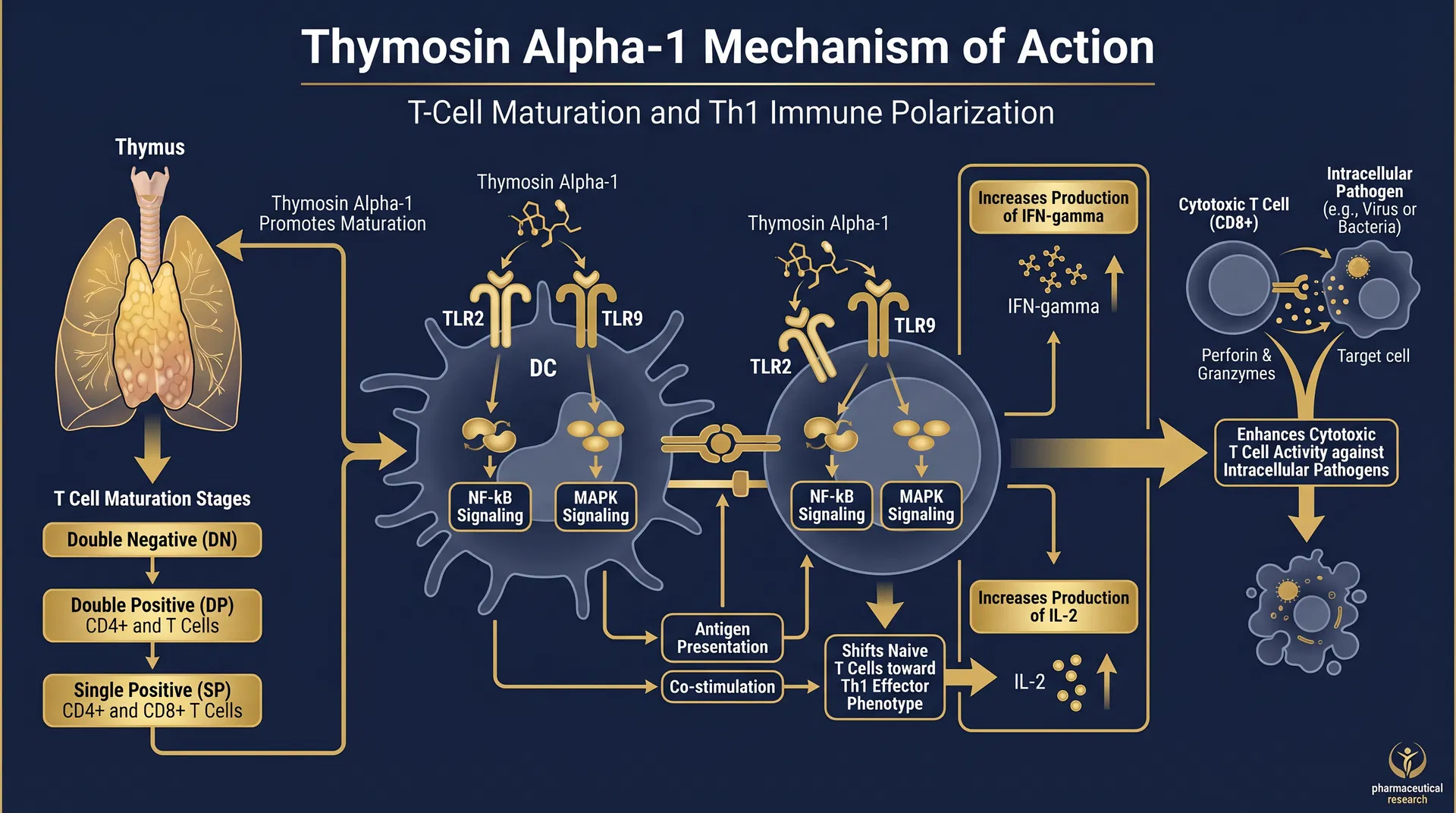
- Primary mechanism: activates toll-like receptors (TLR2, TLR9) on dendritic cells and T-lymphocytes, enhancing Th1 immune responses, NK cell activity, and antigen presentation.
- FDA-approved as Zadaxin® in multiple countries (not the US) for hepatitis B, hepatitis C, and as an adjuvant to chemotherapy; the clinical dataset includes Phase 3 trials in viral hepatitis.
- Thymosin α1 levels decline with age in parallel with thymic involution — the progressive loss of thymic tissue that reduces naïve T-cell output and contributes to immunosenescence.
- Research applications include studying thymic peptide biology, innate/adaptive immune crosstalk, antiviral immunity mechanisms, and age-related immune decline (immunosenescence).
Molecular Composition
Thymosin Alpha-1 is a 28-amino-acid peptide with an N-terminal acetyl group (Ac-Ser-Asp-Ala-Ala-Val-Asp-Thr-Ser-Ser-Glu-Ile-Thr-Thr-Lys-Asp-Leu-Lys-Glu-Lys-Lys-Glu-Val-Val-Glu-Glu-Ala-Glu-Asn-OH). The N-terminal acetylation is required for full biological activity. The molecular weight is 3,108.4 Daltons.
The peptide is highly acidic (net charge -6 at physiological pH) due to its high content of aspartate and glutamate residues, a property that distinguishes it from most other immunomodulatory peptides and may influence its receptor interactions and biodistribution.
How Does It Work?
Thymosin Alpha-1 strengthens immune responses by promoting T-cell maturation and shifting naive T cells toward Th1 effector phenotypes that fight intracellular pathogens.
Thymosin Alpha-1 exerts its immunomodulatory effects through multiple mechanisms. Its primary activity involves promotion of T-cell maturation and differentiation: Tα1 stimulates the expression of T-cell surface markers (CD3, CD4, CD8) on immature thymocytes and promotes the differentiation of naive T cells toward Th1 effector phenotypes, enhancing cell-mediated immunity.
Tα1 also activates toll-like receptor 9 (TLR9) signaling in dendritic cells and macrophages, stimulating the production of type I interferons (IFN-α/β) and pro-inflammatory cytokines (IL-12, TNF-α) that are critical for antiviral and antitumor immunity. Additionally, Tα1 upregulates MHC class I and II expression on antigen-presenting cells, enhancing antigen presentation to T cells.
In the context of chronic infection, Tα1 reverses T-cell exhaustion — the progressive loss of T-cell function that occurs during persistent antigen stimulation — by restoring effector T-cell responses.
Key Research Pathways
T-Cell Maturation / Th1 Differentiation
Stimulates T-cell surface marker expression and promotes Th1 effector differentiation, enhancing cell-mediated immunity against pathogens and tumors.
TLR9 / Type I Interferon Signaling
Activates TLR9 in dendritic cells and macrophages, stimulating IFN-α/β and IL-12 production critical for antiviral and antitumor responses.
MHC Class I/II Upregulation
Increases MHC class I and II expression on antigen-presenting cells, enhancing antigen presentation efficiency to CD8+ and CD4+ T cells.
T-Cell Exhaustion Reversal
Restores effector T-cell function in chronic infection settings by reversing exhaustion markers (PD-1, TIM-3) and restoring cytokine production.
Key Findings from the Literature
- Approved in 35+ countries (Zadaxin®) for hepatitis B, hepatitis C, and influenza vaccination adjuvant
- Promotes T-cell maturation and Th1 differentiation — enhances cell-mediated immunity
- TLR9 agonism in dendritic cells: stimulates type I interferon and IL-12 production
- Reverses T-cell exhaustion in chronic infection models
- Upregulates MHC class I/II on antigen-presenting cells, enhancing antigen presentation
- Investigated for COVID-19 treatment: reduced mortality in severe cases (Zhang et al., 2020)
Important Research Context
Research References
Peer-reviewed literature supporting the research profile of Thymosin Alpha-1
The following peer-reviewed studies form the primary evidence base for Thymosin Alpha-1's research profile. All references are sourced from PubMed, NCBI, and peer-reviewed scientific journals. Published research is available through PubMed, NCBI, and peer-reviewed biomedical journals.
- 1.
Goldstein AL, et al. Thymosin alpha 1: biology and therapeutic implications in infectious disease, cancer, and immunodeficiency. Expert Opinion on Biological Therapy. 2009.PMID: 19392576
Comprehensive review of thymosin alpha-1's immune-modulating mechanisms and clinical applications.
- 2.
Tuthill CW, Rios I, McBeath R. Thymosin alpha 1: past clinical experience and future promise. Annals of the New York Academy of Sciences. 2010.PMID: 20536460
Review of thymosin alpha-1 clinical trial data across hepatitis B, hepatitis C, and cancer indications.
- 3.
Camerini R, Garaci E. Historical review of thymosin alpha 1 in infectious diseases. Expert Opinion on Biological Therapy. 2015.PMID: 26098768
Thymosin alpha-1 approved in 35+ countries for hepatitis B and C; extensive safety record across clinical use.
Thymosin Alpha-1
Immune Research
Purgo Labs list price, read 12 Sep 2026 · per-lot COA on the vendor page
Use code HEALTH for 20% off
Fast FedEx shipping · Discreet packaging
Technical Specifications
| Peptide Class | Thymic immunomodulatory peptide (28 amino acids) |
| Molecular Weight | 3,108.4 Da |
| Regulatory Status | Approved in 35+ countries (Zadaxin®) |
| Net Charge | -6 at physiological pH (highly acidic) |
| Available Sizes | 5mg vials |
| Form | Lyophilized powder |
| Purity | ≥99% (third-party tested) |
View full legal status guide →
Source Thymosin Alpha-1 at Purgo Labs
≥99% purity · Third-party COA · Use code HEALTH for 20% off
Other Compounds in This Guide




Related Research Guides
Supporting Research
Thymosin Alpha-1 has genuine human trial history and is approved in 35+ countries for hepatitis B, hepatitis C, and as an immune adjuvant. However, present the evidence honestly: early sepsis RCT signals were followed by a larger Phase 3 trial (TETIS, 2025, n=1,106) that was negative — no mortality benefit vs placebo. Approved-abroad status is for viral hepatitis indications, not the anti-aging or recovery uses often marketed.
References
- Wu J, et al.HUMAN RCT, n=361Crit Care. 2013. PubMedLower 28-day mortality in severe sepsis patients (single-blind). Positive signal that was not replicated in the larger Phase 3 trial.
- Wu J, et al.HUMAN RCT, Phase 3, n=1106, NEGATIVEBMJ. 2025. PubMedLargest controlled trial did not show a survival benefit for sepsis vs placebo. Primary endpoint not met.
Research Databases
Ready to Source Thymosin Alpha-1?
Purgo Labs offers Thymosin Alpha-1 with ≥99% purity, third-party certificates of analysis, and fast FedEx shipping. This is an affiliate link — we may earn a commission at no cost to you.