Adamax
BDNF/NGF Upregulation & Neuroprotective Signaling via Adamantane-Enhanced Semax Derivative
Adamax — Adamantane-Modified Semax Nootropic Peptide
Last reviewed: August 2026
Adamax is a modified version of Semax — a peptide that has been a registered medicine in Russia since 1994 for stroke recovery and cognitive impairment. The modification adds an adamantane group (a cage-like molecule used in drugs like memantine) to make it more stable and better at crossing into the brain.
Semax (and by extension Adamax) works by rapidly increasing BDNF — brain-derived neurotrophic factor — in the brain. BDNF promotes the survival of neurons, strengthens synaptic connections, and supports the formation of new memories. The adamantane modification is designed to make this effect stronger and longer-lasting.
BDNF levels decline with age, chronic stress, and neurodegeneration. Low BDNF is associated with depression, cognitive decline, and Alzheimer's disease. Most interventions that raise BDNF (exercise, certain antidepressants) work indirectly and slowly. Semax-class peptides raise BDNF directly and rapidly — within hours in animal studies.
Adamax is a plausible next-generation Semax derivative with a well-reasoned structural modification. However, it is a supplier-defined compound with no peer-reviewed studies characterizing it specifically. Its properties are inferred from Semax literature, not directly demonstrated. Treat it as a novel research compound requiring independent characterization.
What is Adamax?
Adamax is a synthetic nootropic peptide developed as a structurally modified analog of Semax — itself a synthetic heptapeptide derived from the ACTH(4-10) fragment of adrenocorticotropic hormone. Semax (Met-Glu-His-Phe-Pro-Gly-Pro) has been a registered medicine in Russia since 1994, where it is used clinically for stroke recovery, cognitive impairment, and neuroprotection. Adamax extends the Semax scaffold by incorporating an adamantane group at the N-terminus, a medicinal chemistry strategy designed to enhance CNS penetration, metabolic stability, and duration of action.
The proposed mechanism centers on the well-characterized ability of Semax to rapidly upregulate brain-derived neurotrophic factor (BDNF) and nerve growth factor (NGF) in glial cells and hippocampal tissue. BDNF is one of the most important molecules in cognitive neuroscience — it promotes neuronal survival, synaptic plasticity, and the formation of new memories. Adamax is hypothesized to produce these same neurotrophin-upregulating effects with enhanced potency and CNS bioavailability due to the adamantane modification.
Important caveat: Adamax is a supplier-defined research compound. No peer-reviewed studies characterize Adamax specifically — its proposed mechanism is inferred from the Semax parent literature and from the established pharmacology of adamantane-modified CNS compounds. The mechanism is biologically plausible but has not been directly demonstrated for Adamax.
- Adamax is an adamantane-modified, N-acetylated derivative of Semax (ACTH(4-10) analog: Met-Glu-His-Phe-Pro-Gly-Pro). It is a supplier-defined research compound with no peer-reviewed studies characterizing it specifically.
- Parent compound Semax has been a registered medicine in Russia since 1994 for stroke recovery and cognitive impairment, with 30+ years of published research documenting rapid BDNF and NGF upregulation.
- The adamantane modification is a validated medicinal chemistry strategy (used in amantadine, memantine) that increases lipophilicity, metabolic stability, and CNS penetration — but these effects have not been demonstrated for Adamax specifically.
- Proposed mechanism (inferred from Semax): BDNF/NGF upregulation via glial cell activation, TrkB receptor signaling, and MC4R melanocortin pathway modulation.
- Available in both lyophilized powder (reconstituted injection) and nasal spray formulations; intranasal delivery provides direct olfactory pathway access to CNS.
Molecular Composition
Adamax is a synthetic peptide consisting of the Semax heptapeptide core (Met-Glu-His-Phe-Pro-Gly-Pro, derived from ACTH(4-10)) with an N-terminal adamantane modification and N-terminal acetylation. The adamantane group is a rigid, cage-like hydrocarbon scaffold (tricyclo[3.3.1.1,7]decane) that is well-established in medicinal chemistry for its ability to increase lipophilicity, metabolic stability, and blood-brain barrier penetration.
The parent compound Semax has a molecular weight of 813.9 Da. An adamantyl group adds roughly 135 Da, so Adamax is expected to be in the region of 950 Da; no supplier or publication we have found states a measured value, which is why the figure on this page is marked as an estimate. It is available in both lyophilized powder form (for reconstitution) and as a nasal spray formulation, which provides direct intranasal delivery to the olfactory epithelium — a route that bypasses the blood-brain barrier for certain neuropeptides.
How Does It Work?
Adamax is a Semax derivative with an adamantane modification designed to enhance CNS penetration; its proposed mechanism involves BDNF and NGF upregulation inferred from the extensively characterized Semax parent compound.
Adamax's proposed mechanism is inferred from its parent compound Semax, which has an extensively characterized research profile spanning 30+ years of Russian clinical and preclinical research.
Semax's primary documented mechanism is rapid upregulation of BDNF (brain-derived neurotrophic factor) and NGF (nerve growth factor) in glial cells and hippocampal tissue. BDNF binds to TrkB receptors, activating intracellular signaling cascades (PI3K/Akt, MAPK/ERK) that promote neuronal survival, synaptic strengthening (long-term potentiation), dendritic growth, and neurogenesis in the hippocampus. NGF supports cholinergic neuron survival and is critical for memory consolidation in the basal forebrain.
Semax also modulates melanocortin receptor signaling, particularly MC4R (melanocortin-4 receptor), which is expressed throughout the CNS and is involved in cognitive function, neuroprotection, and the regulation of BDNF expression. MC4R agonism provides a second pathway through which Semax (and by extension Adamax) may promote neurotrophic signaling.
The adamantane modification is hypothesized to enhance these effects through three mechanisms: (1) Increased lipophilicity: adamantane raises the compound's logP, improving passive diffusion across the blood-brain barrier; (2) Metabolic stability: the rigid adamantane cage resists enzymatic degradation, potentially extending the compound's half-life; (3) CNS penetration: adamantane-modified compounds (amantadine, memantine) are established CNS-active drugs, validating the general strategy.
Critical note: these mechanisms are inferred from Semax literature and adamantane pharmacology. No peer-reviewed studies have directly characterized Adamax's pharmacokinetics, receptor binding profile, or in vivo activity.
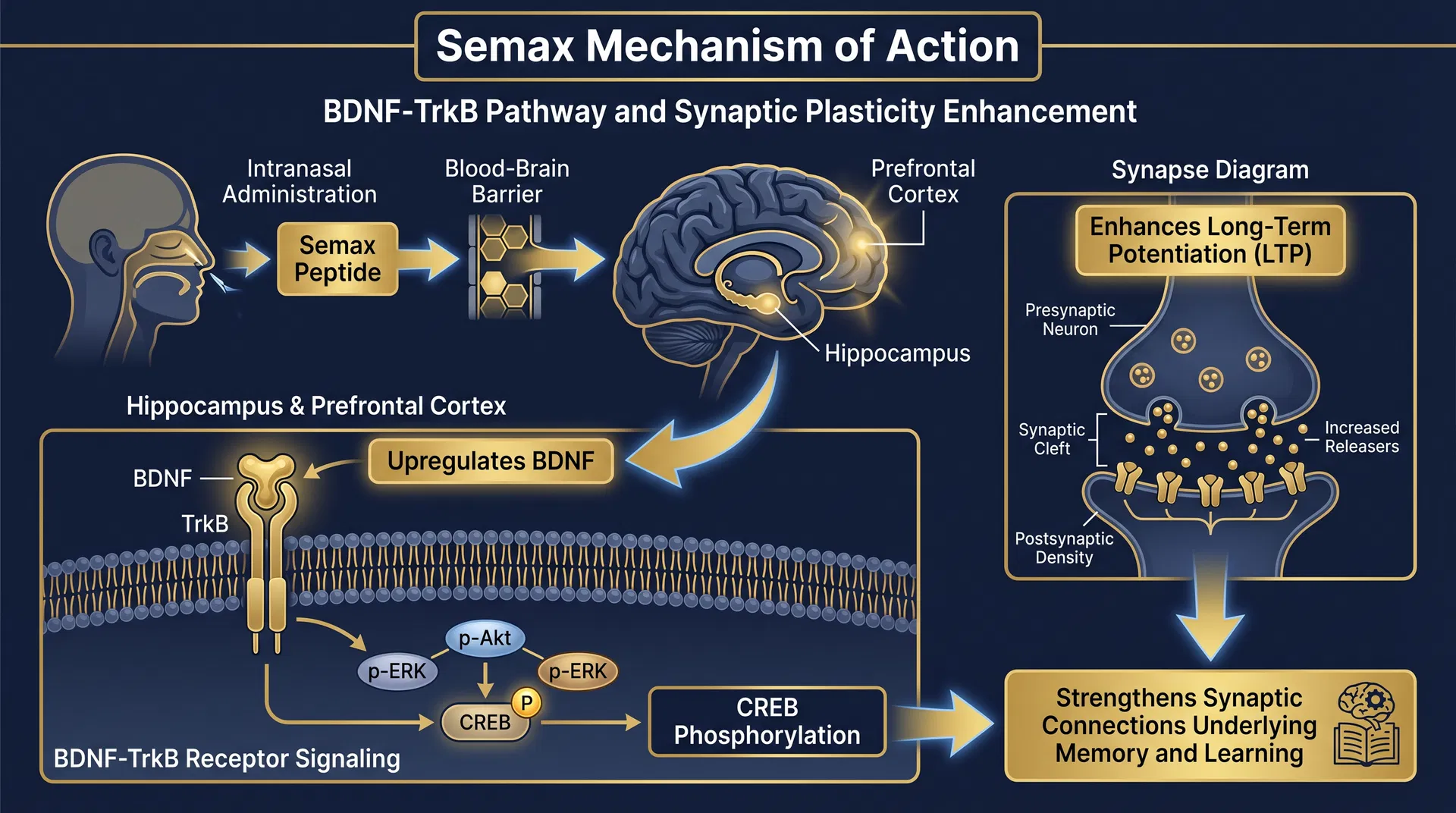
Key Research Pathways
BDNF Upregulation / TrkB Signaling
Inferred from Semax parent: rapidly upregulates BDNF mRNA in glial cells and hippocampal tissue, activating TrkB receptors to drive PI3K/Akt and MAPK/ERK cascades that promote neuronal survival, synaptic plasticity, and hippocampal neurogenesis.
NGF Upregulation / Cholinergic Neuroprotection
Inferred from Semax parent: upregulates nerve growth factor (NGF), supporting cholinergic neuron survival in the basal forebrain — a system critical for memory consolidation and cognitive function.
MC4R Melanocortin Signaling
ACTH(4-10)-derived peptides modulate melanocortin-4 receptor (MC4R) signaling in the CNS, providing a second pathway for neuroprotection and BDNF regulation independent of direct neurotrophin induction.
Enhanced CNS Penetration (Adamantane)
The adamantane modification increases lipophilicity and metabolic stability, hypothesized to improve blood-brain barrier penetration and extend the compound's duration of action compared to unmodified Semax.
Key Findings from the Literature
- Parent compound Semax: rapidly upregulates BDNF and NGF mRNA in rat glial cultures within hours (Dolotov et al., 2006)
- Semax increases hippocampal BDNF and TrkB signaling after intranasal administration (Agapova et al., 2007)
- Adamantane modification strategy validated by CNS-active drugs amantadine and memantine (NMDA antagonists)
- Semax registered medicine in Russia since 1994 for stroke recovery and cognitive impairment
- Intranasal delivery route (nasal spray) provides direct olfactory pathway to CNS, bypassing blood-brain barrier
Important Research Context
Research References
Peer-reviewed literature supporting the research profile of Adamax
The following peer-reviewed studies form the primary evidence base for Adamax's research profile. All references are sourced from PubMed, NCBI, and peer-reviewed scientific journals. Published research is available through PubMed, NCBI, and peer-reviewed biomedical journals.
- 1.
Dolotov OV, et al. Semax, an analogue of adrenocorticotropin (4-10), binds specifically and increases levels of brain-derived neurotrophic factor protein in rat basal forebrain. Journal of Neurochemistry. 2006.PMID: 16635254
Semax rapidly upregulates BDNF mRNA and TrkB receptor expression in rat hippocampus after intranasal administration — the primary proposed mechanism for cognitive effects.
- 2.
Agapova TY, et al. Neurotrophin gene expression in rat brain under the action of Semax, an analogue of ACTH 4-10. Neuroscience Letters. 2007.PMID: 17353092
Semax increases hippocampal BDNF and TrkB signaling under ischemic conditions, supporting neuroprotective research applications.
Adamax
Cognitive Research
Purgo Labs list price, read 12 Sep 2026 · per-lot COA on the vendor page
10mg $69.99 → $55.99 with code HEALTH (20% off; price read 2 Oct 2026)
- 1 certificate verified at the lab10mg$69.99→ $55.99
Fast FedEx shipping · Discreet packaging
Technical Specifications
| Compound Name | Adamax (adamantane-modified Semax) |
| Parent Compound | Semax (ACTH(4-10) analog, registered medicine Russia 1994) |
| Sequence | Ac-Adm-Met-Glu-His-Phe-Pro-Gly-Pro-NH2 |
| Molecular Weight | ~1,100 Da (estimated) |
| Modification | N-terminal adamantane group + N-acetylation |
| Primary Research Target | BDNF/NGF upregulation, TrkB/MC4R signaling |
| Available Forms | Lyophilized powder, nasal spray |
| Regulatory Status | Research chemical; not FDA-approved |
| Purity | ≥99% (third-party tested) |
Source Adamax at Purgo Labs
10mg $69.99 list · $55.99 with code HEALTH · lab-verifiable COA per lot
Other Compounds in This Guide




Supporting Research
Adamax is an adamantane-modified neuropeptide analog. Evidence is preclinical only, primarily from Russian research groups. No human clinical trials have been conducted.
References
Research Databases
Ready to Source Adamax?
Purgo Labs offers Adamax with ≥99% purity, third-party certificates of analysis, and fast FedEx shipping. This is an affiliate link — we may earn a commission at no cost to you.