Semaglutide vs Tirzepatide (2026): Which Is Better for Weight Loss, Muscle Loss, and Speed?
Semaglutide vs tirzepatide head-to-head: does semaglutide or tirzepatide work faster? Is tirzepatide better than Wegovy for weight loss? How do they compare for muscle loss? SURMOUNT-5 trial data, side effects, and cost breakdown.
| Category | Semaglutide | Tirzepatide |
|---|---|---|
| Primary Mechanism | GLP-1 receptor agonist — slows gastric emptying, reduces appetite, increases insulin secretion | Dual GLP-1 + GIP receptor agonist — additive satiety signaling, greater insulin sensitization |
| Primary Application | Type 2 diabetes management, weight loss (Ozempic/Wegovy) | Type 2 diabetes (Mounjaro), weight loss (Zepbound) |
| Route | SubQ injection (weekly) | SubQ injection (weekly) |
| Evidence Level | Tier 1 — multiple Phase 3 RCTs in humans (SUSTAIN, STEP trials) | Tier 1 — Phase 3 RCTs in humans (SURPASS, SURMOUNT trials) |
| Best For | Established safety profile, T2D + weight loss, cardiovascular risk reduction | Maximum fat loss efficacy, dual mechanism, newer but strong trial data |
Semaglutide and Tirzepatide are the two dominant GLP-1 based weight loss medications. Semaglutide is a GLP-1 receptor agonist — it uses weekly injections of an FDA approved compound at doses up to 2.4 mg, combined with diet and exercise, to produce weight reduction in patients with type 2 diabetes or obesity. Tirzepatide adds GIP receptor agonism on top of GLP-1, making it a dual action agonist. Clinical trials show Tirzepatide produces greater fat loss — the average weight loss is 22.5% vs 14.9% for semaglutide in head-to-head data — but Semaglutide has a longer track record and more established safety data. Both compounds slow gastric emptying, reduce appetite, and improve blood sugar control. Common side effects include nausea, vomiting, and GI discomfort during the titration phase. Insurance coverage for both medications varies significantly; GLP-1 obesity treatments are frequently excluded from formularies, making research-grade access an important consideration for many users who want to lose weight without the branded drug cost.
Our Verdict
Winner: Tirzepatide (fat loss) / Semaglutide (established safety)
Tirzepatide wins on fat loss — 15–22% body weight reduction vs 10–15% for Semaglutide in clinical trials. Semaglutide wins on established safety data, cardiovascular outcomes evidence, and familiarity. For researchers prioritizing maximum fat loss, Tirzepatide is the stronger compound. For those wanting the most established safety profile, Semaglutide is the better choice.
Pathway Comparison Diagram
Semaglutide activates a single receptor (GLP-1R); Tirzepatide activates two (GLP-1R + GIPR) — the dual-agonist mechanism explains the superior weight loss outcomes in SURMOUNT trials. For background on the GLP-1 peptide family, see the GLP-1 Peptides guide. For the three-way comparison, see Semaglutide vs Tirzepatide vs Retatrutide.
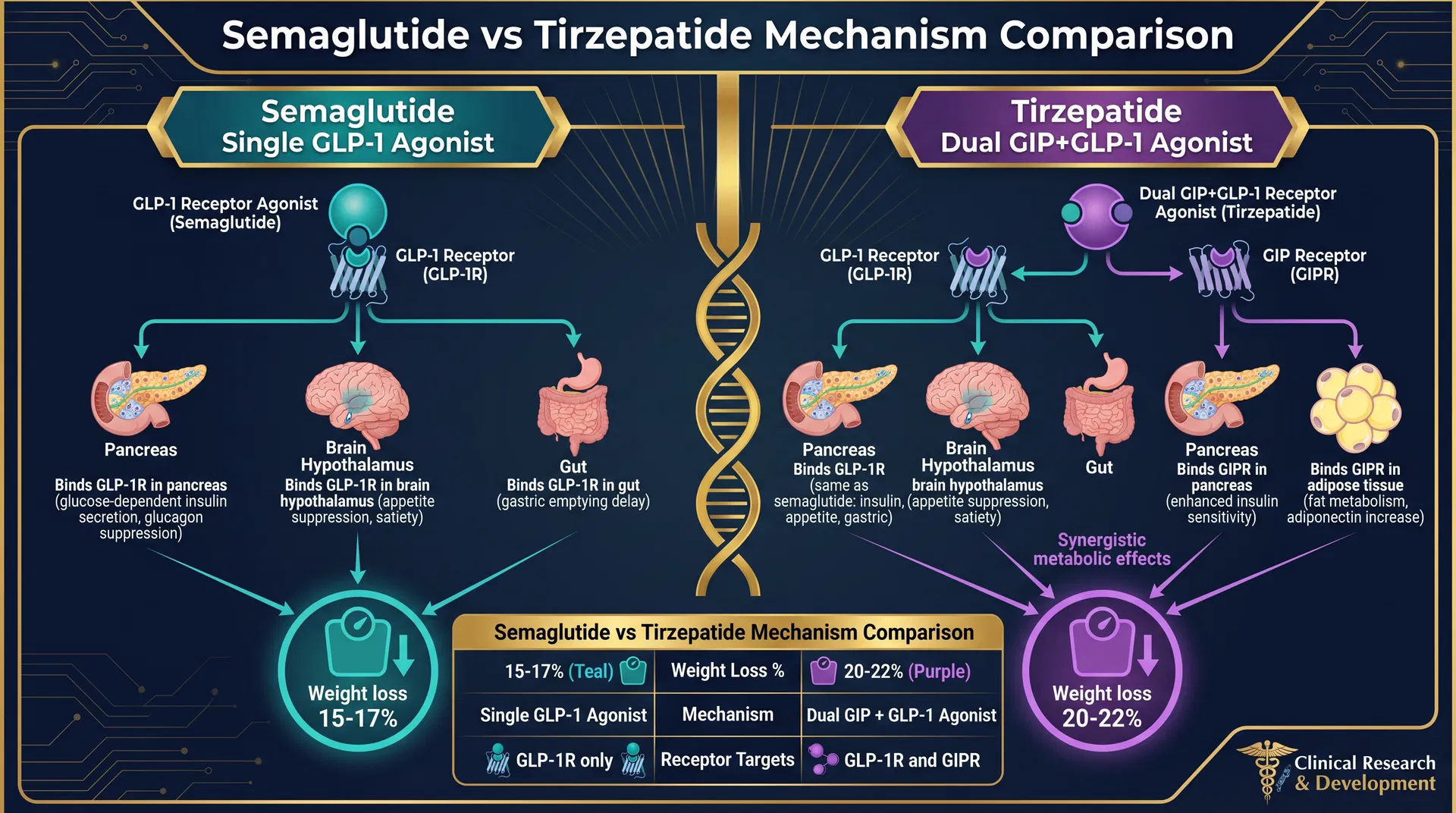
Semaglutide vs Tirzepatide: Side-by-Side
| Category | Semaglutide | Tirzepatide |
|---|---|---|
| Receptor Targets | GLP-1 (single agonist) | GIP + GLP-1 (dual agonist) |
| Fat Loss (Clinical) | 10–15% body weight at 68 weeks | 15–22% body weight at 72 weeks |
| FDA Approval | Ozempic (T2D), Wegovy (obesity) | Mounjaro (T2D), Zepbound (obesity) |
| Cardiovascular Data | Extensive (SUSTAIN, STEP trials) | Growing (SURPASS-CVOT ongoing) |
| Starting Dose | 0.25mg/week | 2.5mg/week |
| Max Dose | 2.4mg/week (Wegovy) | 15mg/week (Zepbound) |
| Side Effects | Moderate GI effects | Similar GI effects, slightly more nausea |
| Half-life | ~7 days | ~5 days |
Source Both Peptides at Purgo Labs
Purgo Labs carries research-grade Semaglutide and Tirzepatide with third-party COAs. Use code HEALTH for 20% off.
Frequently Asked Questions
Which causes more weight loss: Semaglutide or Tirzepatide?
Tirzepatide produces greater fat loss in clinical trials — 15–22% body weight reduction vs 10–15% for Semaglutide. The added GIP receptor agonism enhances fat cell insulin sensitivity and produces complementary appetite suppression.
Can I switch from Semaglutide to Tirzepatide?
Yes, but always restart titration from the lowest dose. GLP-1 tolerance does not carry over to Tirzepatide — starting at an equivalent dose will cause significant GI side effects.
Which has better cardiovascular outcomes?
Semaglutide has more established cardiovascular outcomes data from the SUSTAIN and STEP trials, which showed significant reduction in MACE events. Tirzepatide's cardiovascular outcomes trial (SURPASS-CVOT) is ongoing.
Efficacy: Which Produces More Weight Loss?
Clinical trial data is unambiguous: tirzepatide produces significantly greater weight loss than semaglutide. In the SURMOUNT-1 trial, tirz vs semaglutide showed tirzepatide at 15 mg/week produced a mean 22.5% reduction in body weight over 72 weeks. Semaglutide at 2.4 mg/week (Wegovy dose) produced 14.9% in the STEP-1 trial. The SURMOUNT-5 head-to-head trial confirmed this gap. Tirzepatide produced 47% more weight loss than semaglutide in a direct comparison. Does semaglutide or tirzepatide work faster? Tirzepatide shows greater weight loss at every time point in head-to-head data. Is tirzepatide better than Wegovy? By weight loss outcomes, yes — tirzepatide outperforms Wegovy (semaglutide 2.4 mg) in the SURMOUNT-5 trial. What is better tirzepatide or semaglutide? For maximum weight loss, tirzepatide; for longer cardiovascular safety data, semaglutide. See the Tirzepatide Before and After guide for detailed timelines.
The mechanism difference explains the efficacy gap. Semaglutide is a selective GLP-1 receptor agonist. Tirzepatide activates both GLP-1 and GIP receptors simultaneously. GIP receptor activation enhances insulin secretion from beta cells. It also appears to amplify the appetite-suppressing effects of GLP-1 signaling. The result is additive satiety without proportionally additive side effects.
What the cited studies used
One row per compound: the amount and schedule administered in a specific indexed study, who received it, and the paper. These are reports of what was done in that study, not recommendations, and several are animal or single-dose studies. Where no indexed human regimen exists we say so rather than print a number. Community "stacks" and cycle schedules are not reproduced on this site.
Research use only. Compound Review scores vendors on documentation — laboratory certificates, lot records, pricing and company identity. Nothing on this page is guidance on human or veterinary use, dosing or health outcomes.
| Compound | Regimen in the study | Population | Source |
|---|---|---|---|
| Semaglutide | 2.4 mg subcutaneous once weekly for 68 weeks (after dose escalation), plus lifestyle intervention | 1,961 adults with BMI ≥30 (or ≥27 with a weight-related condition), no diabetes — STEP 1 | PMID 33567185 Wilding et al., N Engl J Med 2021 |
| Tirzepatide | 5, 10 or 15 mg subcutaneous once weekly for 72 weeks, including a 20-week escalation | 2,539 adults with BMI ≥30 (or ≥27 with a complication), no diabetes — SURMOUNT-1 | PMID 35658024 Jastreboff et al., N Engl J Med 2022 |
Research use only. Compound Review scores vendors on documentation — laboratory certificates, lot records, pricing and company identity. Nothing on this page is guidance on human or veterinary use, dosing or health outcomes.
Key Clinical Trials at a Glance
The evidence base for both compounds is built on large Phase 3 randomized controlled trials. The table below summarizes the pivotal studies that define the efficacy and safety profiles of each compound.
| Trial | Compound | Duration | Weight Loss | HbA1c Δ | CV Outcome |
|---|---|---|---|---|---|
| STEP-1 | Semaglutide 2.4 mg | 68 wks | −14.9% | Obesity trial | Not primary |
| SUSTAIN-6 | Semaglutide 0.5–1.0 mg | 104 wks | −4.5 kg | −1.1% | 26% MACE ↓ |
| SELECT | Semaglutide 2.4 mg | ~3.3 yrs | −9.4% | Obesity/CV trial | 20% MACE ↓ |
| SURMOUNT-1 | Tirzepatide 15 mg | 72 wks | −22.5% | Obesity trial | Not primary |
| SURMOUNT-5 | Tirz vs Sema (H2H) | 72 wks | 47% more vs sema | Obesity trial | Not primary |
| SURPASS-2 | Tirz 15 mg vs Sema 1.0 mg | 40 wks | −12.4% vs −8.5% | −2.58% vs −1.86% | Not primary |
Sources: NEJM STEP-1 (Wilding et al., 2021), NEJM SUSTAIN-6 (Marso et al., 2016), NEJM SELECT (Lincoff et al., 2023), NEJM SURMOUNT-1 (Jastreboff et al., 2022), Lancet SURMOUNT-5 (2024), NEJM SURPASS-2 (Frías et al., 2021).
HbA1c Reduction: Which Is Better for Diabetes?
For type 2 diabetes management, both compounds are highly effective — but tirzepatide shows a consistent edge in glycemic control. In the SURPASS-2 head-to-head trial, tirzepatide 15 mg reduced HbA1c by −2.58 percentage points vs −1.86 percentage points for semaglutide 1.0 mg over 40 weeks. Approximately 92% of tirzepatide patients achieved HbA1c below 7% vs 81% for semaglutide.
The mechanism behind tirzepatide’s superior glycemic control is the GIP receptor component. GIP (Glucose-dependent Insulinotropic Polypeptide) is an incretin hormone that potentiates insulin secretion from pancreatic beta cells in a glucose-dependent manner. In combination with GLP-1R agonism, GIP receptor activation produces additive insulin secretion without proportionally increasing hypoglycemia risk. The dual mechanism also reduces glucagon secretion more effectively than GLP-1 alone.
Semaglutide’s cardiovascular outcomes data remains more extensive. The SUSTAIN-6 trial demonstrated a 26% reduction in MACE (major adverse cardiovascular events) for semaglutide in high-risk T2D patients. The SELECT trial confirmed a 20% MACE reduction in obese patients without T2D. Tirzepatide’s cardiovascular outcomes trial (SURPASS-CVOT) is ongoing.
Does Semaglutide or Tirzepatide Work Faster?
Both compounds begin producing measurable weight loss within the first 4–8 weeks of treatment, but tirzepatide tends to produce faster and greater early weight loss due to its dual GIP/GLP-1 mechanism. In the SURMOUNT-5 head-to-head trial, tirzepatide-treated patients lost significantly more weight at every measured timepoint compared to semaglutide. By week 12, tirzepatide patients had lost approximately 7–9% body weight vs 5–7% for semaglutide at equivalent titration stages.
The speed of onset depends heavily on titration. Semaglutide's starting dose (0.25 mg/week) is sub-therapeutic — it's purely a tolerability dose. Meaningful weight loss typically begins after reaching 0.5–1.0 mg/week at weeks 4–8. Tirzepatide's 2.5 mg starting dose is also sub-therapeutic, with clinical weight loss effects emerging at the 5–7.5 mg range (weeks 4–12). Neither compound produces rapid early results; both require a 12–20 week titration period to reach full therapeutic dose.
Speed Summary
Tirzepatide works faster and produces more weight loss at every timepoint in head-to-head data. Both compounds require 12–20 weeks of titration to reach full therapeutic dose. Neither is a "fast" solution — both are long-term metabolic interventions.
Is Tirzepatide Better Than Wegovy?
Yes — by the primary endpoint of weight loss, tirzepatide (Zepbound) is clinically superior to Wegovy semaglutide. The SURMOUNT-5 trial, the first direct head-to-head comparison, confirmed tirzepatide produced 47% more weight loss than semaglutide over 72 weeks. At the highest doses (tirzepatide 15 mg vs semaglutide 2.4 mg), the absolute difference was approximately 20.2% vs 13.7% body weight reduction.
However, "better" depends on the research endpoint. Wegovy (semaglutide) has more extensive cardiovascular outcomes data — the SELECT trial demonstrated a 20% reduction in MACE events in obese patients without T2D. Tirzepatide's cardiovascular outcomes trial (SURPASS-CVOT) is still ongoing. For researchers focused on cardiovascular endpoints, semaglutide remains the better-characterized compound.
For pure fat loss research, tirzepatide is the stronger compound. For cardiovascular risk reduction research, semaglutide has the more complete evidence base. The choice depends on the specific research question.
What About Retatrutide? The Triple Agonist
Retatrutide (LY3437943) adds a third receptor target — GLP-1, GIP, and glucagon receptor agonism simultaneously — making it a triple agonist. Early Phase 2 data (NEJM, 2023) showed mean weight loss of 24.2% at 48 weeks at the highest dose, exceeding both semaglutide and tirzepatide. The glucagon receptor component drives additional energy expenditure and hepatic fat reduction beyond what the GLP-1/GIP combination achieves.
Retatrutide is currently in Phase 3 trials and is not yet approved. For researchers interested in the triple agonist mechanism, see the Retatrutide vs Tirzepatide comparison and the GLP-3 R compound page.
Side Effects: How Do They Compare?
Both compounds share the same GI side effect profile: nausea, vomiting, diarrhea, and constipation. These are dose-dependent and typically peak during the titration phase. The key difference is nausea frequency and persistence. Semaglutide produces nausea in approximately 44% of subjects (STEP-1), while tirzepatide produces nausea in 31% (SURMOUNT-1). However, semaglutide's nausea tends to resolve faster after titration.
Both compounds carry a class warning for thyroid C-cell tumors based on rodent studies (not confirmed in humans). Neither should be used in patients with a personal or family history of medullary thyroid carcinoma or MEN2. Pancreatitis risk is low but present for both. Neither compound has shown increased cardiovascular risk — semaglutide has demonstrated cardiovascular benefit in the SUSTAIN-6 and SELECT trials. For detailed dosing protocols, see the Semaglutide Dosage Guide and the Tirzepatide Dosage Guide.
Cost and Availability
Both branded medications are expensive in the US without insurance. Wegovy (semaglutide 2.4 mg) lists at approximately $1,300–$1,500/month. Zepbound (tirzepatide) lists at approximately $1,060–$1,200/month — slightly less expensive than Wegovy at launch. Insurance coverage varies significantly; GLP-1 medications for obesity (as opposed to T2D) are frequently excluded from formularies. Patients who want to lose weight with these medications often face out-of-pocket costs that make research-grade alternatives appealing. The average weight loss achieved in clinical trials — 22.5% for tirzepatide vs 14.9% for semaglutide — represents the upper bound of what these medications can achieve; real-world outcomes depend heavily on adherence, diet, and exercise.
Research-grade semaglutide and tirzepatide are available from suppliers like Purgo Labs at significantly lower cost for research purposes. These are not FDA-approved for human use and are sold for laboratory research only.
Dosing Protocols
Both compounds use a slow titration schedule to minimize GI side effects. Semaglutide starts at 0.25 mg/week and escalates every 4 weeks: 0.25 → 0.5 → 1.0 → 1.7 → 2.4 mg/week over 16 weeks. Tirzepatide starts at 2.5 mg/week and escalates every 4 weeks: 2.5 → 5 → 7.5 → 10 → 12.5 → 15 mg/week over 20 weeks. Both are administered as weekly subcutaneous injections.
Use the Peptide Dosage Calculator to convert your target dose into exact syringe units based on your vial concentration. See the Semaglutide Dosage Guide and Tirzepatide Dosage Guide for full titration schedules and reconstitution instructions.
Semaglutide vs Tirzepatide: Which Is Right for Your Research?
Choose Semaglutide if…
- • You need the most established long-term safety data
- • Cardiovascular outcomes are a primary research endpoint
- • You want a lower starting dose for GI sensitivity protocols
- • The research involves T2D + weight loss combination endpoints
- • You're comparing against the Ozempic/Wegovy reference standard
Choose Tirzepatide if…
- • Maximum fat loss efficacy is the primary endpoint
- • You're studying dual GIP/GLP-1 receptor mechanisms
- • Research involves insulin resistance or metabolic syndrome
- • You want to compare against the current best-in-class standard
- • Lower nausea frequency is important for the protocol design
Calculate Your Exact Dose
The reconstitution calculator converts a stated amount into syringe units for a given vial concentration — a bench tool, not dosing guidance.
Related Resources
Related Guides
Ready to Start Your Research?
Purgo Labs provides research-grade research peptides with third-party COAs. Code HEALTH is 20% off every order at Purgo Labs (verified recurring).
Visit Purgo Labs