Epithalon vs GHK-Cu
Head-to-head comparison of Epithalon and GHK-Cu for anti-aging, longevity, and cellular repair. Which peptide is better for anti-aging research?
| Category | Epithalon | GHK-Cu |
|---|---|---|
| Primary Mechanism | Telomerase activation (TERT), telomere elongation, epigenetic gene regulation | Copper chelation, TGF-β/VEGF upregulation, collagen synthesis, anti-inflammatory gene regulation |
| Primary Application | Telomere maintenance, longevity, circadian rhythm regulation | Skin rejuvenation, wound healing, hair follicle stimulation, tissue remodeling |
| Route | SubQ injection or IV | SubQ injection or topical |
| Evidence Level | Tier 3 — animal models + limited human longevity studies | Tier 2–3 — human skin studies + extensive in vitro data |
| Best For | Telomere-targeted longevity, epigenetic aging, circadian/sleep optimization | Skin anti-aging, wound healing, hair loss, collagen remodeling |
Epithalon and GHK-Cu are two of the most researched peptides in the anti-aging and longevity space, but they work through fundamentally different mechanisms. Epithalon targets telomere maintenance and pineal gland function; GHK-Cu targets tissue remodeling, collagen synthesis, and gene expression. Understanding these differences helps researchers build the most effective anti-aging protocol.
Our Verdict
Winner: Stack
Epithalon and GHK-Cu are highly complementary anti-aging peptides — Epithalon addresses cellular aging at the DNA level (telomere maintenance), while GHK-Cu addresses tissue aging at the structural level (collagen, skin, wound repair). For comprehensive anti-aging research, stacking both is more effective than either alone. If choosing one: Epithalon for systemic longevity; GHK-Cu for skin, tissue, and structural anti-aging.
Pathway Comparison Diagram
Epithalon targets the nucleus — activating telomerase to extend telomeres and delay cellular senescence. GHK-Cu targets the extracellular matrix — stimulating collagen synthesis and resetting gene expression toward a youthful pattern.
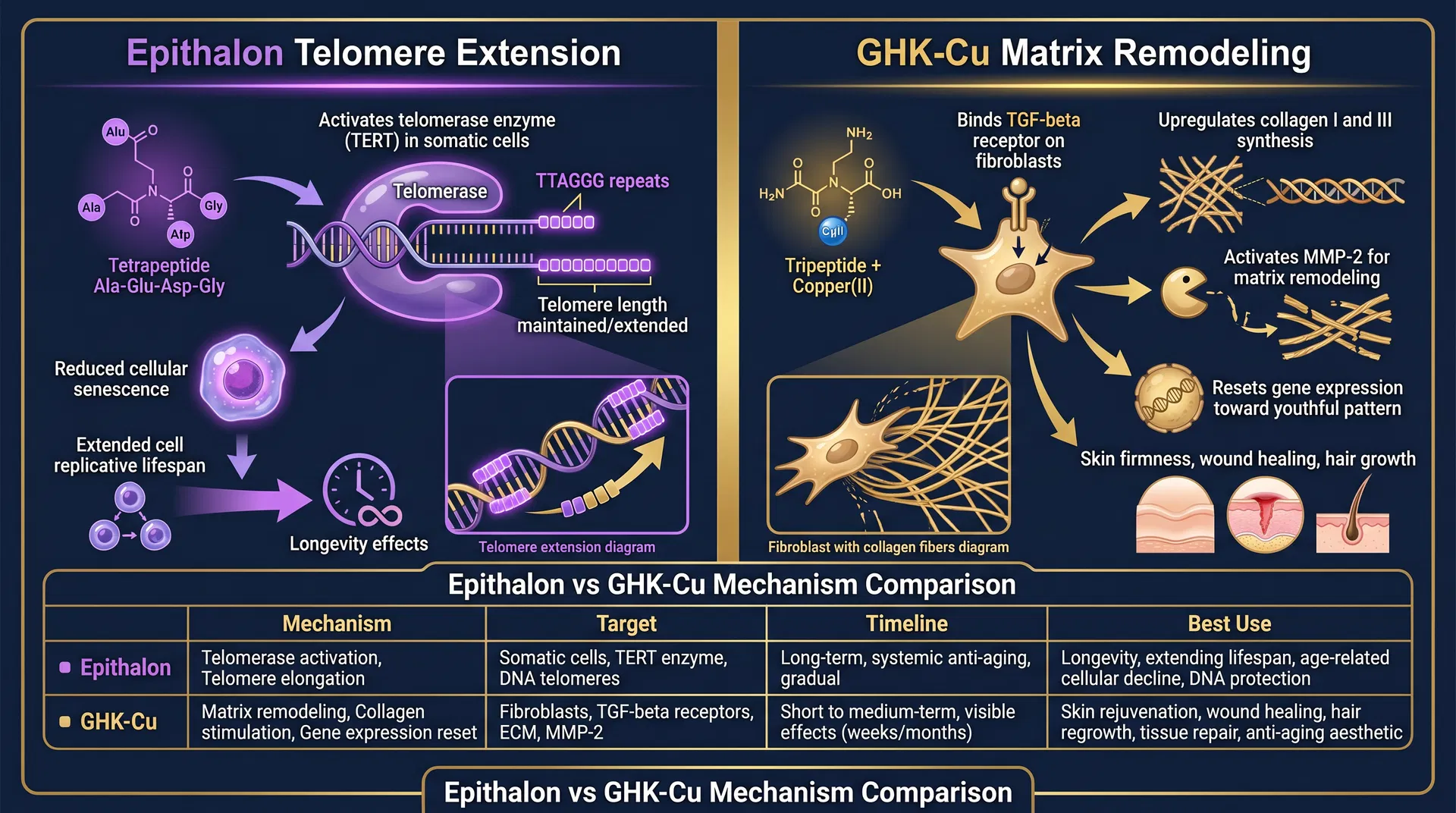
Epithalon vs GHK-Cu: Side-by-Side
| Category | Epithalon | GHK-Cu |
|---|---|---|
| Primary Mechanism | Telomerase activation, telomere extension | Gene expression (4,000+ genes), collagen synthesis |
| Anti-aging Target | Cellular aging, DNA repair | Tissue aging, skin, structural repair |
| Administration | SubQ injection (cycled) | Topical or subQ injection |
| Skin Benefits | Indirect (cellular repair) | Direct — collagen, elastin, HA synthesis |
| Systemic Effects | Pineal regulation, immune modulation | Broad tissue repair, anti-inflammatory |
| Cycle Protocol | 10–20 days, 2–3x/year | Continuous or 8–12 week cycles |
| Research Base | Russian clinical research | Extensive international research |
| Cost | Moderate | Moderate |
Source Both Peptides at Purgo Labs
Purgo Labs carries pharmaceutical-grade Epithalon and GHK-Cu with third-party COAs. Use code HEALTH for 20% off.
Frequently Asked Questions
Can I stack Epithalon and GHK-Cu?
Yes — they work through completely different mechanisms and are fully compatible. Epithalon targets telomere maintenance and cellular aging; GHK-Cu targets tissue remodeling and structural anti-aging. Together they provide comprehensive anti-aging coverage.
Which is better for skin anti-aging?
GHK-Cu is the stronger choice for skin — it directly stimulates collagen, elastin, and hyaluronic acid synthesis and can be applied topically. Epithalon has indirect skin benefits through cellular repair but is not primarily a skin peptide.
How often do I need to cycle Epithalon?
The standard protocol is 10–20 day cycles, 2–3 times per year. This matches the Russian clinical research protocols. GHK-Cu can be used continuously (topical) or in longer cycles (injectable).
Calculate Your Exact Dose
Use our free peptide calculator to convert your dose into exact syringe units based on your vial concentration.
Related Resources
Related Guides
Ready to Start Your Research?
Purgo Labs provides pharmaceutical-grade research peptides with third-party COAs. Use code HEALTH for 20% off your first order.
Visit Purgo Labs