Semax vs Selank
Semax and Selank are the two most studied cognitive peptides from Russian neuroscience research — but they operate on fundamentally different axes. Semax drives cognitive performance through BDNF upregulation and dopaminergic modulation. Selank reduces anxiety and stabilizes mood through GABA-A modulation and serotonin regulation. Understanding when to use each — and when to stack both — requires understanding their distinct mechanisms.
Choose Semax if your primary goals are focus, working memory, executive function, or neuroprotection. Choose Selank if your primary goals are anxiety reduction, stress resilience, or mood stabilization. Stack both for comprehensive cognitive optimization — they are mechanistically complementary and are frequently used together in research protocols targeting both the cognitive and emotional dimensions of brain function.
Research use only. Compound Review scores vendors on documentation — laboratory certificates, lot records, pricing and company identity. Nothing on this page is guidance on human or veterinary use, dosing or health outcomes.
Mechanism Deep Dive
Semax (Met-Glu-His-Phe-Pro-Gly-Pro) is a synthetic heptapeptide analogue of ACTH(4-7) with a Pro-Gly-Pro C-terminal extension that prevents rapid enzymatic degradation. It was developed at the Institute of Molecular Genetics of the Russian Academy of Sciences and has been approved in Russia as a drug for stroke recovery and cognitive impairment.
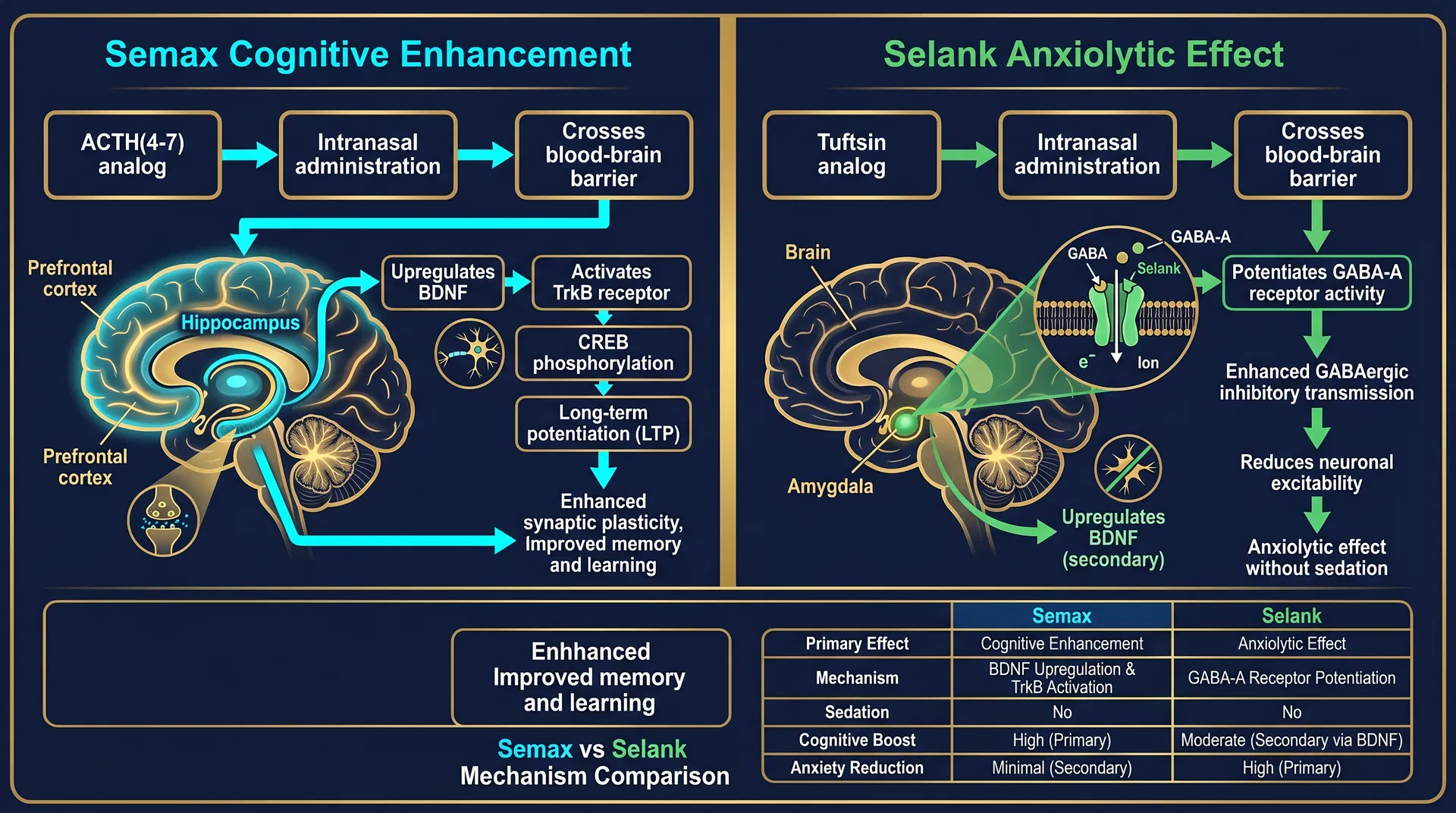
Its primary mechanism is upregulation of BDNF (brain-derived neurotrophic factor) and NGF (nerve growth factor) in the hippocampus and prefrontal cortex — the two brain regions most critical for memory consolidation and executive function. BDNF promotes neuronal survival, dendritic spine density, and long-term potentiation (LTP), the cellular basis of memory formation.
Semax also modulates dopamine and serotonin release in the mesolimbic and mesocortical pathways, enhancing motivation, focus, and working memory. It normalizes HPA axis reactivity, reducing cortisol in chronic stress models. In stroke research, Semax has demonstrated neuroprotective effects through reduction of IL-6 and TNF-α neuroinflammation and upregulation of VEGF for angiogenesis.
Selank (Thr-Lys-Pro-Arg-Pro-Gly-Pro) is a synthetic analogue of the endogenous neuropeptide tuftsin (Thr-Lys-Pro-Arg) with a Gly-Pro-Pro C-terminal extension for metabolic stability. It was developed alongside Semax at the Institute of Molecular Genetics and is approved in Russia for generalized anxiety disorder and mixed anxiety-depressive disorder.
Selank's primary mechanism is modulation of GABA-A receptor activity — the same receptor system targeted by benzodiazepines — producing anxiolytic effects without receptor downregulation, sedation, or dependence. Unlike benzodiazepines, Selank does not cause cognitive blunting, withdrawal syndrome, or tolerance development at research doses.
Selank also stabilizes enkephalin degradation (endogenous opioid peptides involved in mood and emotional memory), upregulates BDNF expression (providing mild nootropic benefit), and normalizes serotonin turnover. Its immunomodulatory effects through tuftsin-like activity add an anti-inflammatory dimension relevant to anxiety driven by neuroinflammation.
Semax and Selank share one key mechanism — BDNF upregulation — but diverge sharply in their primary pathways. Semax drives the dopaminergic and noradrenergic systems that power focus and motivation; Selank stabilizes the GABAergic and serotonergic systems that regulate anxiety and emotional tone. This complementarity is why the combination is so widely used: Semax's stimulatory effects can be anxiogenic in stress-sensitive individuals, and Selank's GABA-A modulation directly buffers this. Together, they provide both the cognitive ceiling and the emotional floor for optimal brain function.
Pathway Comparison Diagram
Semax drives BDNF/TrkB signaling in the hippocampus and prefrontal cortex for cognitive enhancement; Selank potentiates GABA-A receptor activity in the amygdala for anxiolytic effects without sedation — two complementary mechanisms visualized.
Head-to-Head Comparison
| Category | Semax | Selank |
|---|---|---|
| Primary Function | Nootropic, neuroprotective, cognitive enhancer | Anxiolytic, anti-stress, mood stabilizer |
| Molecular Origin | Synthetic heptapeptide analogue of ACTH(4-7) with Pro-Gly-Pro extension | Synthetic analogue of tuftsin (Thr-Lys-Pro-Arg) with Gly-Glu-Thr extension |
| Primary Mechanism | BDNF/NGF upregulation, dopamine/serotonin modulation, HPA axis regulation | GABA-A receptor modulation, serotonin stabilization, enkephalin protection |
| Cognitive Enhancement | Strong — improves working memory, attention, executive function; human clinical data | Moderate — secondary to anxiolytic effects; BDNF upregulation provides mild nootropic benefit |
| Anxiety Reduction | Mild — HPA axis modulation reduces stress reactivity; can be anxiogenic at high doses | Strong — direct GABA-A modulation; comparable to benzodiazepines without dependence or sedation |
| Neuroprotection | Strong — BDNF/NGF upregulation protects neurons; Phase III data for stroke recovery | Moderate — BDNF upregulation and anti-neuroinflammatory effects; less direct neuroprotective evidence |
| Onset (Intranasal) | 15–30 minutes; peak cognitive effects at 30–60 minutes | 15–30 minutes; anxiolytic effects within 30 minutes |
| Duration of Action | 4–6 hours; some users report residual cognitive effects for 8–12 hours | 4–8 hours; anxiolytic effects may persist longer than cognitive effects |
| Side Effect Profile | Mild stimulant effects, possible irritability at high doses; generally well-tolerated | Minimal — no sedation, no dependence, no withdrawal; very clean safety profile |
| Dependence Risk | None reported at research doses | None — no GABA-A downregulation or tolerance development reported |
| Clinical Evidence | Phase III human trials (stroke, ADHD, optic nerve); approved drug in Russia | Phase II/III human trials (GAD, mixed anxiety-depression); approved drug in Russia |
| Best Stacked With | Selank (anxiolytic buffer), BPC-157 (gut-brain axis), Dihexa (synaptogenesis) | Semax (cognitive ceiling), BPC-157 (dopamine/serotonin repair), Epithalon (sleep/mood) |
| Primary Research Use | Cognitive impairment, stroke recovery, ADHD, neuroprotection, focus enhancement | Generalized anxiety disorder, stress, anxiety-driven cognitive impairment, mood stabilization |
What the cited studies used
One row per compound: the amount and schedule administered in a specific indexed study, who received it, and the paper. These are reports of what was done in that study, not recommendations, and several are animal or single-dose studies. Where no indexed human regimen exists we say so rather than print a number. Community "stacks" and cycle schedules are not reproduced on this site.
Research use only. Compound Review scores vendors on documentation — laboratory certificates, lot records, pricing and company identity. Nothing on this page is guidance on human or veterinary use, dosing or health outcomes.
| Compound | Regimen in the study | Population | Source |
|---|---|---|---|
| Semax | No human dose-ranging trial in our reference set Semax is a registered intranasal preparation in Russia; the trials behind that registration are not PubMed-indexed in a form we have verified, so we print no amount. | — | none |
| Selank | Administered for 14 days; amount not stated in the abstract Russian-language clinical study reporting cytokine markers; we cite the duration and population only. | Patients with generalised anxiety disorder and neurasthenia | PMID 18577961 Uchakina et al., Zh Nevrol Psikhiatr 2008 |
Which Should You Use?
| Goal | Primary | Add-On |
|---|---|---|
| Focus, working memory, executive function | Semax | Selank (add-on) |
| Generalized anxiety, stress, cortisol reduction | Selank | Semax (optional) |
| Anxiety-driven cognitive impairment | Both (stack) | Dihexa |
| Neuroprotection, stroke recovery, TBI | Semax | BPC-157 |
| Mood stabilization, depression with anxiety | Selank | Semax |
| Sleep quality, nighttime anxiety | Selank | Epithalon |
| ADHD-like symptoms, attention deficit | Semax | Selank |
| Comprehensive cognitive optimization | Both (stack) | Dihexa or BPC-157 |
Frequently Asked Questions
What is the main difference between Semax and Selank?
Semax is primarily a nootropic and neuroprotective peptide that enhances cognitive performance, focus, and memory through BDNF/NGF upregulation and dopaminergic/serotonergic modulation. Selank is primarily an anxiolytic and anti-stress peptide that calms the nervous system through GABA-A modulation, serotonin stabilization, and enkephalin protection. Semax sharpens cognition; Selank reduces anxiety. They address different but complementary aspects of brain function.
Which is better for focus and cognitive performance — Semax or Selank?
Semax is significantly more studied for cognitive enhancement. It upregulates BDNF in the hippocampus and prefrontal cortex, enhances dopamine and serotonin signaling, and has demonstrated improvements in attention, working memory, and executive function in both animal and human studies. Selank has mild nootropic effects through BDNF upregulation and enkephalin stabilization, but it is not primarily a cognitive enhancer — its cognitive benefits are secondary to its anxiolytic effects.
Which is better for anxiety — Semax or Selank?
Selank is the clear choice for anxiety. It modulates GABA-A receptors (anxiolytic effect without dependence), increases serotonin turnover, and stabilizes enkephalins (endogenous mood peptides). It reduces cortisol without sedation. Semax can have mild anxiogenic effects in some users due to its dopaminergic and noradrenergic stimulation, making it less suitable as a primary anxiety treatment — though it does have HPA axis modulating properties that can reduce stress reactivity at appropriate doses.
Can Semax and Selank be stacked together?
Yes — Semax and Selank are commonly stacked because their mechanisms are largely complementary. Selank provides the anxiolytic and mood-stabilizing floor while Semax provides the cognitive and focus ceiling. The combination is sometimes called the 'Russian nootropic stack' and is used in research protocols targeting both anxiety reduction and cognitive enhancement simultaneously. Selank's GABA-A modulation can also buffer Semax's stimulatory effects, reducing the risk of overstimulation.
How are Semax and Selank administered?
Both peptides are most commonly administered intranasally (nasal spray) because they cross the blood-brain barrier more efficiently via the olfactory route. Semax is available as both intranasal and subcutaneous, with the intranasal route preferred for cognitive effects due to direct CNS delivery. Selank is also available as subcutaneous injection. Both have rapid onset (15–30 minutes intranasally) and short half-lives (minutes to hours), making multiple daily administrations common in research protocols.
Which peptide has more clinical research?
Both were developed at the Institute of Molecular Genetics of the Russian Academy of Sciences and have been studied in Russia for decades. Semax has more published human clinical data, particularly for ischemic stroke recovery (Phase III trials), ADHD, and optic nerve disease. Selank has strong preclinical data and several Russian Phase II/III clinical trials for generalized anxiety disorder (GAD) and mixed anxiety-depressive disorder. Semax is approved as a drug in Russia for stroke and cognitive impairment; Selank is approved for anxiety disorders.
Are Semax and Selank safe research compounds?
Both have favorable safety profiles in research settings. Neither causes dependence, hormonal suppression, or significant organ toxicity at research doses. Selank is notably non-sedating and non-addictive compared to benzodiazepines, with no withdrawal syndrome reported. Semax can cause mild stimulant-like effects (increased alertness, mild restlessness) at higher doses, and some users report mild irritability during the initial adaptation period. Both are for research purposes only and not approved for human use in the United States.
Research-Grade Semax and Selank
Purgo Labs offers ≥99% purity, third-party COA-verified Semax and Selank for research purposes.
Shop Semax & Selank at Purgo Labs