Sermorelin vs CJC-1295 vs Tesamorelin
Three generations of GHRH analogues — compared across half-life, GH pulse pattern, fat loss evidence, FDA status, and research applications.
What the cited studies used
One row per compound: the amount and schedule administered in a specific indexed study, who received it, and the paper. These are reports of what was done in that study, not recommendations, and several are animal or single-dose studies. Where no indexed human regimen exists we say so rather than print a number. Community "stacks" and cycle schedules are not reproduced on this site.
Research use only. Compound Review scores vendors on documentation — laboratory certificates, lot records, pricing and company identity. Nothing on this page is guidance on human or veterinary use, dosing or health outcomes.
| Compound | Regimen in the study | Population | Source |
|---|---|---|---|
| Sermorelin (GHRH 1-29) | 2 mg subcutaneous, once nightly at bedtime, for 6 weeks | Eleven healthy men aged 64–76 with low baseline IGF-I | PMID 9005976 Vittone et al., Metabolism 1997 |
| Tesamorelin | 2 mg subcutaneous once daily for 26 weeks | 412 adults with HIV and abdominal fat accumulation, randomised, placebo-controlled | PMID 18057338 Falutz et al., N Engl J Med 2007 |
What Are GHRH Analogues?
Growth hormone-releasing hormone (GHRH) is a 44-amino-acid neuropeptide produced by the hypothalamus that travels to the anterior pituitary and binds to GHRH receptors, triggering the synthesis and pulsatile release of growth hormone (GH). Endogenous GHRH has a plasma half-life of only 6–7 minutes due to rapid degradation by the enzyme dipeptidyl peptidase IV (DPP-IV) and other proteases.
GHRH analogues are synthetic peptides designed to mimic or improve upon endogenous GHRH. The three compounds compared here — sermorelin, CJC-1295, and tesamorelin — represent three distinct engineering approaches to extending the biological activity of GHRH while preserving its receptor-level mechanism of action.
All three compounds work through the same fundamental pathway: GHRH receptor (GHRHR) agonism → pituitary somatotroph activation → GH secretion → hepatic IGF-1 production. They differ critically in how long they remain active in circulation, which determines their GH pulse pattern, dosing frequency, and downstream metabolic effects.
Pathway Comparison Diagram
All three activate GHRH-R to stimulate pituitary GH release — but Sermorelin is pulsatile (10-min half-life), CJC-1295 is sustained (30-min), and Tesamorelin is FDA-approved specifically for visceral fat reduction in HIV lipodystrophy.
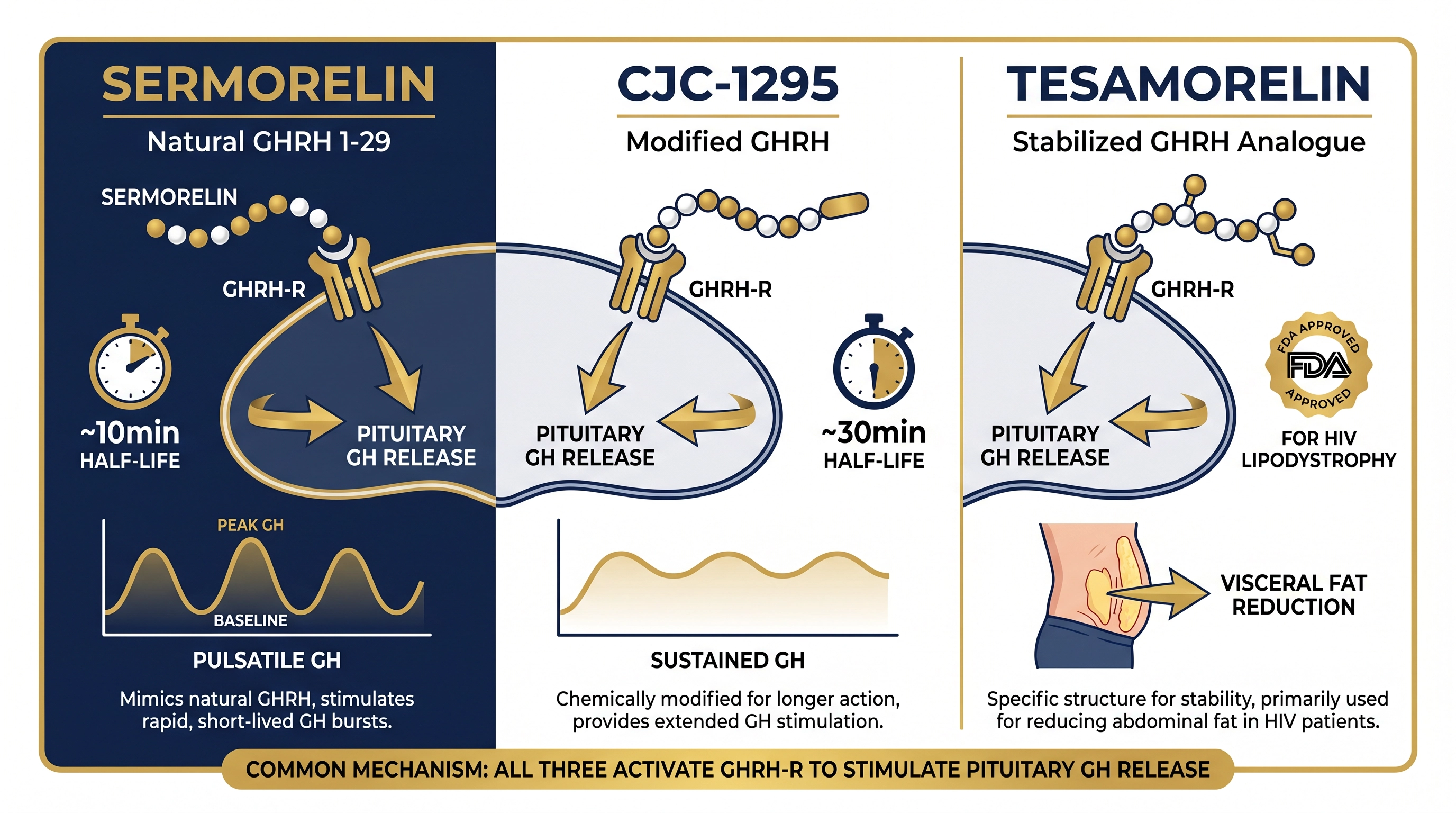
How Each Compound Extends GHRH Activity
Uses only the first 29 amino acids of native GHRH (residues 1–29). This fragment retains full receptor binding activity. No structural modification for DPP-IV resistance — relies on rapid clearance to mimic physiological pulsatility.
A 29-amino-acid GHRH analogue with four amino acid substitutions for DPP-IV resistance, plus a maleimidopropionic acid (MPA) linker that covalently binds to serum albumin after injection. Albumin binding extends the half-life from minutes to 6–8 days.
Carries the complete 44-amino-acid GHRH sequence with a trans-3-hexenoic acid group attached to the N-terminal tyrosine. This modification blocks DPP-IV cleavage at the N-terminus, extending the half-life to ~26–38 minutes while preserving full-length receptor engagement.
Half-Life and GH Pulse Pattern
The most clinically significant difference between these three compounds is how their half-lives determine the pattern of GH release. This matters because physiological GH secretion is pulsatile — occurring in 6–12 discrete pulses per day — and this pulsatility is important for maintaining receptor sensitivity and avoiding tachyphylaxis.
Injected at bedtime, sermorelin produces a single GH pulse that coincides with the natural nocturnal GH surge. The short half-life means GH returns to baseline within 1–2 hours, preserving receptor sensitivity for subsequent pulses.
The albumin-bound DAC modification maintains continuous GHRH receptor stimulation for days after a single injection. This produces sustained IGF-1 elevation but blunts the natural pulsatile GH pattern. The 'GH bleed' effect is a defining characteristic of CJC-1295 with DAC.
The 26–38 minute half-life allows tesamorelin to produce a larger and more sustained GH pulse than sermorelin while still clearing before the next dose. Once-daily dosing maintains pulsatility. The full 44-aa sequence engages the receptor more completely than sermorelin's 29-aa fragment.
What the Research Shows
- FDA-approved 1997–2008 for pediatric GH deficiency (Geref); commercially withdrawn, not due to safety concerns
- Increases GH and IGF-1 in GH-deficient adults in multiple clinical studies
- Improves sleep quality (SWS) in older adults — Walker et al. (1996)
- Limited Phase III data for fat loss or muscle anabolism in healthy adults
- Well-established safety profile from pediatric use era
- Teichman et al. (2006): single dose increases mean GH 2–10× and sustains elevation for 6 days in healthy adults
- Dose-dependent IGF-1 increases of 1.5–3× baseline maintained for 9–11 days post-injection
- Body fat reduction and lean mass increases observed in 12-week studies
- Most extensively studied GHRH analogue in combination protocols (CJC-1295 + ipamorelin)
- No serious adverse events in published human trials; glucose monitoring recommended
- Falutz et al. (2010, NEJM): 26-week RCT — 15.2% reduction in visceral adipose tissue (VAT) vs. placebo in HIV+ patients
- Sustained VAT reduction maintained at 52 weeks with continued treatment
- Significant IGF-1 elevation (mean +181 ng/mL) confirmed in Phase III trials
- FDA-approved 2010 as Egrifta (tesamorelin for injection) for HIV-associated lipodystrophy
- Glucose dysregulation (HbA1c elevation) observed in ~4% of subjects in Phase III trials
- Improved triglyceride levels and lipid profiles in multiple studies
Full Comparison Table
| Parameter | Sermorelin | CJC-1295 | Tesamorelin |
|---|---|---|---|
| Compound Class | GHRH analogue (truncated) | GHRH analogue (DAC-modified) | GHRH analogue (full-length, modified) |
| Amino Acid Length | 29 aa (GHRH 1–29) | 29 aa + DAC modification | 44 aa (GHRH 1–44) + trans-3-hexenoic acid |
| Plasma Half-Life | ~10–12 minutes | ~6–8 days (with DAC) | ~26–38 minutes |
| GH Release Pattern | Pulsatile (physiological) | Sustained (non-pulsatile) | Pulsatile (larger amplitude) |
| Dosing Frequency | Daily (bedtime preferred) | 1–2× per week | Once daily |
| FDA Approval | None (research compound) | None (research compound) | Yes — HIV lipodystrophy (Egrifta) |
| Visceral Fat Evidence | Limited human data | Moderate (clinical studies) | Phase III RCT: −15–18% VAT |
| IGF-1 Elevation | Mild to moderate | Sustained elevation (days) | Moderate to significant |
| Muscle Anabolism Evidence | Limited | Moderate (+ ipamorelin stack) | Limited (not primary use) |
| Glucose Dysregulation Risk | Low | Moderate (sustained GH) | Moderate (monitor HbA1c) |
| Preserves GH Pulsatility | Yes | No (continuous stimulation) | Yes |
| Synergy with Ipamorelin | Good | Excellent (most studied) | Good (less studied) |
| Research Cost | Lowest | Moderate | Highest |
Side Effects and Safety Considerations
Class-effect advantage: All three GHRH analogues preserve the hypothalamic-pituitary-somatotroph feedback axis. Unlike exogenous recombinant HGH (rhGH), they do not suppress endogenous GH production. GH secretion remains responsive to physiological signals (sleep, exercise, fasting) even during use.
- Injection site reactionscommon
- Headachecommon
- Flushing
- Fluid retention (mild)
- Glucose dysregulation
Mildest overall profile due to short half-life and moderate GH pulse amplitude.
- Injection site reactionscommon
- Water retention / edemacommon
- Arthralgia / joint paincommon
- Carpal tunnel syndrome
- Glucose dysregulation
- Headachecommon
Sustained GH elevation increases risk of fluid retention and glucose effects vs. pulsatile compounds.
- Injection site reactionscommon
- Arthralgia / joint paincommon
- Peripheral edemacommon
- HbA1c elevation
- Nausea
- Headachecommon
Glucose monitoring (HbA1c) is recommended. FDA label includes warnings for pre-diabetic subjects.
Which GHRH Analogue to Choose
The only GHRH analogue with Phase III RCT data and FDA approval for visceral adiposity. A 15–18% VAT reduction over 26 weeks is the strongest evidence-based outcome in this class.
Sustained IGF-1 elevation from CJC-1295 with DAC, combined with the GH pulse amplification from ipamorelin, is the most studied protocol for lean mass research. Weekly dosing convenience is an additional factor.
The most physiologically faithful GH pulse pattern, lowest side effect burden, and established safety profile from its FDA approval era make sermorelin the preferred starting compound for GH optimization research.
Bedtime injection produces a GH pulse that coincides with slow-wave sleep (SWS), where endogenous GH secretion is highest. Published data (Walker et al.) specifically demonstrates SWS improvement with sermorelin.
The 6–8 day half-life allows 1–2 injections per week, making CJC-1295 the most convenient GHRH analogue for research protocols requiring infrequent dosing.
As the only FDA-approved compound in this class, tesamorelin has the most rigorous clinical evidence base, including multiple Phase III RCTs and a full FDA label with documented safety and efficacy data.
Stacking GHRH Analogues with GHSR Agonists
Do not stack two GHRH analogues. Sermorelin, CJC-1295, and tesamorelin all act on the same GHRH receptor. Combining them produces receptor competition, not synergy. The evidence-supported approach is to combine one GHRH analogue with a GHSR agonist (ghrelin mimetic) such as ipamorelin, which acts on a completely different receptor (GHS-R1a).
Synergistic GH pulse; physiological pulsatility preserved; good for anti-aging and sleep protocols
Most studied stack; sustained IGF-1 elevation; preferred for body recomposition research
Larger GH pulse amplitude; preserves pulsatility; less studied than CJC-1295 combination
Frequently Asked Questions
What is the difference between sermorelin, CJC-1295, and tesamorelin?
All three are GHRH analogues that stimulate pituitary GH secretion, but they differ in structure, half-life, and clinical application. Sermorelin is a 29-amino-acid truncated GHRH fragment with a ~10–12 minute half-life, typically dosed at bedtime. CJC-1295 is a 29-amino-acid GHRH analogue with a Drug Affinity Complex (DAC) modification that extends its half-life to 6–8 days, allowing weekly dosing and producing sustained GH elevation. Tesamorelin is a full-length 44-amino-acid GHRH analogue with an N-terminal trans-3-hexenoic acid modification extending its half-life to ~26–38 minutes; it is the only FDA-approved GHRH analogue (for HIV-associated lipodystrophy).
Which GHRH analogue produces the most GH?
CJC-1295 with DAC produces the most sustained and elevated GH levels due to its 6–8 day half-life, which maintains continuous GHRH receptor stimulation. However, this comes at the cost of physiological pulsatility — CJC-1295 blunts the natural GH pulse pattern. Tesamorelin produces the largest single-dose GH pulse amplitude among the three. Sermorelin produces the most physiologically faithful pulsatile GH release, closely mimicking endogenous GHRH patterns.
Can sermorelin, CJC-1295, and tesamorelin be stacked together?
Stacking two or more GHRH analogues is not recommended because they compete for the same GHRH receptor and offer no additive benefit. The evidence-supported approach is to combine one GHRH analogue with a GHSR agonist (ghrelin mimetic) such as ipamorelin. The most studied combination is CJC-1295 + ipamorelin, which provides synergistic GH stimulation through complementary receptor pathways.
Which GHRH analogue is best for fat loss?
Tesamorelin has the strongest evidence base for visceral fat reduction, with FDA approval specifically for HIV-associated lipodystrophy and Phase III RCTs demonstrating a 15–18% reduction in visceral adipose tissue (VAT) over 26 weeks. CJC-1295 has shown meaningful reductions in body fat in clinical studies, though not with the same regulatory-grade evidence. Sermorelin has limited human fat-loss data. For research focused on visceral adiposity, tesamorelin is the evidence-supported choice.
What is the difference between CJC-1295 with DAC and without DAC (Modified GRF 1-29)?
CJC-1295 without DAC (also called Modified GRF 1-29 or Mod GRF 1-29) is a 29-amino-acid GHRH analogue with a half-life of approximately 30 minutes — similar to tesamorelin. CJC-1295 with DAC includes a Drug Affinity Complex that binds to albumin in the bloodstream, extending the half-life to 6–8 days. The DAC version produces sustained GH elevation but loses pulsatility; the non-DAC version preserves pulsatile GH release. Most research references to 'CJC-1295' in the context of peptide stacking refer to the DAC version.
Which GHRH analogue is safest?
All three share a class-effect safety profile: injection site reactions, fluid retention, arthralgia, and headache. Sermorelin is generally considered to have the mildest side effect burden due to its short half-life and physiological GH pulse amplitude. CJC-1295 with DAC carries the highest risk of sustained GH elevation side effects (carpal tunnel, glucose dysregulation) due to its continuous receptor stimulation. Tesamorelin carries a moderate glucose dysregulation risk. All three preserve the hypothalamic-pituitary feedback axis, which is a key safety advantage over exogenous HGH.
Is tesamorelin better than CJC-1295 for muscle growth?
CJC-1295 has more research supporting muscle anabolism due to its sustained IGF-1 elevation over days rather than hours. Tesamorelin produces a strong but shorter-duration GH/IGF-1 pulse. For muscle growth research, CJC-1295 (especially when combined with ipamorelin) is the more commonly studied protocol. Tesamorelin's primary clinical application is visceral fat reduction rather than muscle anabolism.
Source GHRH Analogues from Purgo Labs
Sermorelin, CJC-1295/Ipamorelin blend, and other GHRH analogues available with third-party COA verification and ≥99% purity standards.
Use code HEALTH for 20% off your order
Related Guides
Research Use Only: Sermorelin, CJC-1295, and tesamorelin are research compounds supplied by Purgo Labs strictly for qualified laboratory research purposes. None are approved by the FDA for general human use outside of tesamorelin's specific indication for HIV-associated lipodystrophy. This content is for educational and scientific reference only and does not constitute medical advice.