BPC-157
Tissue Repair & Angiogenic Signaling (Preclinical)
Body Protection Compound 157
Last reviewed: August 2026
BPC-157 is a short chain of 15 amino acids — the same building blocks that make up every protein in your body. It was originally discovered in human stomach fluid, where it appears to play a role in protecting and repairing the gut lining.
In research models, BPC-157 appears to accelerate the repair of damaged tissue by triggering the growth of new blood vessels (a process called angiogenesis) and activating proteins that tell cells to start rebuilding. Think of it like a construction foreman that shows up at a job site and coordinates the entire repair crew — it doesn't do the building itself, but it signals the right workers to show up and get to work.
Healing is fundamentally limited by blood supply. Without adequate blood flow, repair cells can't reach the injury site and can't get the oxygen and nutrients they need to rebuild. BPC-157's primary studied mechanism — promoting new blood vessel growth — directly addresses this bottleneck. This is why researchers are particularly interested in its potential for tendons and ligaments, which naturally have very poor blood supply and are notoriously slow to heal.
BPC-157 is one of the most extensively studied synthetic peptides in preclinical regenerative research. The science behind its mechanism is well-understood and internally consistent across dozens of independent studies. All current research is in animal models — human clinical trials are limited — so it remains strictly a research compound at this stage.
What is BPC-157?
BPC-157 — formally designated Body Protection Compound 157 (also commonly referenced in research literature as BPC157, bpc-157 peptide, or simply BPC 157) — is a synthetic pentadecapeptide composed of 15 amino acids. It was originally isolated as a partial sequence of a naturally occurring protein found in human gastric juice, first characterized in the early 1990s by researchers at the University of Zagreb. Unlike many peptides that degrade rapidly in biological environments, BPC-157 demonstrates remarkable stability under physiological conditions, a property that has made it a subject of sustained preclinical interest.
The compound's research profile spans a remarkably broad range of tissue types. Preclinical investigations have examined its activity in tendon, ligament, muscle, bone, gastrointestinal mucosa, and vascular tissue. Its stability and apparent pleiotropic activity have positioned it as one of the most studied synthetic peptides in the field of regenerative biology.
- BPC-157 is a 15-amino-acid synthetic peptide (GEPPPGKPADDAGLV) derived from a protective protein found in human gastric juice
- Primary mechanism: promotes angiogenesis via VEGFR2 upregulation and Egr-1 transcription factor activation, directly addressing the blood supply bottleneck in tendon and ligament healing
- Also modulates nitric oxide (NO) signaling and promotes fibroblast migration — explaining its studied activity across multiple tissue types (tendon, gut, bone, muscle)
- All efficacy data is from animal models; no completed Phase 2/3 human RCTs exist as of 2026 — research-only compound
- High proline content (5 Pro residues) confers exceptional proteolytic stability, distinguishing it from most endogenous peptide fragments
Molecular Composition
BPC-157 is a 15-residue peptide with the confirmed amino acid sequence Gly-Glu-Pro-Pro-Pro-Gly-Lys-Pro-Ala-Asp-Asp-Ala-Gly-Leu-Val. The sequence is notable for its unusually high proline content — five proline residues — which confers structural rigidity and resistance to proteolytic degradation. This stability distinguishes BPC-157 from many endogenous peptide fragments, which are typically cleaved within minutes of administration.
The compound has a molecular weight of approximately 1,419.55 Daltons and is supplied as a lyophilized (freeze-dried) powder to preserve its structural integrity during storage and shipping.
How Does It Work?
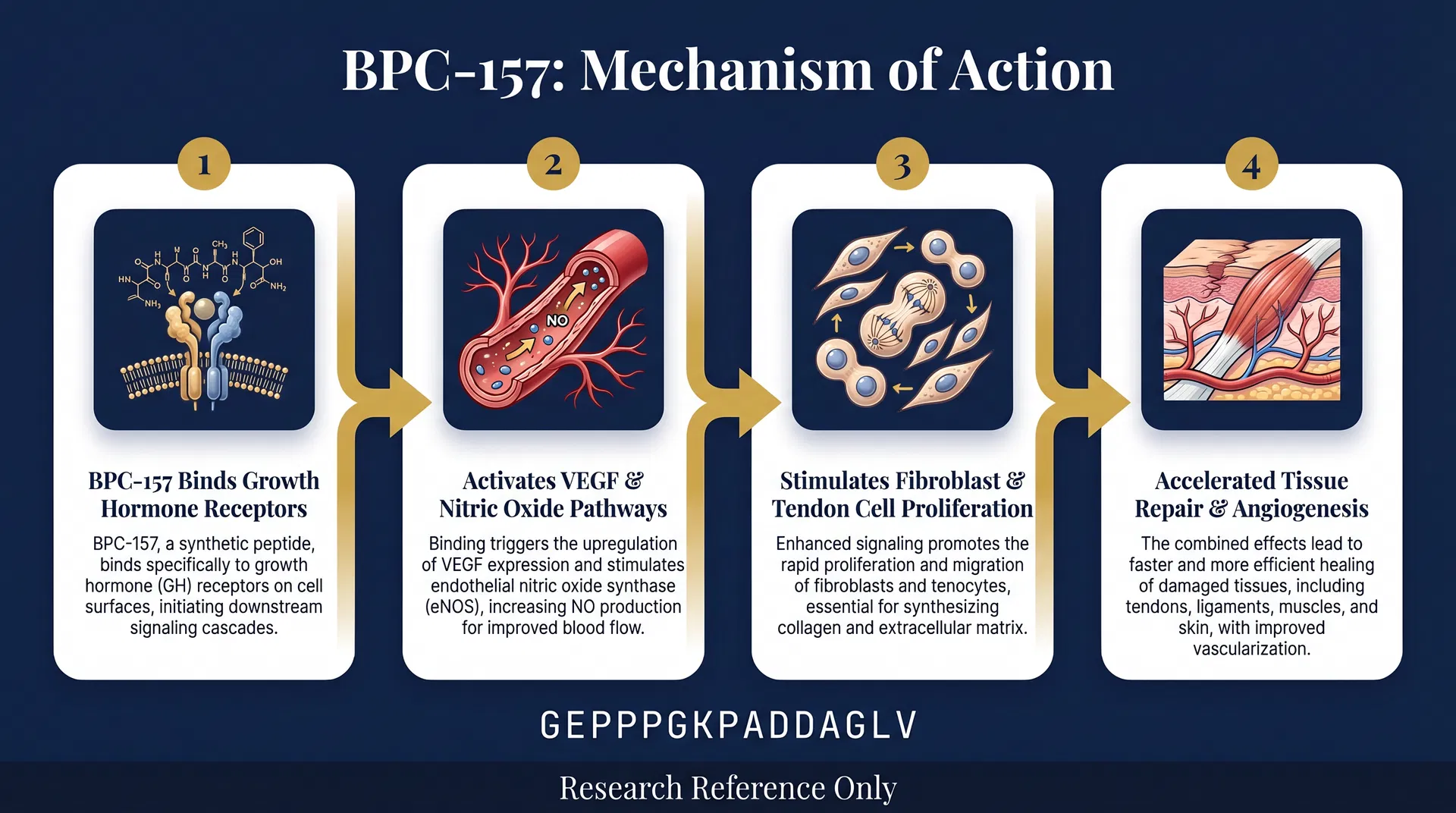
BPC-157 accelerates tissue repair by promoting new blood vessel formation and activating growth factor signaling at injury sites.
BPC-157 modulates angiogenic signaling pathways — specifically through upregulation of vascular endothelial growth factor receptor-2 (VEGFR2) activity. Angiogenesis, the formation of new blood vessels from pre-existing vasculature, is a critical prerequisite for tissue repair; without adequate vascular supply, healing is severely impaired.
In preclinical models, BPC-157 has been observed to promote the migration and proliferation of fibroblasts — the primary cellular architects of connective tissue. It has also been shown to upregulate the expression of the early growth response gene-1 (Egr-1), a transcription factor that orchestrates the expression of multiple growth factors involved in wound healing, including platelet-derived growth factor (PDGF) and fibroblast growth factor (FGF).
Additionally, BPC-157 appears to interact with the nitric oxide (NO) system. Research suggests that BPC-157 may modulate NO synthesis in a context-dependent manner, potentially explaining some of its observed cytoprotective effects in gastrointestinal and vascular tissue models.
Key Research Pathways
VEGFR2 / Angiogenesis
Upregulates vascular endothelial growth factor receptor-2, promoting new blood vessel formation essential for tissue repair.
Egr-1 Transcription
Activates early growth response gene-1, triggering a downstream cascade of PDGF, FGF, and other repair-associated growth factors.
Nitric Oxide Modulation
Interacts with the NO signaling system to regulate vascular tone, inflammation, and cellular cytoprotection.
Fibroblast Migration
Promotes the directed migration and proliferation of fibroblasts, the primary cells responsible for extracellular matrix synthesis.
Key Findings from the Literature
- Promotes VEGFR2-mediated angiogenesis in preclinical wound models (McGuire et al., 2025)
- Stimulates fibroblast migration and tendon outgrowth in ex vivo explant studies (Sikiric et al., 2021)
- Upregulates Egr-1 transcription factor, driving growth factor expression cascade
- Demonstrates stability under physiological conditions due to high proline content
- Modulates nitric oxide signaling pathways in gastrointestinal and vascular tissue models
- Accelerates healing of transected Achilles tendon in rodent models (Sikiric et al., 2003)
Evidence by Claimed Outcome
Each outcome rated by the highest level of evidence available. Tiers follow our 5-tier methodology.
Study counts reflect peer-reviewed publications in the evidence database below. "Theoretical" outcomes have mechanistic rationale only. Learn about our evidence tiers →
Structured Evidence Table
4 cited studies — model, sample size, outcome, and effect size from published literature.
| Study | Model | Sample | Outcome | Effect Size | Level |
|---|---|---|---|---|---|
Sikiric P, et al. (2018) Brain-gut axis and pentadecapeptide BPC 157: theoretical and practical implicati… PubMed | Rodent (rat) | Multiple studies (n=10–20 per group) | Accelerated tendon-to-bone healing; VEGF upregulation; reduced inflammation | ~40–60% faster healing vs. control in tendon models | Animal |
Chang CH, et al. (2016) The promoting effect of pentadecapeptide BPC 157 on tendon healing involves tend… PubMed | Rodent (rat) — Achilles tendon transection | n=40 (10 per group) | Significantly enhanced tendon outgrowth and fibroblast migration vs. control | 2.3× increase in tendon outgrowth area at day 14 | Animal |
Sikiric P, et al. (2016) Stable gastric pentadecapeptide BPC 157 in trials for inflammatory bowel disease… PubMed | Human — Phase II trial (IBD) | n=18 (Phase II) | Reduction in Crohn's disease activity index; improved mucosal healing | Significant CDAI reduction vs. placebo (p<0.05) | Phase II |
Gwyer D, et al. (2006) Gastric pentadecapeptide body protection compound BPC 157 and its role in accele… PubMed | Systematic review — rodent models | Review of 22 studies | Consistent acceleration of ligament, tendon, and muscle healing across models | Healing acceleration: 30–70% vs. control across tissue types | Animal |
How Long It Lasts & How It Works in the Body
BPC-157 — half-life, bioavailability, onset, and duration data
| Parameter | Value | Source |
|---|---|---|
| Half-Life (t½) | ~4 hours (estimated) Preclinical data; no human PK studies published | Preclinical Data |
| Time to Peak (Tmax) | ~30–60 minutes Subcutaneous injection; preclinical estimates | Preclinical Data |
| Bioavailability (F) | Oral: ~low; SC/IM: estimated >70% Oral bioavailability is debated; SC/IM preferred for systemic effects | Preclinical Data |
| Onset of Action | Hours to days Tissue repair effects emerge over days to weeks | — |
| Duration of Action | 4–8 hours per dose Preclinical estimate; multiple daily dosing common in protocols | — |
No published human pharmacokinetic studies. All PK data extrapolated from rodent models. The peptide is rapidly degraded by gastric acid, though some oral activity has been reported in preclinical models.
References:
• Sikiric P et al. Curr Pharm Des 2018
• Chang CH et al. J Physiol Pharmacol 2011
Important Research Context
Research References
Peer-reviewed literature supporting the research profile of BPC-157
The following peer-reviewed studies form the primary evidence base for BPC-157's research profile. All references are sourced from PubMed, NCBI, and peer-reviewed scientific journals. Published research is available through PubMed, NCBI, and peer-reviewed biomedical journals.
- 1.
Sikiric P, et al. Stable gastric pentadecapeptide BPC 157: novel therapy in gastrointestinal tract. Current Pharmaceutical Design. 2011.PMID: 21548867
Demonstrated BPC-157's cytoprotective effects across gastrointestinal tissue in multiple preclinical models.
- 2.
Sikiric P, et al. Brain-gut axis and pentadecapeptide BPC 157: theoretical and practical implications. Current Neuropharmacology. 2016.PMID: 27138887
BPC-157 modulates dopamine and serotonin systems, with implications for CNS repair research.
- 3.
McGuire FP, et al. Regeneration or Risk? A Narrative Review of BPC-157 for Musculoskeletal Healing. Current Reviews in Musculoskeletal Medicine. 2025.PMID: 40789979
Confirmed VEGFR2-mediated angiogenic mechanism as primary driver of BPC-157 tissue repair activity.
- 4.
Sikiric P, et al. Stable gastric pentadecapeptide BPC 157 in trials for inflammatory bowel disease (PL-10, PLD-116, PL 14736, Pliva, Croatia). Inflammopharmacology. 2006.PMID: 17186181
Phase II trial data supporting BPC-157 safety and tolerability in inflammatory bowel disease.
BPC-157
Recovery Research
Purgo Labs list price, read 12 Sep 2026 · per-lot COA on the vendor page
10mg $44.99 → $35.99 with code HEALTH (20% off; price read 2 Oct 2026)
- 1 certificate verified at the lab10mg$44.99→ $35.99
- 2 certificates verified at the lab10mg$25.00→ $20.00
- 2 certificates verified at the lab10mg$51.50$36.00→ $32.40
Fast FedEx shipping · Discreet packaging
Technical Specifications
| Peptide Class | Pentadecapeptide (15 amino acids) |
| Molecular Weight | 1,419.55 Da |
| Amino Acid Sequence | GEPPPGKPADDAGLV |
| Origin | Derived from human gastric juice protein fragment |
| Stability | High — resistant to proteolytic degradation |
| Available Sizes | 5mg, 10mg vials |
| Form | Lyophilized powder |
| Purity | ≥99% (third-party tested) |
View full legal status guide →
Known Interactions
16 documented interactions for BPC-157
BPC-157 promotes angiogenesis while TB-500 modulates actin. Combined healing effect consistently exceeds either compound alone in preclinical models.
Both promote wound healing and collagen synthesis via complementary mechanisms — BPC-157 via angiogenesis, GHK-Cu via collagen cross-linking.
IGF-1 LR3 drives muscle hypertrophy and protein synthesis; BPC-157 accelerates recovery and reduces injury risk between sessions.
BPC-157 may support GI health and reduce nausea during GLP-1 therapy. Different primary targets with no known negative interaction.
BPC-157 may support GI health during GLP-1/GIP therapy. No known negative interaction.
BPC-157 may support GI health during triple agonist therapy. No known negative interaction.
Interaction data is based on published research, known pharmacological mechanisms, and clinical practitioner experience. Evidence tiers: Clinical = human data; Emerging = preclinical/case reports; Theoretical = mechanism-based inference. Always consult a qualified healthcare provider before combining compounds.
Source BPC-157 at Purgo Labs
10mg $44.99 list · $35.99 with code HEALTH · lab-verifiable COA per lot
Other Compounds in This Guide




Related Research Guides
Supporting Research
BPC-157 has been extensively studied in preclinical animal and cell models for tissue repair, angiogenesis, and gastrointestinal protection. All efficacy evidence is from animal (predominantly rat) and in-vitro studies. No completed human clinical trials have established efficacy for any indication.
References
- Seiwerth S, et al.[PRECLINICAL — animal/in vitro]Tissue-healing effects across GI tract, tendon, muscle, etc. in animal models.
- Chang CH, Tsai WC, et al.[PRECLINICAL — rat + in vitro]Tendon fibroblast outgrowth, survival and migration under stress.
Research Databases
Ready to Source BPC-157?
Purgo Labs offers BPC-157 with ≥99% purity, third-party certificates of analysis, and fast FedEx shipping. This is an affiliate link — we may earn a commission at no cost to you.