LL-37
Innate Immune Defense & Immunomodulatory Signaling
LL-37 — Human Cathelicidin Antimicrobial Peptide
Last reviewed: August 2026
LL-37 is a human host defense peptide — part of your innate immune system's first line of defense against infection. It's the only cathelicidin peptide produced by humans, and it's found in neutrophils (white blood cells), epithelial cells lining your airways and gut, and skin cells. When you get an infection or injury, LL-37 is one of the first molecules your body deploys.
LL-37 works through multiple mechanisms simultaneously. It directly kills bacteria by disrupting their cell membranes (it's effective against both gram-positive and gram-negative bacteria, including antibiotic-resistant strains). It also has antiviral and antifungal activity. Beyond direct antimicrobial action, it modulates the immune response — it can both amplify inflammation when needed (to fight infection) and resolve it when the threat has passed. It also promotes wound healing by stimulating angiogenesis and cell migration.
Antibiotic resistance is one of the most serious threats in modern medicine. LL-37 kills bacteria through a physical membrane disruption mechanism that bacteria cannot easily develop resistance to, unlike conventional antibiotics that target specific metabolic pathways. This makes it a compelling research subject for next-generation antimicrobial strategies. Its dual role as both antimicrobial and immune modulator also makes it interesting for inflammatory disease research.
LL-37 is your body's own natural antibiotic — a peptide that's been refined by millions of years of evolution to fight infection. Its broad-spectrum antimicrobial activity, resistance to bacterial resistance mechanisms, and immune-modulating properties make it one of the most scientifically interesting compounds in the immune research space. Research-only compound.
What is LL-37?
LL-37 is the only member of the cathelicidin family of antimicrobial peptides expressed in humans, derived from the C-terminal 37 amino acids of the hCAP18 precursor protein. It is produced by neutrophils, macrophages, epithelial cells, and NK cells as a critical component of the innate immune response, providing first-line defense against a broad spectrum of bacterial, viral, and fungal pathogens.
Beyond its direct antimicrobial activity, LL-37 is a potent immunomodulatory molecule that bridges innate and adaptive immunity. It modulates toll-like receptor (TLR) signaling, promotes dendritic cell maturation, regulates neutrophil function, and stimulates angiogenesis and wound healing — making it one of the most multifunctional peptides in the human immune system.
- Dihexa (N-hexanoic-Tyr-Ile-(6) aminohexanoic amide) is a small peptide derived from angiotensin IV, developed by Joseph Harding's lab at Washington State University as a potent cognitive enhancer.
- Mechanism: binds hepatocyte growth factor (HGF) and potentiates its interaction with the MET receptor tyrosine kinase, driving synaptogenesis (new synapse formation) in hippocampal neurons.
- Harding et al. (2013, Journal of Pharmacology and Experimental Therapeutics) showed Dihexa was approximately 10 million times more potent than BDNF at inducing synaptogenesis in hippocampal cultures.
- Unlike most nootropic peptides that modulate existing signaling, Dihexa promotes structural synaptic changes — new synapse formation rather than just enhanced neurotransmitter signaling.
- Research applications include studying HGF/MET signaling in neuroplasticity, synaptogenesis mechanisms in memory formation, and potential neuroprotective strategies in neurodegenerative disease models.
Molecular Composition
LL-37 is a 37-amino-acid cationic amphipathic peptide with a net positive charge of +6 at physiological pH. The "LL" designation refers to the two leucine residues at the N-terminus. The peptide adopts an alpha-helical conformation in hydrophobic environments (such as bacterial membranes), which is essential for its membrane-disrupting antimicrobial activity.
The molecular weight is 4,493.3 Daltons. The amphipathic helix structure — with hydrophobic residues on one face and cationic residues on the other — is the structural basis for LL-37's ability to selectively disrupt negatively charged bacterial membranes while sparing the zwitterionic membranes of mammalian cells.
How Does It Work?
LL-37 kills bacteria and modulates immune responses by disrupting bacterial cell membranes and activating pattern-recognition receptors on immune cells.
LL-37 exerts antimicrobial activity through membrane disruption: the cationic peptide is electrostatically attracted to the negatively charged lipopolysaccharide (LPS) of Gram-negative bacteria and the teichoic acids of Gram-positive bacteria. Upon membrane contact, LL-37 inserts its hydrophobic face into the lipid bilayer, forming pores or disrupting membrane integrity through a carpet or toroidal pore mechanism, leading to bacterial lysis.
In its immunomodulatory role, LL-37 acts as a ligand for multiple receptors: it activates formyl peptide receptor-like 1 (FPRL1/FPR2) on neutrophils and monocytes, modulates TLR2, TLR4, and TLR9 signaling (both activating and inhibiting depending on context), and promotes dendritic cell maturation and Th1 polarization. LL-37 also binds to and neutralizes LPS, preventing TLR4-mediated septic shock.
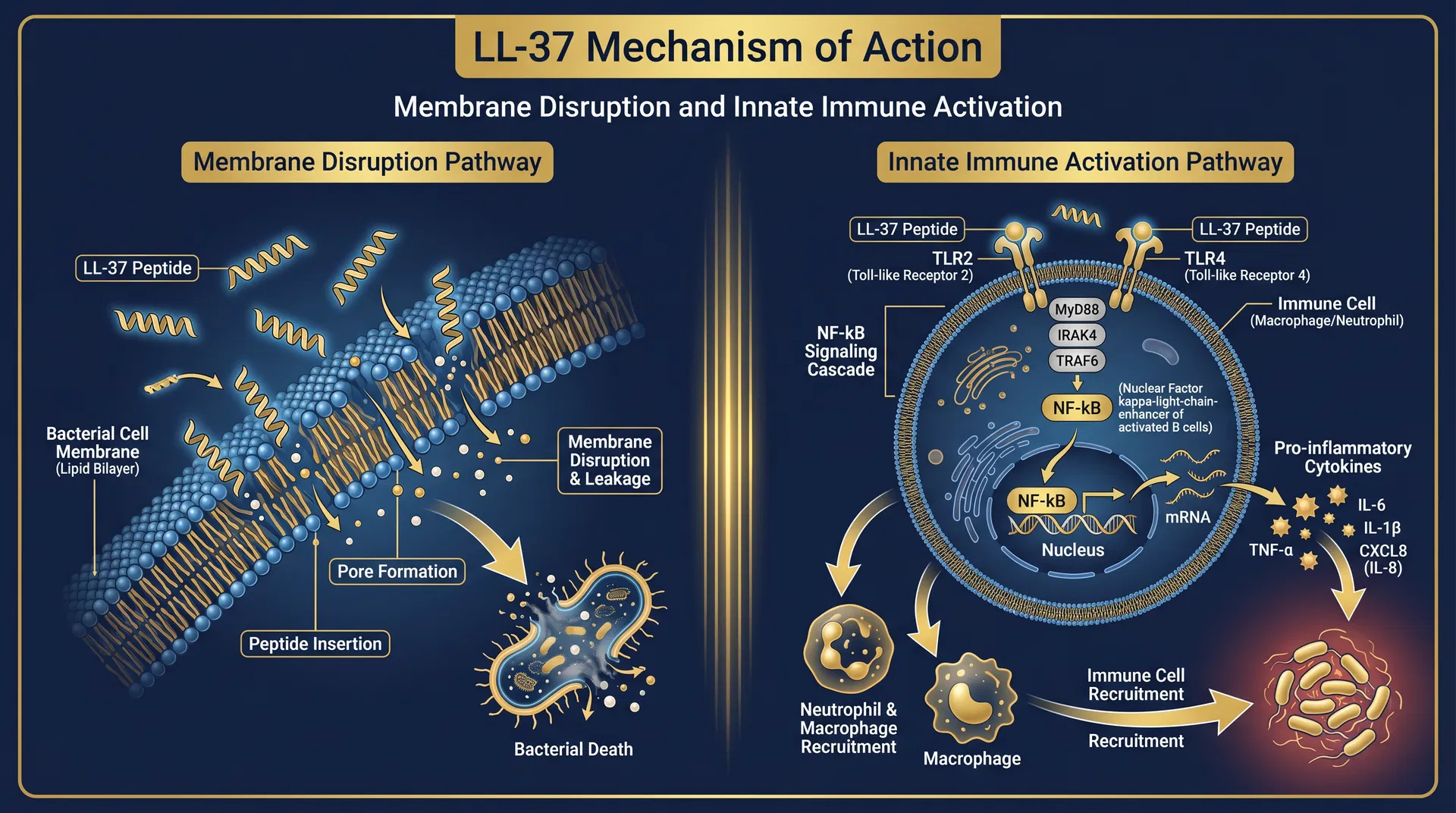
Key Research Pathways
Membrane Disruption (Antimicrobial)
Cationic amphipathic helix inserts into bacterial membranes, forming pores or disrupting bilayer integrity through carpet/toroidal pore mechanisms.
TLR Modulation (Innate Immunity)
Modulates TLR2, TLR4, and TLR9 signaling, with context-dependent activating and inhibitory effects on innate immune responses.
FPR2 / Immunomodulation
Activates formyl peptide receptor-like 1 (FPR2/FPRL1) on neutrophils and monocytes, modulating chemotaxis and inflammatory resolution.
VEGF-A / Angiogenesis
Upregulates VEGF-A expression and promotes angiogenesis, contributing to wound healing and tissue repair beyond antimicrobial defense.
Key Findings from the Literature
- Only human cathelicidin — broad-spectrum antimicrobial activity against bacteria, viruses, and fungi
- Membrane disruption mechanism: cationic amphipathic helix disrupts bacterial lipid bilayers
- Modulates TLR2, TLR4, TLR9 signaling — bridges innate and adaptive immunity
- LPS neutralization prevents TLR4-mediated endotoxin shock in preclinical models
- Promotes angiogenesis via VEGF-A upregulation and FPR2-mediated signaling
- Anti-biofilm activity against drug-resistant pathogens including MRSA and P. aeruginosa
Important Research Context
Research References
Peer-reviewed literature supporting the research profile of LL-37
The following peer-reviewed studies form the primary evidence base for LL-37's research profile. All references are sourced from PubMed, NCBI, and peer-reviewed scientific journals. Published research is available through PubMed, NCBI, and peer-reviewed biomedical journals.
- 1.
Zanetti M. Cathelicidins, multifunctional peptides of the innate immunity. Journal of Leukocyte Biology. 2004.PMID: 12960280
Comprehensive review of cathelicidin LL-37 as a multifunctional innate immune peptide.
- 2.
Mookherjee N, Hancock RE. Cationic host defence (antimicrobial) peptides: innate immune regulatory peptides as a novel approach for treating infections. Cellular and Molecular Life Sciences. 2007.PMID: 17310278
LL-37 modulates innate immune responses beyond direct antimicrobial activity.
- 3.
Heilborn JD, et al. The cathelicidin anti-microbial peptide LL-37 is involved in re-epithelialization of human skin wounds and is lacking in chronic ulcer epithelium. Journal of Investigative Dermatology. 2003.PMID: 12603850
LL-37 promotes wound re-epithelialization and is deficient in chronic non-healing wounds.
LL-37
Immune Research
Purgo Labs list price, read 12 Sep 2026 · per-lot COA on the vendor page
Use code HEALTH for 20% off
Fast FedEx shipping · Discreet packaging
Technical Specifications
| Peptide Class | Cathelicidin antimicrobial peptide (37 amino acids) |
| Molecular Weight | 4,493.3 Da |
| Structural Feature | Cationic amphipathic alpha-helix (net charge +6) |
| Antimicrobial Spectrum | Gram-positive, Gram-negative bacteria; viruses; fungi |
| Available Sizes | 5mg vials |
| Form | Lyophilized powder |
| Purity | ≥99% (third-party tested) |
View full legal status guide →
Source LL-37 at Purgo Labs
≥99% purity · Third-party COA · Use code HEALTH for 20% off
Other Compounds in This Guide




Related Research Guides
Supporting Research
LL-37 has preclinical evidence for antimicrobial and wound-healing activity. Limited human evidence exists for topical/local wound applications. No basis exists for systemic injectable immune-modulating claims in humans.
References
- Ramos R, et al.PRECLINICAL — in vitro/ex vivoPeptides. 2011. PubMedLL-37 promotes wound re-epithelialization and is deficient in chronic non-healing wounds; topical application rationale.
- Grönberg A, et al.HUMAN — topical, small studyLimited human evidence for topical LL-37 in wound healing; systemic injectable evidence does not exist.
Research Databases
Ready to Source LL-37?
Purgo Labs offers LL-37 with ≥99% purity, third-party certificates of analysis, and fast FedEx shipping. This is an affiliate link — we may earn a commission at no cost to you.