BPC-157 Research Overview
A comprehensive summary of the published BPC-157 research: mechanisms of action, key studies by application area, evidence quality ratings, and what the science actually supports.
Research Disclaimer: The majority of BPC-157 research has been conducted in animal models. Human clinical data is limited to a small number of trials, primarily for gastrointestinal conditions. This overview is for educational purposes only and does not constitute medical advice.
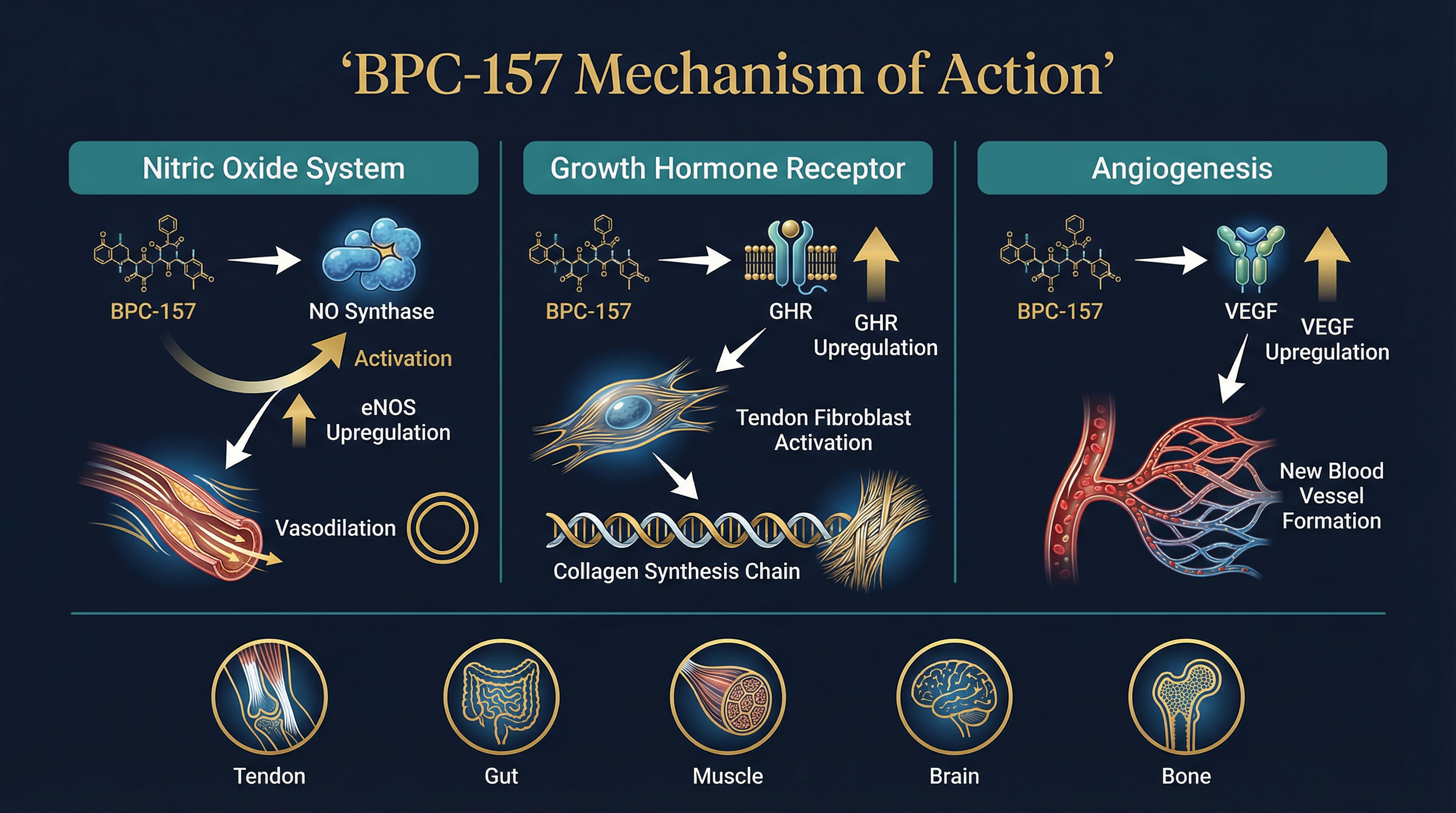
BPC-157 primary signaling pathways. For educational and research purposes only.
What Is BPC-157?
BPC-157 (Body Protection Compound-157) is a synthetic pentadecapeptide — a chain of 15 amino acids — derived from a protein found in human gastric juice. It was first isolated and characterized by Croatian researcher Predrag Sikirić and colleagues at the University of Zagreb in the 1990s, who have since published the majority of the primary research.
The compound's amino acid sequence is: Gly-Glu-Pro-Pro-Pro-Gly-Lys-Pro-Ala-Asp-Asp-Ala-Gly-Leu-Val. It is stable in human gastric juice — an unusual property for a peptide that has made it a subject of interest for both oral and injectable research applications.
BPC-157 is not FDA-approved for any indication. It is classified as a research chemical and is sold for research purposes only. The compound has been studied under the pharmaceutical designation PL-10 (oral formulation) for inflammatory bowel disease, which represents the most advanced clinical development to date.
Mechanisms of Action
Growth Hormone Receptor Upregulation
BPC-157 upregulates GH receptor expression in tendon fibroblasts, amplifying the tissue's response to endogenous growth hormone. This is the primary proposed mechanism for accelerated tendon and ligament healing.
VEGF-Mediated Angiogenesis
BPC-157 promotes new blood vessel formation through vascular endothelial growth factor (VEGF) upregulation. Improved blood supply to injured tissue accelerates delivery of nutrients and immune cells required for repair.
Nitric Oxide System Modulation
BPC-157 has a bidirectional relationship with the NO system — it upregulates eNOS (endothelial NOS) in ischemic tissue and downregulates iNOS (inducible NOS) in inflammatory states. This regulatory role explains its efficacy across diverse tissue types.
Dopaminergic & Serotonergic Modulation
BPC-157 interacts with dopamine D1/D2 receptors and modulates serotonin synthesis. This pathway underlies the observed antidepressant and anxiolytic effects in animal models.
Cytoprotection of Mucosal Tissue
In the gut, BPC-157 protects mucosal cells from damage by upregulating EGF receptor expression and reducing intestinal permeability. This is the original discovery context and most mechanistically understood application.
Anti-Inflammatory Cytokine Modulation
BPC-157 reduces expression of pro-inflammatory cytokines including TNF-α and IL-6 in injured tissue, reducing the inflammatory phase of healing and accelerating transition to the proliferative phase.
Key Studies by Application Area
BPC-157 significantly accelerated Achilles tendon healing in rats. Treated animals showed superior tendon strength, faster collagen organization, and earlier return to normal gait vs controls.
Upregulation of growth hormone receptor expression in tendon fibroblasts; enhanced VEGF-mediated angiogenesis
High — most replicated finding in BPC-157 research
BPC-157 accelerated recovery from gastrocnemius muscle crush injury. Treated animals showed faster regeneration of muscle fibers and reduced inflammatory infiltrate.
Satellite cell activation; reduced inflammatory cytokine expression (TNF-α, IL-6)
High — supports muscle recovery applications
BPC-157 healed acetic acid-induced gastric ulcers in rats significantly faster than controls. Dose-dependent effect observed from 10 ng/kg to 10 μg/kg.
Cytoprotection of gastric mucosa; upregulation of EGF receptor expression; NO system modulation
Very high — original discovery context; most mechanistically understood
Oral BPC-157 (PL-10 formulation) showed significant reduction in Crohn's Disease Activity Index scores vs placebo in a Phase 2 trial. Well-tolerated with no serious adverse events.
Mucosal healing; reduction of intestinal permeability; anti-inflammatory effects on intestinal epithelium
Very high — only significant human clinical data available
BPC-157 significantly accelerated bone healing in a rat segmental defect model. Radiographic and histological evidence of superior bone formation vs controls at 4 and 8 weeks.
Osteoblast activation; enhanced periosteal blood supply via angiogenesis
Moderate — fewer replications than tendon/muscle data
BPC-157 reduced neurological deficits and improved functional recovery in a rat TBI model. Both systemic and local administration showed benefit.
Neuroprotection via NO system; reduction of excitotoxicity; promotion of neurogenesis
Moderate — emerging area with promising but limited data
BPC-157 modulates dopamine release and receptor expression. Showed antidepressant-like effects in forced swim test and tail suspension test in rodents.
Interaction with dopamine D1/D2 receptors; modulation of dopamine synthesis enzymes
Moderate — supports anxiety/depression research applications
BPC-157 works through both NO-dependent and NO-independent pathways. It can rescue NO-deficient states and counteract NO overproduction, suggesting a regulatory rather than simply stimulatory role.
Bidirectional NO system modulation — upregulates eNOS in ischemic tissue, downregulates iNOS in inflammatory states
Very high — explains the breadth of BPC-157's effects across different tissue types
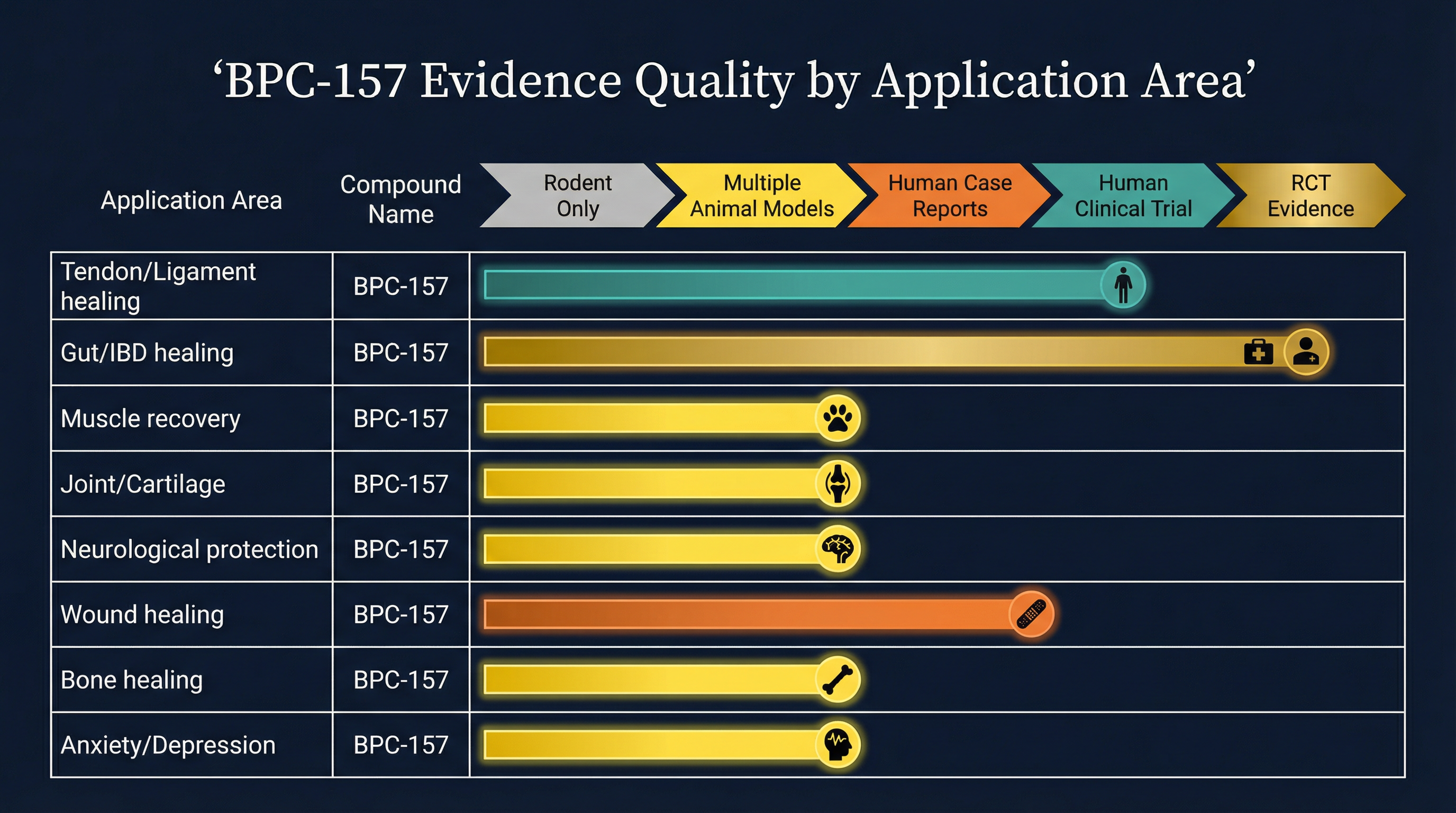
Evidence quality ratings by application area. Animal data unless otherwise noted. For educational purposes only.
Evidence Quality by Application
Summary of evidence strength across all studied applications as of 2026.
| Application | Animal Evidence | Human Data | Notes |
|---|---|---|---|
| Tendon & Ligament Repair | Strong (animal) | Limited | Most replicated finding; ACL, Achilles, rotator cuff models all show benefit |
| Muscle Recovery | Strong (animal) | None | Crush injury, laceration, and DOMS models all positive |
| Bone Healing | Moderate (animal) | None | Segmental defect and fracture models positive; fewer replications |
| Gut Health / IBD | Strong (animal + human Phase 2) | Phase 2 positive | Original discovery context; most mechanistically understood; human data exists |
| Gastric Ulcers | Very strong (animal) | Limited | Dose-dependent healing in multiple ulcer models |
| Traumatic Brain Injury | Moderate (animal) | None | Emerging area; neuroprotective effects in multiple TBI models |
| Anxiety / Depression | Moderate (animal) | None | Dopaminergic modulation; antidepressant-like effects in rodent behavioral tests |
| Corneal Healing | Moderate (animal) | None | Accelerated corneal epithelial healing; potential ophthalmic application |
Limitations of the Current Evidence Base
The majority of BPC-157 studies come from Predrag Sikirić's group at the University of Zagreb. Independent replication by other research groups is limited, which is a significant concern for evidence quality.
Most studies use rat models. Peptide pharmacokinetics, bioavailability, and tissue distribution can differ significantly between rodents and humans, making direct translation of dosing and efficacy data uncertain.
The most commercially relevant applications (tendon, ligament, muscle healing) have no human randomized controlled trial data. The only human data is from gastrointestinal studies.
BPC-157 appears to work through multiple simultaneous pathways, making it difficult to isolate which mechanisms are responsible for observed effects and whether those mechanisms are active in humans at the doses used in research.
Source BPC-157 for Research
Third-party tested, batch-verified BPC-157 for research purposes.
View BPC-157 at Purgo LabsUse code HEALTH for 20% off
Related BPC-157 Resources
How to Reconstitute & Inject BPC-157
BPC-157 reconstitutes in bacteriostatic water (BAC water). For a 5mg vial, add 2mL BAC water for a 2.5mg/mL solution. Stable for 4 weeks refrigerated. Administer subcutaneously near the area of interest, or intraperitoneally in research models. Use a 27–31G insulin syringe.
Frequently Asked Questions
What is BPC-157?
BPC-157 (Body Protection Compound-157) is a synthetic pentadecapeptide derived from a protein found in human gastric juice. It consists of 15 amino acids and has been studied extensively in animal models for its regenerative, anti-inflammatory, and cytoprotective properties. It is not FDA-approved for human use.
What does the research say about BPC-157 for healing?
Animal studies consistently show BPC-157 accelerates healing of tendons, ligaments, muscles, and bones. The proposed mechanism involves upregulation of growth hormone receptor expression, VEGF-mediated angiogenesis, and modulation of the nitric oxide system. Human clinical trials are limited.
Has BPC-157 been tested in human clinical trials?
BPC-157 has been studied in limited human trials, primarily for inflammatory bowel disease (as PL-10, an oral formulation). A Phase 2 trial for Crohn's disease showed promising results. No large-scale Phase 3 human trials have been completed for musculoskeletal applications.
What is the mechanism of action of BPC-157?
BPC-157 appears to work through multiple pathways: upregulation of growth hormone receptor expression in tendon fibroblasts, promotion of angiogenesis via VEGF, modulation of the nitric oxide system (both NO-dependent and NO-independent pathways), and interaction with the dopaminergic and serotonergic systems.
Is BPC-157 safe based on research?
Animal studies show a favorable safety profile with no observed toxicity at therapeutic doses. No lethal dose has been established in animal models. The primary safety concern is the absence of large-scale human safety data. GI studies in humans (for IBD) showed good tolerability.
What conditions has BPC-157 been studied for?
BPC-157 has been studied in animal models for: tendon and ligament healing, muscle repair, bone healing, inflammatory bowel disease, gastric ulcers, traumatic brain injury, spinal cord injury, corneal healing, and psychiatric conditions including depression and anxiety.
How does BPC-157 compare to TB-500?
BPC-157 and TB-500 (Thymosin Beta-4) work through different mechanisms. BPC-157 is primarily a local repair agent that works best near the injection site. TB-500 is a systemic agent that promotes cell migration and differentiation throughout the body. They are often stacked for synergistic effects on tissue repair.
What is the half-life of BPC-157?
BPC-157's half-life is relatively short — estimated at 4–6 hours for subcutaneous administration. This is why twice-daily dosing is commonly used in research protocols. The short half-life means the compound does not accumulate significantly with repeated dosing.